The press releases on this website are provided for historical reference purposes only.
Please note that certain information may have changed since the date of release.
January 25, 2024




Japan Aerospace Exploration Agency
TOMY Company, Ltd.
Sony Group Corporation
Doshisha University
The Transformable nano rover (Lunar Excursion Vehicle 2 (LEV-2), with the nickname "SORA-Q"), has succeeded in taking an image of the SLIM spacecraft*1 that landed on the lunar surface and was jointly developed by four parties, namely, JAXA, TOMY Company, Ltd., Sony Group Corporation and Doshisha University*2. LEV-2, together with the Lunar Excursion Vehicle (LEV-1)*3, are the first Japanese lunar surface exploration rovers*4, and LEV-2 is the world's first rover to conduct fully autonomous exploration of the lunar surface*4. LEV-2 and LEV-1 also performed synchronized and coordinated lunar surface exploration for the first time*4. LEV-2 is now the world's smallest and lightest lunar exploration rover.
LEV-2 and LEV-1 were mounted on the SLIM spacecraft and were deployed to the lunar surface from SLIM just prior to the landing of the main lander on January 20, 2024. Subsequently, LEV-2 took images including that of the SLIM spacecraft on the lunar surface. The image data was relayed to Erath through the LEV-1's communication system.
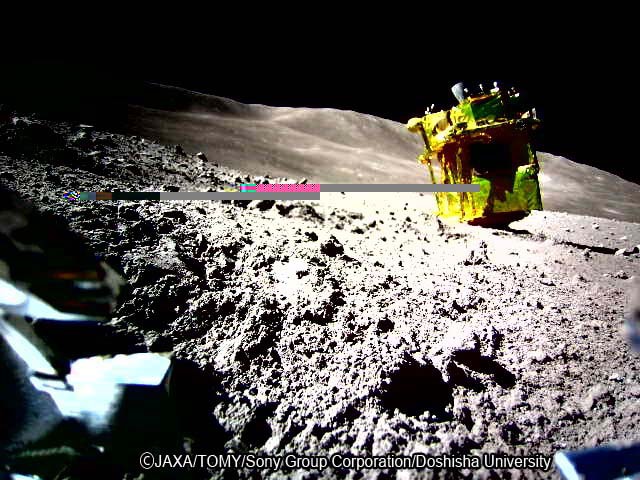
This image not only shows how SLIM landed on the lunar surface but also proves that the following actions have been performed correctly: transformation of LEV-2 from the folded spherical shape to the deployed wheeled configuration, movement of LEV-2 on the lunar surface, image acquisition by the onboard cameras, autonomous selection of transmitting images that effectively captured the SLIM spacecraft and its vicinity, and wireless data transmission between LEV-2 and LEV-1 on the lunar surface.
The other data, including travel logs, are still under analysis, and the results will be announced in the future.
[ Comments ]
We successfully captured an image of SLIM, and this was a major accomplishment. The LEV-2 "SORA-Q" has excellent autonomous operation and motion characteristics, which were developed based on toy technology, the latest sensor robotics technology, and JAXA's space technology. It has been announced as the world's smallest and Japan's first lunar robot.
We want to express our deep gratitude to all the companies and institutions as well as the people who supported us and who participated in our research and development.
This year marks the 10th year since the Space Exploration Innovation Hub Center began conducting research and development aimed at the moon, joining hands with companies from all over Japan. There will be a large number of Japanese technologies going to the moon in the coming years, and this is just the beginning of a new lunar exploration era with many more expectations for Japan's success following LEV-2.
I am very pleased that the LEV-2 "SORA-Q" made a great contribution to the mission of pinpoint landing the Small Lunar Demonstration Mission (SLIM). SORA-Q became the first Japanese robot to land on and capture images of the lunar surface.
I would like to express my sincere gratitude to all the people involved and to everyone who supported us in the pursuit of our dream.
We hope that the success of the SORA-Q project will trigger children around the world to develop an interest in natural science. At the same time, we hope that it will inspire them to believe in the importance of taking on difficult and new challenges, and in the power to create their own future by giving them dreams and hopes.
As we celebrate our 100th anniversary, we are proud to have played a part in this great accomplishment through the technology of the toys that made our livelihood, and we will continue to take on new challenges in the future.
We are honored to have participated in the joint development of a transformable lunar robot and to have fulfilled this exploration mission on the lunar surface.
In this joint research, we have been mainly engaged in the development of the robot's operation system and image processing technology by utilizing "Spresense™", an IoT board computer with a smart sensing processor which is developed and sold by Sony Semiconductor Solutions. It is a great achievement that we were able to show the possibility of deploying consumer devices in the harsh environment of space.
Sony Group will continue to pursue creating new technologies and exploring their applications to the space and other area, aiming to contribute to research and development that pushes our civilization forward and makes the earth more sustainable.
I am very happy and grateful to have participated in the SLIM project and to have achieved the acquisition of SLIM images on the Moon by SORA-Q, which is the product of joint research by four parties. I believe that this small particle will make a great contribution to space development in the future. Next year, The Doshisha will celebrate its 150th anniversary. We will continue to take on new challenges.
