The press releases on this website are provided for historical reference purposes only.
Please note that certain information may have changed since the date of release.
February 14, 2012
- Sony realize new concept by combining contactless IC card technology with its newly developed “RFID Over Power Line” technology -
Tokyo, Japan - February 14, 2012 - In recent years, the situation surrounding the supply of electricity and energy has changed significantly, and this has raised social concern over the impact of such supply on the global environment and our lives.
On the other hand, discussions on the implementation of HEMS (Home Energy Management System)/BEMS (Building and Energy Management System) in the majority of the currently proposed smart grid initiatives have been based on the perspective of electricity suppliers and operators. From the perspective of users, the core functions of these management systems include the ability to check electricity consumption and monitor the operating conditions of electrical devices. These functions have been developed with the intent to further direct users' attention to energy conservation.
Given these developments, Sony Corporation (hereafter, “Sony”) has developed an “Authentication Outlet” that enables users to actively manage and control their power consumption. This new technology focuses on “electrical outlets” as the infrastructure through which electricity is inevitably consumed. More specifically, two types of outlets have been developed: the “Authentication Outlet: FeliCa Type” which uses the contactless IC card technology “NFC/FeliCa” to authenticate electrical devices and the “Authentication Outlet: RFID Over Power Line type” that adopts Sony's new “RFID Over Power Line” technology to authenticate electrical devices via a power supply cable.
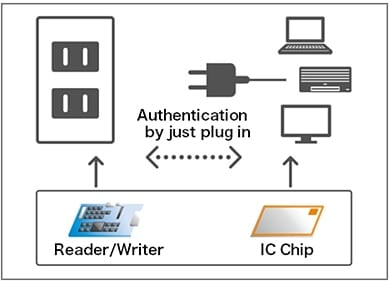
Based on this technological development, Sony is working to implement its technology in the necessary equipment and systems to provide users with the ability to consume electricity in a way that best suits their individual lifestyles.
Additionally, Sony plans to create new services that provide value beyond energy conservation by partnering with other manufacturers that share its vision to facilitate the trial and verification of its various services, and formulate technology and service specifications regarding these products and services.
Once these “Authentication Outlets” are widely implemented, users will be able to authenticate the owners of electrical devices (e.g. home electric appliances, electrical vehicles), manage and consume electricity on a per-device basis in addition to authorizing their use, keep records of past electricity usage, and finally have the ability to be charged and then process payments for their electricity consumption by combining the aforementioned features with electronic money payments.
Sony will continue to further develop this technology, thereby helping to create new relationships between people and their electricity usage and devices. By commercializing and promoting the adoption of this technology, Sony hopes to contribute to society by enabling enhanced energy conservation and the company will continue its mission to create new value through the development of its electrical devices that support a more intelligent and efficient way of life.
Sony has developed two types of “Authentication Outlets” by combining an “electrical outlet” unit that works as an interface for electricity consumption with an “authentication feature” based on the proven contactless IC card technology commonly used as a train fare card or an electronic money platform.
The “Authentication Outlet” is equipped with a contactless IC chip in the plug of the electrical device, while the electrical outlet is embedded with a contactless IC card reader/writer, controller or communication interface. When an electrical device is plugged into an outlet, the “Authentication Outlet” identifies a specific user or electrical device for authentication and matches it with each instance of electricity consumption. The adoption of the cryptographic communication technology used in FeliCa enables the outlet to quickly and correctly authenticate a device, while also preventing identity theft.
This technology also makes possible the building of a new type of power control system where users are provided with the ability to manage the electricity consumption of individual devices including the ability to keep track of the electricity usage of individual users (amount consumed and consumption history).
The collection of such usage data may also enable the offering of new types of services in the future.
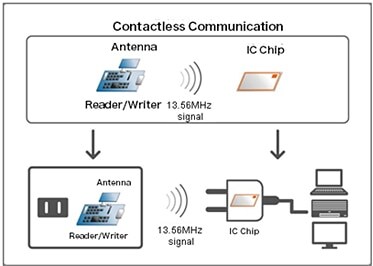
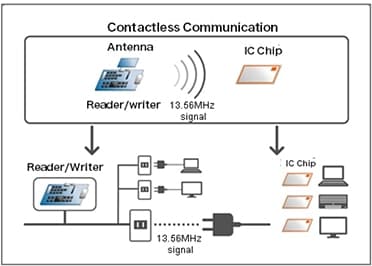
The “Authentication Outlet: FeliCa type” achieves the above functionalities by incorporating an antenna-connected IC chip into the plug of an electrical device and an antenna-connected reader/writer or controller into an electrical outlet.
On the other hand, the “Authentication Outlet: RFID Over Power Line type” aims to expand the functionality of the outlet's applications by combining Sony's newly developed “RFID Over Power Line” technology with its conventional contactless IC card technology.
This technology enables mutual authentication between an electrical device and a power supply by sending authentication information down the power line.
On the other hand, the contactless IC card technology establishes wireless communication between an IC chip and a reader/writer via an antenna, while the new “RFID Over Power Line” technology does so via physical power line cables.
More specifically, when the input-output terminal of a reader/writer built into a power supply (e.g. an electrical outlet) is connected to a power line, the read signal is superimposed on the power line.
In this case, similar to conventional contactless IC card technology, an electrical device, which would be the counterpart to an IC card, establishes passive communication without requiring a power supply. Accordingly, unlike the conventional PLC (Power Line Communication), a plugged-in device can be identified and authenticated simply by being plugged into an electrical outlet, regardless of whether power is actually supplied to the device or not.
A prototype of this “Authentication Outlet” system will be demonstrated at Sony's booth at “NFC&Smart WORLD 2012” which will be held at Tokyo Big Sight in Japan from March 6-9, 2012.
