The press releases on this website are provided for historical reference purposes only.
Please note that certain information may have changed since the date of release.
February 19, 2024
World Wide Fund for Nature Japan ("WWF Japan"), Yayasan WWF Indonesia ("WWF-Indonesia"), Sony Group Corporation ("Sony") and SynecO, Inc. ("SynecO") today announced the launch of a pilot project to introduce Synecoculture™, an agricultural method that utilizes the self-organizing function of ecosystems, to critical areas of forests in Sumatra, Indonesia. The project aims to verify the effectiveness of Synecoculture in forest restoration activities in the places where manual work is constrained.
In April 2021, WWF Japan and Sony signed a three-year WWF Corporate Partnership Agreement to step up their collaboration in tackling climate change and conserving biodiversity through forest conservation, and to bring about a healthy global environment. The two parties will further collaborate to introduce Synecoculture into critical areas of forests where WWF-Indonesia has been implementing a project to conserve forests and biodiversity towards the realization of a nature positive future. In cooperation with the local community, the project will measure the effects of Synecoculture on forest restoration in the area over a period of approximately one year, until the end of 2024. Through these activities, the project aims to both contribute to the continuation of multi-generational use of forests and habitat recovery for biodiversity, and contribute to the local community in the long term.
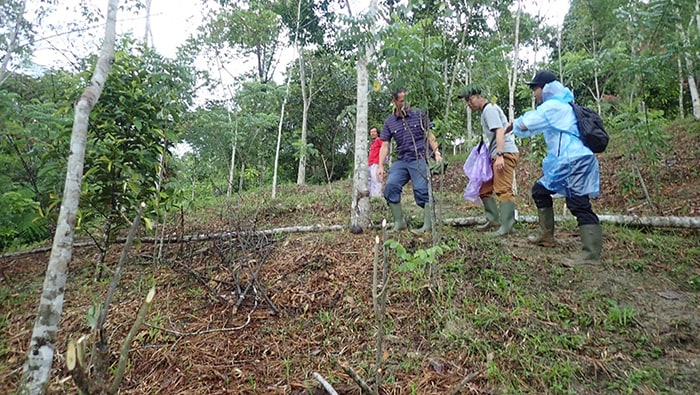
WWF Japan and WWF-Indonesia have been engaged in forest restoration activities in Sungai Abu village, Solok District, West Sumatra Province, Indonesia to conserve wildlife and biodiversity endangered due to the destruction of tropical forests. In order to ensure the required sunlight for the planted trees and to help their growth, it is necessary to manage the undergrowth for about four years after planting. However, the activity areas are on steep ground and manual work is difficult and inefficient. With this pilot project, strategic vegetation introduction and management of ecological succession based on the Synecoculture concept aims for efficient and diverse vegetation establishment even on steep slopes.
In addition, since Synecoculture enables production of a wide variety of useful plants, this project also aims to provide some opportunities to diversify income sources of the local community where rice and fruit trees are the main agricultural produce. This could also improve the livelihoods of the local community.
Through this project, SynecO will provide WWF-Indonesia and the local community with lectures and workshops on Synecoculture, consultation and maintenance for the start-up of the plots, and planning and analysis of effectiveness measurement. WWF Japan and WWF-Indonesia will be in charge of overall preparation and securing cooperation of local stakeholders for smooth operations of setting up and managing the plots, collecting necessary data and measuring the effectiveness of the project.
Synecoculture is an agricultural method that eliminates the need for the plowing, fertilizing, and use of agrochemicals that impact the environment, by taking maximum advantage of the self-organizing functions such as material circulation that occur naturally in ecosystems, aiming to create rich ecosystems with a diverse mix of plants that coexist and thrive.
This cultivation method, advocated by Masatoshi Funabashi, President and Representative Director of SynecO and a senior researcher at Sony Computer Science Laboratories Inc., achieves biodiversity and ecosystem functions that exceed natural conditions, through active intervention by human activities. It is characterized by a comprehensive approach that makes multi-faceted uses of ecosystem, that considers not only food production but also the impact on areas such as the environment and health.
SynecO is working to establish a Synecoculture management system*1 around the world that utilizes Sony's technologies, such as big data analysis that help cultivate plants in accordance with each local climate, and high-precision compact sensors to help manage farms.
WWF Japan leads a wide range of environmental conservation projects that help build a future in which humans live in harmony with nature. Sony also promotes environmental activities and has launched its long-term environmental plan "Road to Zero" *2 to achieve a "zero environmental footprint" by 2050, while supporting and working together with WWF Japan for more than three decades since 1989.
WWF Japan and Sony will continue to work together to build a sustainable future and a decarbonized society in which humans live in harmony with nature.
WWF is a global environmental conservation organization established in Switzerland in 1961. To build a future in which humans live in harmony with nature, WWF is currently promoting environment projects in more than 100 countries to protect rare wildlife species, preserve natural environments such as forests and oceans, promote sustainable use of natural resources, and prevent global warming, among many other things.
[WWF Japan Website]
[WWF-Indonesia official website]
WWF® and ©1986 Panda Symbol are owned by WWF. All rights reserved.

Sony Group Corporation is a creative entertainment company with a solid foundation of technology. From Game & Network Services to Music, Pictures, Entertainment Technology & Services, Imaging & Sensing Solutions and Financial Services - Sony's purpose is to fill the world with emotion through the power of creativity and technology.
[Sony Group Website]

A wholly owned subsidiary of Sony that promotes businesses specializing in environmental technologies related to augmented ecosystems, such as Synecoculture. The inaugural project of the Corporate Venture Capital (Sony Innovation Fund: Environment), which Sony established in September 2020 as an initiative to foster new environmental technologies.
[SynecO Website]

