Now You Can Bring Your Gunpla (Gundam Model Kits) to Life and Launch Them into Space — With the High-Quality Gunpla Scan Service to be Launched by Bandai Namco Group and Sony

Known as "Gunpla," plastic models of the Mobile Suit Gundam series have shipped over 700 million units since their release in 1980. A service that will make the dreams of Gunpla fans around the world come true is about to begin. This is the High-Quality Gunpla Scan Service, which will be piloted at The Gundam Base Fukuoka in Fukuoka, Japan from February through April, 2025.The service enables users to scan Gunpla they have built using a special device to create 3D data. Then, they can enjoy a diorama movie of their scanned one-of-a-kind Gunpla launching into space. In the future, this service will also try to produce battles among Gunplas in a virtual space.This service pilot will be provided by Sony Music Entertainment (Japan) (SMEJ) in collaboration with the Bandai Namco Group, led primarily by BANDAI SPIRITS. We spoke with Yusuke Watanabe of the PV Team, EdgeTech Project Department, SMEJ, about the development background and his team's passion about the service.
Contents
3D scanning service planned by enthusiastic Gunpla fans

With this high-quality scanning service, users will be able to enjoy watching their Gunpla launch into space in the form of an animated video.
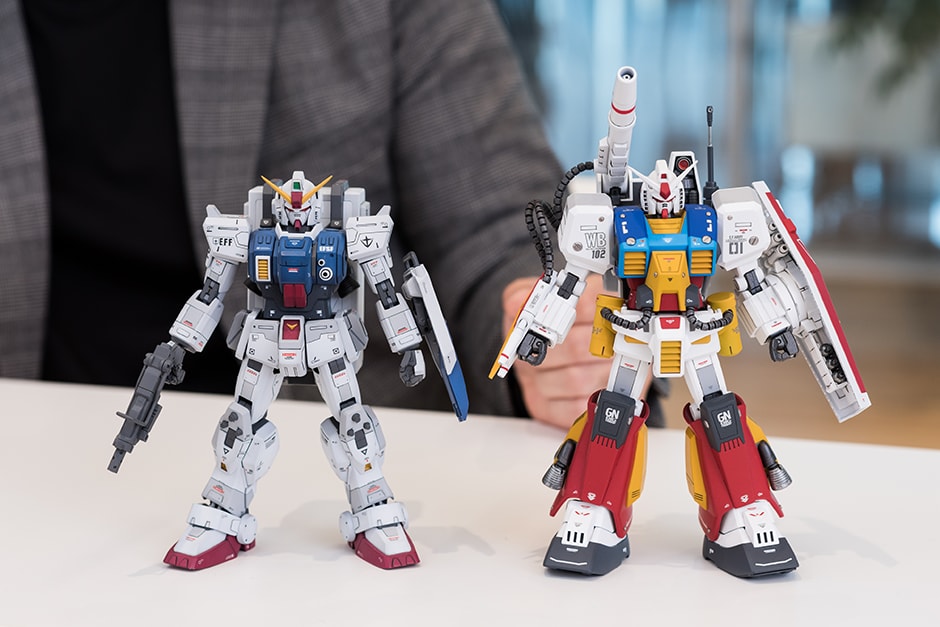
Gunpla, which is celebrating their 45th anniversary this year, are still very popular both in and outside Japan. They feature intricate details and are of high quality even when assembled as is, but hardcore fans can go even further and create one-of-a-kind custom Gunpla, as they pursue a realistic rendition of the story. Contests to compete for the highest degree of mastery in such custom models are also held on a global scale.
Gunpla are popular not only among young people in their late teens and early 20s, but also those who experienced the Gunpla boom in the 1980s as children. Watanabe, who planned the High-Quality Gunpla Scan Service, is one of the fans who grew up in the first Gunpla boom. Watanabe explains the content of the service like this:
"In this service, a Gunpla is scanned to create 3D data, which can be used to view and move the Gunpla in a digital space. In addition, we will make it possible to create and download a diorama movie in which the user's Gunpla launches into space based on that 3D data."
A high-definition 3D scanning device called SCANOSYS™ will be used for this service. This scanning technology was developed under the leadership of SMEJ. For optical scanning, four Sony's α™ (Alpha™) series mirrorless interchangeable-lens cameras are used. This generates 3D model data with quality close to the actual Gunpla, which is packed with the creator's attention to detail, by integrating high-precision shape data and captured texture data.
Watanabe goes on to say, "Until now, Gunpla have mostly been about the enjoyment of building and admiring. By converting them into 3D data, users can now enjoy things that they cannot realize physically, such as making their Gunpla appear in famous scenes of anime, holding their own exhibitions or sales events, and operating and battling the Gunpla they build." He also said that he would like to create a circulating ecosystem that connects such users.

Gunpla will be made into 3D data using SCANOSYS, a high-definition 3D scanning device developed under the leadership of SMEJ.
The result of an in-house call for ideas for a “Gundam x Sony” collaboration
The High-Quality Gunpla Scan Service started as one of SMEJ's PV Projects. PV stands for "From Physical to Virtual." These projects aim to create unprecedented entertainment experiences by digitizing various objects in the real world, not just Gunpla, and bringing them into the virtual world.
The Gunpla project resulted from a Sony Group in-house call for ideas in 2020. It was a competition for the best ideas based on the theme of "Gundam x Sony."
"When I proposed a plan to scan Gunpla and convert them into 3D data, the people at Sunrise (currently Bandai Namco Filmworks) who produce Gundam TV series animations were very receptive to the idea. Scanning and battling Gunpla was in fact a long-cherished wish of the Bandai Namco Group, and we immediately proceeded with the collaboration," says Watanabe.
Watanabe, who planned the project, joined Sony Interactive Entertainment (SIE) in 1997 and has been active mainly as a game director and producer, but he was originally a big fan of plastic models. He has been a Gunpla fan since elementary school, and he himself has made over 100 of them. He said, "I have brought Gundam project proposals to Bandai Namco Entertainment at SIE, as well."
3DCG tools developed from scratch just for Gunpla
The hardware aspect of SCANOSYS, which scans Gunpla into 3D data, was developed using Sony's existing technology. The development of tools that allow the rigid bodies of Gunpla to be animated without awkwardness and enable rigging (inserting the skeletal information and linking them to 3D models) through simple operations would have been "difficult without the knowledge and experience gained from game production."
"It's a technique called auto-skinning. Normally, you cannot move the 3D scanned data as it is. It is necessary to incorporate skeletal information into the data and use a technique to freely transform the 3D model according to the movement of the skeleton," says Watanabe.
There is a great demand for moving 3D data. 3DCG production tools for creators such as Maya and Blender are often used.
"You must remember that Gundam is a robot, so the structure of the joints is different from that of a human body. A new algorithm was needed to play back the animation from the 3D data so that the movement of the robot would not seem awkward," says Watanabe.
This is why Watanabe asked a game production company that he had connections with through many years of game production to develop a skinning tool. In so doing, they were able to develop a tool specialized for Gunpla.
This tool has been evaluated by Bandai Namco Group personnel as "achieving high-precision skinning even for modified Gunpla that tend to have complex shapes."

Using a technology called auto-skinning, the team was able to independently develop tools specifically for Gunpla, making it possible to freely transform 3D models.
Realizing Gunpla fans' long-cherished dreams
The High-Quality Gunpla Scan Service is the first of PV Projects. Watanabe talks about future prospects as well:
"I can't specify the exact time yet, but in the future, I would like to expand the service to the point where the scanned Gunpla will be able to battle each other. In that case, it will be a challenge to convert the points that the creator is particular about, such as modification ideas, techniques, and the degree of completion, into numerical values and convert them into machine performance. We are considering taking approach that references the evaluation index of Gunpla contests, but if you have any specific ideas, we would be grateful if you could let us know."
The concept of "Gunpla battle," in which Gunpla would battle each other, has existed in the world of fiction for over 40 years and can be said to be a long-cherished dream of Gunpla fans. In fact, the person in charge at the Bandai Namco Group also said, "Gunpla battle has been a dream of Gunpla staff for years now, and we have been in a process of trial and error to achieve it for some time."
The High-Quality Gunpla Scan Service will be piloted at The Gundam Base Fukuoka in Fukuoka, Japan from February 22 to April 27, 2025. Use is by reservation only (reservations can be made online starting February 12), and the price is scheduled to be 3,300 yen (tax included) per use.
In conjunction with the service, there will also be a "Gunpla Scanners Contest Vol.0." There will be two categories where creators can show off their works of art: the Build Category, which will judge the Gunplas themselves, and the Movie Category, which will judge the 3D videos.
"The world that Gunpla fans around the world have dreamed of is about to come true. By providing the unprecedented service of converting Gunpla to 3D data, we will be able to give users a whole new experience of enjoying their Gunpla," says Watanabe.
Gunpla fans’ dreams will finally come true.
Yusuke Watanabe
PV Team, EdgeTech Project Department, Sony Music Entertainment (Japan) Inc.
Yusuke Watanabe began his career as a designer and joined SIE in 1997. While at JAPAN Studio, he participated in the Ape Escape series as an artist. In the PlayStation® 3 trading card game The Eye of Judgment, he served as director and created the world's first commercial AR-based card game. For the same title, he also collaborated with US-based Hasbro, distributing the trading card game worldwide. In the Knack series, produced with Mark Cerny, the lead system architect for PlayStation® 4 and PlayStation® 5, as general director, he served as producer for a large-scale project spanning studios in and outside Japan. Currently, while conducting research and development on key technologies for next-generation input devices at the UX Research & Development Department, he also works concurrently at SMEJ, where he is involved in producing the High-Quality Gunpla Scan Service project.