Interview
- Tomoko Matsuzaki
- Sony Music Entertainment (Japan)
Creating Seamlessly Physical and
Virtual Entertainment Experiences
Sony Music Entertainment (Japan) and Sony Music Solutions opened THE TOKYO MATRIX, a mission-driven attraction that immerses visitors into the world of anime and game in a physical space, in the Shinjuku area of Tokyo in April 2023. We asked Tomoko Matsuzaki, who helmed the project to open this facility, and who has produced a wide range of entertainment experiences through the planning and management of various music and animation events, about her thoughts on how the world of entertainment will change over the next decade.

THE TOKYO MATRIX
—— How do you think the world of entertainment will change over the next decade?
I believe that we'll see major changes in 20 years, when Gen Z begins to take leadership positions in society, and that the next decade will be a transitional period, during which we'll see the intersection of old media and new media. I do think that the ways in which creators create content and the ways users consume this content will greatly change even during this transitional period. You can see this happening already, with many people now watching anime not just on TV, but online as well. In the next decade after this transitional period, I think we'll see both creators and users being freed from existing restrictions around the TV program seasons and length. This will allow creators to imagine more freely and create what they want to create, without being bound by the time constraints and frameworks of the past, and I think also normalize the promotion of content overseas. With these changes, we as producers will need to determine when, where, and on what devices users are enjoying content, and think about how we can provide content in a way that suits each individual's story.
—— What will be important in creation field going forward?
I believe marketing and communication strategy will become increasingly important in creation field. It doesn't matter how incredible a creator's work, or an IP; if they aren't conveyed to the world, they won't excite or inspire people. We also have to remember that the types of digital devices and media available will be even more diverse in the future. As such, it'll be important to develop a careful strategy for each work—how to convey what makes the work interesting, on what media, and in what order, so that it will spread throughout the world. Technologies will be useful in this process. Soon we'll be analyzing the growing amount of viewer data—growing ever more with the diversification of media—to figure out what to do next, or what patterns exist, to come up with flexible strategies alongside creators. While AI is currently getting attention for its role in supporting content creation, I think that in the future it will play a major role as a marketing tool.
—— What are your thoughts on the relationship between entertainment and technology?
I've long been involved in the creation of new businesses at the intersection of entertainment and technology. In the process, I've taken my inspiration from science fiction-themed movies, novels, and animes, which have long depicted technologies like AR and VR becoming commonplace in their stories of the future. I think these stories are what human beings dream of—in other words, the future that many of us want to realize. Entertainment experiences using small and lightweight AR glasses, for instance, are already becoming more and more of a reality. I want to be among the first to realize these experiences of the future and deliver them to users, and I keep a close eye on technological developments that I think would make these possible. I believe part of what technologies something that will allow us to achieve the future depicted in these science-fiction stories through its advancements.
—— What kind of entertainment experiences do you envision for the future?
What I'm currently interested in is expanding the concept of “reality” through new communication technologies. I believe that being able to communicate and have conversations with people who are far away, without time lag, will become even more important in the future. In the world of video games, it is now common for people to log in from various different locations and play together online. What I'm envisioning is this same sort of experience but in the physical world—with players in all different locations getting the sense that they are all playing together. This is why our goal with THE TOKYO MATRIX is to establish an experience that allows people from distant locations to be able to participate in a game happening in the physical venue. As an initial step, we have implemented a support system in which those outside of the venue can use a web app to send in-game parties “support points” to give them a gameplay advantage. However, what we're really working towards is a new kind of real-life experience that transcends the limitations of physical location, with those outside of the game able to participate in the game more in real-time, helping their favored party, or hindering rival parties.
Another area of focus is the creation of personalized experiences that incorporate interactivity. An example with THE TOKYO MATRIX would be how we use a voice synthesizer, developed by Sony, to have the characters call out the players' names. In the future, we want to enrich the experience further by personalizing it even more—for instance, by starting off with a conversation about how many times the player has participated in the experience.
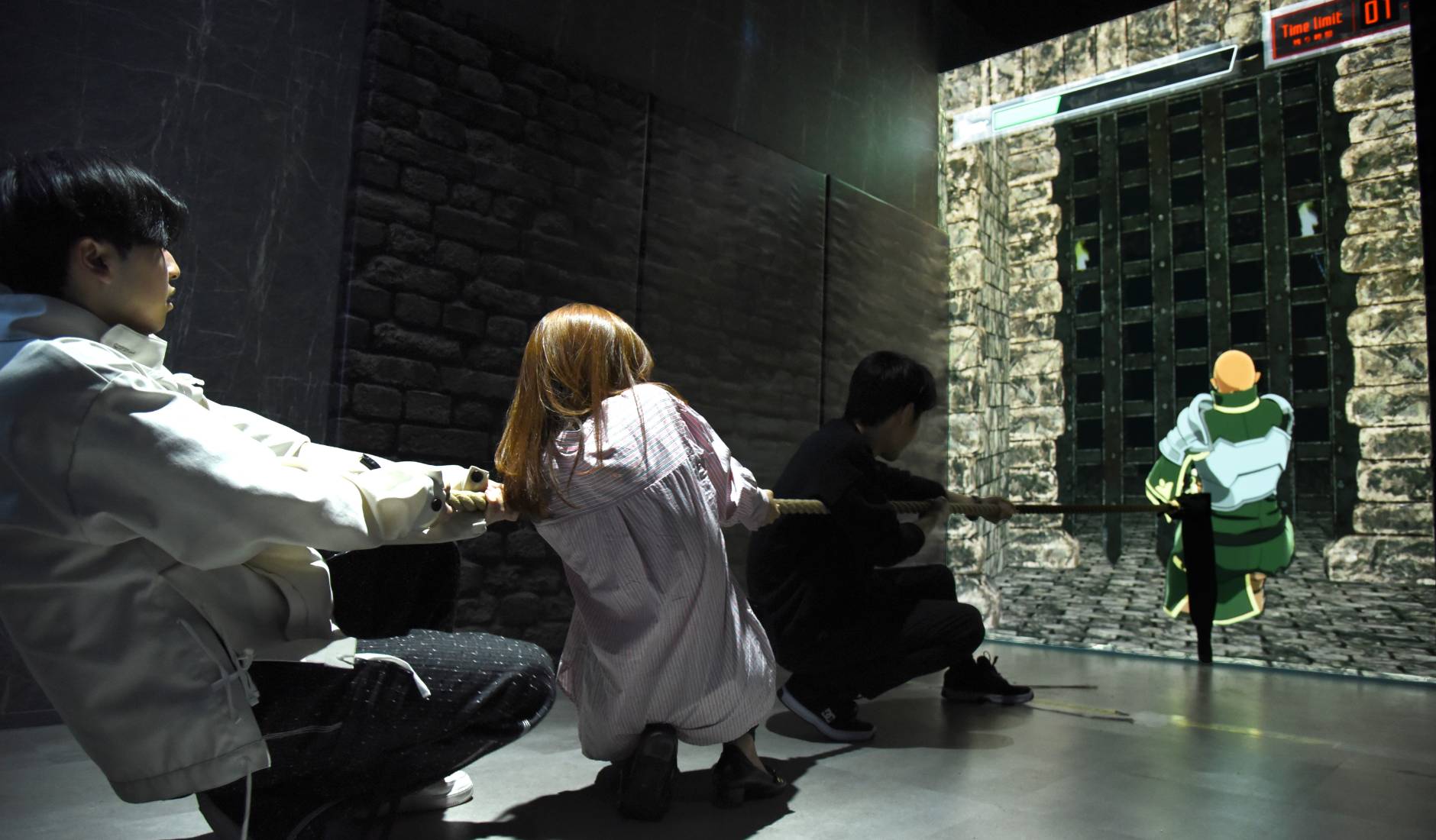
Working with characters in-game in THE TOKYO MATRIX
—— How do you think the fusion of the physical with the virtual will affect the world of entertainment?
What we want to do is to create an experience that can be enjoyed seamlessly between the physical and virtual worlds. This does not mean reproducing the physical world in the virtual. What we are envisioning is something where the physical and the virtual interact with one another to create a single world and experience. An example would be your score in a smartphone game affecting your experience of a real-life attraction, and then your results from this experience being fed back into the smartphone game. I believe if we're able to create an experience that is seamlessly physical and virtual, like a journey that is connected all the way through, that will represent a new kind of entertainment.
—— What are your thoughts on the recent focus on trans-media storytelling in the entertainment industry?
Sony Music Group (Japan) has been engaged in trans-media projects, coming up with various different ways to enjoy the same IP—merchandizing goods and events, exhibitions, orchestra concerts, experiential attractions, 2.5D musicals, card games, and more. The number of ways in which people can have fun will continue to grow, which means we need to be constantly aware of new creators and partners. Because the world of entertainment moves very fast, if you have a promising IP and want it to be a hit, the key is to be prepared to create different forms of media from it as quickly as possible: “Next we'll have an event, then a concert,” and so on.
—— What are your thoughts on the future of Sony Music Group (Japan) and the Sony Group?
I think the role of Sony Music Group (Japan) is to continue to produce hits that bring Kando (emotion) to the world. To do this, we'll need to constantly be coming up with new things, and providing content to users. Our company name has the word “Music” in it, but we work on projects all across the entertainment spectrum, from anime to games, and characters . We want to use this sheer variety in entertainment genres to expand the fun and potential for each of our IPs.
I also feel a major advantage of the company is being a part of the Sony Group. We at Sony Music Group (Japan) are planning to put more of a focus on our overseas expansion moving forward, and I believe by utilizing the Group's global network of sites and employees around the world, we'll be able to create experiences that surprise the world. Going forward, we'll continue taking on new challenges in the world of entertainment, with the aim of becoming a company that other Sony Group employees, partner companies, and creators actively want to work with.
Profile
Tomoko Matsuzaki directed the project for THE TOKYO MATRIX, a mission-driven attraction that opened in the Shinjuku area of Tokyo, involving members from departments such as planning, design, engineering, system development, R&D, and PR, as well as stakeholders from over a dozen companies. Since joining Sony Music Solutions, she has worked in production sales, sales marketing, and event management, and recently in the development of new solutions businesses. She spends her days taking on the challenge of creating new forms of entertainment.

