
BRAVIA TV/home theater system
design conceptHarmonic Presence
A quiet presence, inhabiting the room in comfortable harmony
BRAVIA® TVs and home theater systems continue to pursue the ultimate viewing experience
through pristine picture and sound quality. For Sony designers, the goal is to grasp
the essential elements of the innovative technologies engineers create and bring
those technologies seamlessly into people's lives. So, as we look ahead to
the living spaces of tomorrow, what form should video products take?
One answer to that question is Harmonic Presence, a design concept that brings harmony
to the fore and opens up a new worldview for BRAVIA.
Harmonic Presence:
Exploring a frontier
beyond minimalism
To this point, Sony has focused on limiting the presence of TVs and home theater systems to avoid disrupting immersion in the viewing experience and blend the product into users’ living spaces. Designers have done that by minimizing elements like TV stands, bezels, and other elements that might distract from the viewing experience, using the few elements that remain as a canvas for highlighting the Sony Design aesthetic. In a sense, the team has pursued a kind of minimalist contradiction: erase the product yet leave an impression.
But with content constantly diversifying, screens becoming thinner and thinner, and picture quality growing increasingly sharp, people are seeking out larger TVs and more immersive sound—and that means that video products now play a more important role in the living space. Sensing that shift in the air, Sony designers began asking a new question: Is subduing the product’s presence really the only answer? While they recognized the benefits of minimalism, they started to think that the direction ahead might lie in design that harmonizes with the living space and enriches life itself. That line of thinking led to the new Harmonic Presence design concept and the three key themes below.

Harmony with the Space
Harmony between the Devices
Harmony with the Experience
Harmony with the Space
Shapes, textures, and spatial relationships should all blend elegantly into the living space.
The design should make the room feel better because the product is there.
Harmony between the Devices Designs should ensure that every video and audio product has a distinct personality and appeal. Together, the products should expand the BRAVIA worldview, make the experience more convenient, and make people want to bring the pieces together.
Harmony with the Experience The design should naturally spark and heighten experiences: watching and listening, using the product, connecting people through those experiences, and deepening the enjoyment they share.
These three themes helped shape the design of the 2026 BRAVIA TV models (BRAVIA 9 II and BRAVIA 7 II), the BRAVIA Theatre Trio home theater system, and BRAVIA Theatre Sub 9 subwoofer. The next sections look at how the concept and themes translated into industrial design, UI/UX design, and communication design.
A worldview with cohesion,
a room with rhythm
In addition to featuring larger screens and slimmer designs, the BRAVIA 9 II and BRAVIA 7 II integrate an independent-drive RGB panel powered by Sony's proprietary signal processing technology for individual RGB control of high-density LED backlights. One challenge for the design team was how to accentuate the powerful visual impact those elements deliver by softening the presence of the cables under the center stand. When a user connects multiple devices to a TV, the cables tend to create visual clutter. For the design team, then, showcasing the screen in the visual field—and keeping other elements out of the viewer's line of sight as much as possible—was a central goal.
Because changes to the internal structures posed challenges for applying conventional cable-management concepts, the designers began exploring another idea: using lenticular material to create an optical-camouflage effect that would hide things on the other side. As they prototyped solutions and made refinements, the team eventually arrived at placing a lenticular panel on the front of the stand.* Vertical ridges in the panel diffuse the black lines of the cables behind it, taking the cables out of view and making the TV screen appear to "float" in the space. The lenticular material's optical-camouflage effect, which visually obscures objects behind it, delivers a unique sense of intrigue—something users will want to tell others about.
* On models besides the 115-inch BRAVIA 9 II and the 98-inch BRAVIA 7 II.
Sony focused on perfecting every detail that could deepen immersion in the viewing experience. Working with engineers, the design team revisited the internal board structure and gave the bezel at the bottom of the screen a much narrower profile. The BRAVIA 9 II screen uses a low-reflection film, developed by Sony, to reduce reflections and glare that can interfere with the viewing experience. The remote control, too, received detailed refinements from an inclusive-design perspective—the carefully shaped button surfaces, among others—to make it easier for an even broader range of users to enjoy their viewing experiences.
The team also made major changes to the acoustic side to go along with the larger screen dimensions. One part of the overhaul was the development of a system that places speaker units in the side bezels, closer to the listener’s ears, rather than the under-screen setup that previous models used. To support that structure, the designers created a bezel that looks like two overlapping slates. Openings for the speakers sit in the slit between those plates, which improves sound directivity and helps enhance sound quality. Another focus for the design team was making the product as versatile as possible in space: by making refinements with an eye to how the components would look from every angle, the designers worked to give users more freedom in choosing where to put the TV. The rear surface of the unit is a prime example of that attention to detail, with six acoustic elements, including speakers and diaphragms, sharing a circular motif for a clean, cohesive look all the way around.
Design of the TV bezel and rear panel
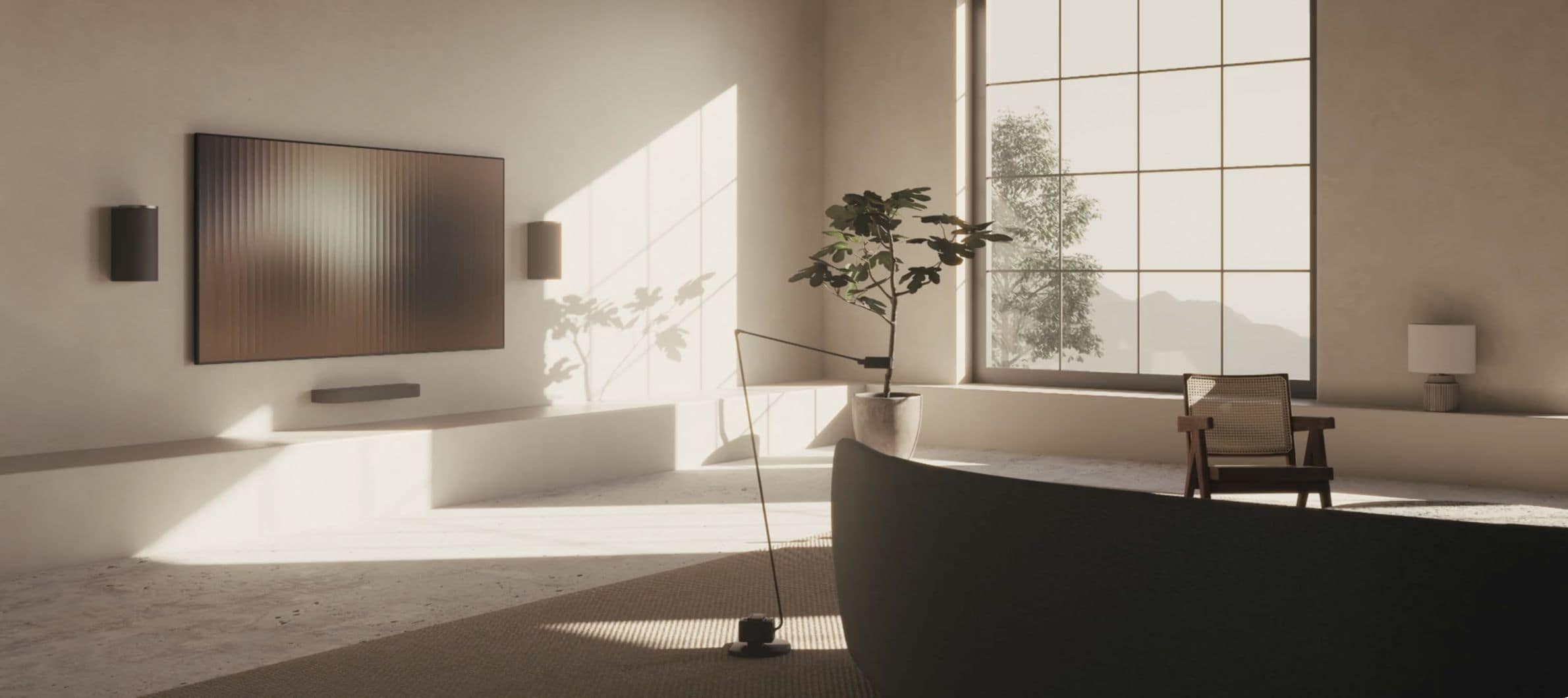
The BRAVIA Theatre Trio home theater system, BRAVIA Theatre Rear 9 rear speakers and BRAVIA Theatre Sub 9 subwoofer also embrace the Harmonic Presence concept, creating a unified worldview across the lineup. Rooted in that conceptual foundation, the products use essential geometric forms like cylinders and cubes to reflect their individual functions and roles. Placed around the living space like quiet objects, the forms create a sense of rhythm in the room.
For BRAVIA Theatre Trio, the designers derived the geometric forms from where each speaker would sit. The center speaker, occupying a spot below the TV, features a D-shaped design. The back of the speaker is flat to allow for wall-mounting together with the TV, while the curved front edges hint at how sound propagates outward. The positions and orientations of the BRAVIA Theatre Rear 9 rear speakers, meanwhile, are user-defined; given the need for adaptability to a wide range of locations and angles, the team gave them a versatile cylindrical form with no fixed direction.
In putting together the design for the BRAVIA Theatre Sub 9, the team explored ways of aligning the look with a distinctive function: two speaker units facing each other to cancel unnecessary vibration inside the cabinet and generate pure, optimal bass. Starting from the idea of a sculpture holding inner energy, the designers arrived at an elegant, no-frills cube form. They also wanted to give an aesthetic voice to the unit-against-unit mechanism, which they did by placing two rectangular bodies face to face in a simple composition—leaving a slit between for bass to pour through with a powerful punch.
Enriching emotion through deeper connections
The UI/UX design brings one Harmonic Presence theme to life: connecting people and deepening enjoyment. At the center of that approach is the new My Cinema feature. The idea grew out of a desire to stretch the traditional conceptions of the picture- and sound-quality settings users adjust before watching a movie. Rather than leaving those in the complex, text-based operations that have been the norm, the designers wanted to turn the configuration process itself into an experience that builds a palpable sense of anticipation before the film begins.
The designers imagined an experience that would let anyone arrive at the optimal settings with ease, intuitively find their personal preferences, and have fun tweaking the parameters. From that conceptual standpoint, the team created a mechanism that made the configuration interface a visualized living space on the TV screen: the user sees their TV and speakers on-screen and, as they select the devices, adjust picture quality, and fine-tune other settings, watches animations reflect each change. The UI also organizes complex settings into layers based on frequency of use, keeping operation simple and easy to navigate.
With this approach, users can not only get animated feedback on how each setting would change things but also adjust the viewing environment in essentially the same way they would rearrange a room. The UI itself has the potential to spark conversations with family and friends, too; an action film on tap might naturally get people talking about what kind of configuration might deliver even more impact, creating a richer viewing experience to relish together.
The first layer covers basic settings. When users want finer control,
the second layer lets them make adjustments and applies animations to visualize
the effects of the pending changes. Users can also save the living spaces they set up
and add more spaces for different movie categories and other viewing conditions.
Designing communication that leaves room
for the imagination
For the communication design to bring people into the new BRAVIA worldview, the team wanted to make it easy to see and understand the Harmonic Presence concept: BRAVIA harmonizes with living spaces and enriches life. One example of that effort is in-situation photography, an approach that involves showing the product in actual usage scenarios and an important visual element in the promotional strategy. Rather than create a living space that simply looks beautiful and perfectly arranged, the team came up with compositions where BRAVIA stands naturally as the centerpiece of an inviting space, the kind of setting where people would want to share time and experiences with someone else. The aim was to create a space that suggests a full, comfortable lifestyle and subtly set the stage for a viewing experience. To do that, the team defined the person at the heart of the world in each photograph—all the way down to their backstory and peripheral details.
In-situation photographs that foreground the user presence
In crafting the communication approach, there was one thing the designers were constantly careful about: not saying too much. The visuals should not make the product seem like something that might intrude on users' daily lives. Instead, the designers knew, the visuals needed to show how the devices gently resonate with people and add just a little color. They should leave space for interpretation and let users choose how to engage. BRAVIA is not the main character—richer, more fulfilling lives are. Users are the ones who bring the emotional experience to full completion. In every visual, the team brought that perspective forward.
BRAVIA design stays quietly at the user’s side,
always changing with them.
The 2026 TVs and home theater system offer a new vision
for video devices in living spaces.
* Project team members as of the April 2026 interview