
Sakurai Kokeshi x Sony DesignExtending the wonders of kokeshi dolls
through collaborative design
Kokeshi are traditional craft objects from Japan's northeastern Tohoku region,
famous across the country for their distinctive look and colors.
In a project like nothing before it, Sony designers have collaborated with
a master artisan who carries the kokeshi tradition forward.
Looking to stretch beyond organizational boundaries and individual design fields,
the effort is an attempt at exploring new ideas and new possibilities for making.
The goal is to combine the power of design with one of Japan's traditional industries
to open up new value and potential.
Here, Naomichi Sakurai, the sixth-generation head of Sakurai Kokeshi,
joins the designers in conversation about the project:
how exceptional handwork and the designers' own discoveries resonated
with one another, how the proposals ultimately became products,
and what the future might hold for fusions of traditional industry and design.

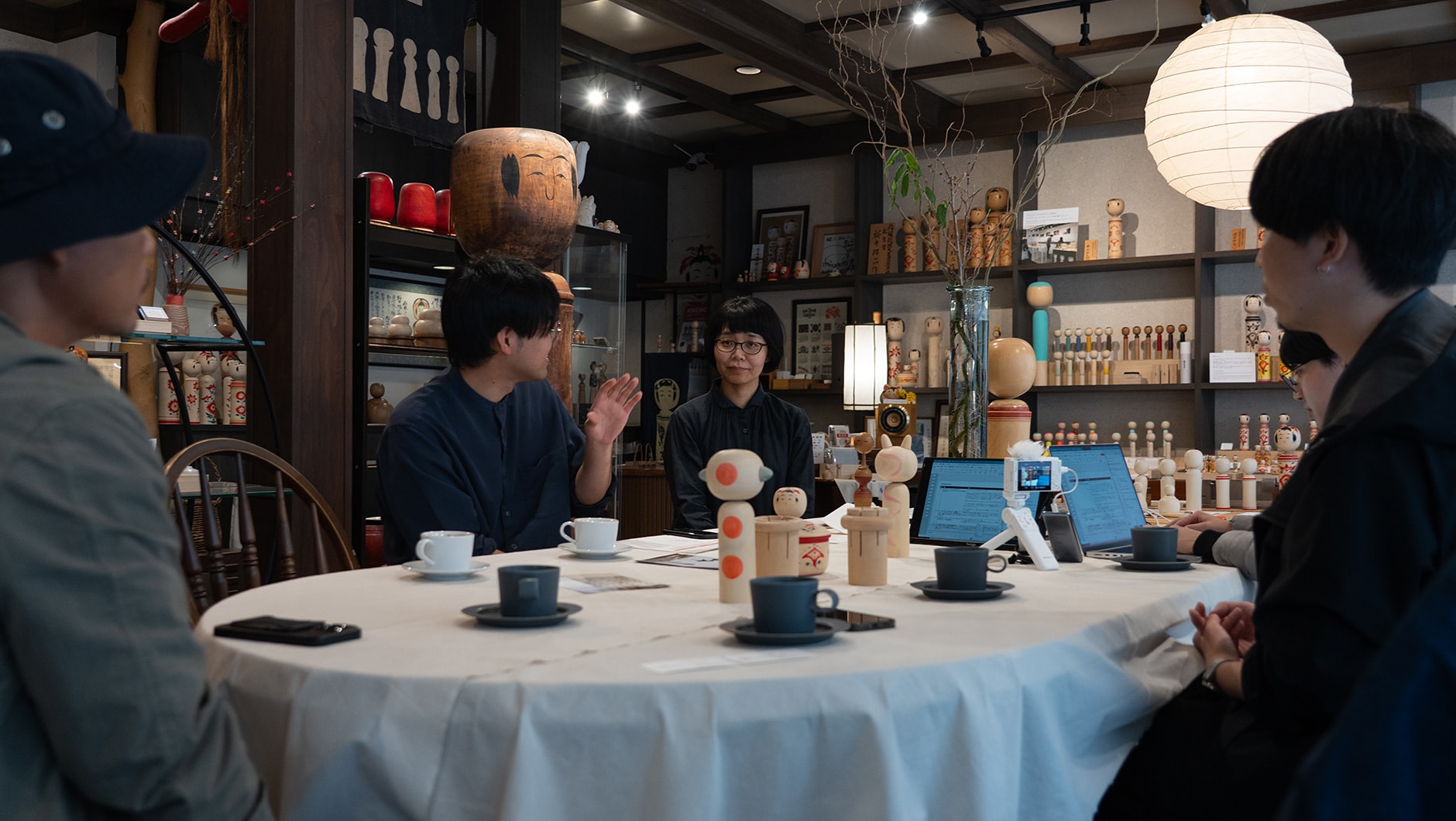
L to R: Sakurai Kokeshi; Hitomi Nakamura, Naomichi Sakurai (sixth generation), Akihiro Sakurai (fifth generation)
Creative Center: Daisuke Serizawa, Mana Sato, Akimasa Mishima
How a kokeshi artisan and
designers forged a creative bond
Kokeshi, which trace back to the Edo period and have roots in Japan's northeastern Tohoku region, are traditional wooden dolls with a unique form: a cylindrical body decorated with flowers and other motifs, topped by a round head with a distinctive expression. Originally made as souvenirs for hot-spring resort visitors, kokeshi dolls gradually took on associations with protection from evil, children's play, and prayers for fertility. One of Japan's preeminent kokeshi production centers is Naruko Onsen in Osaki, Miyagi Prefecture, where artisans continue to pass on the techniques and culture. A defining feature of the craft sets them apart: a single artisan handles the entire process, from turning the wood on a lathe to painting the finished doll. At Sakurai Kokeshi, the thinking and spirit behind the craft—including how the artisan works with the wood itself—matter just as much as the finished object.
Kokeshi are now the centerpiece of a new collaboration with designers. The project is part of IN-HOUSE→SOCIAL DESIGN UNIT,*1 an initiative that channels the creativity of in-house designers and other creative professionals into developing products with the power to make a social impact. Sony designers joined the project, and the items they created around the concept of "letting kokeshi shine on a broader stage"—are now set to go on sale at Isetan. Kokeshi artisans and designers share a place in the world of making things, but their stances and approaches to their craft could hardly be more different. When those two perspectives begin to resonate together, what kind of possibilities come into view? Naomichi Sakurai of Sakurai Kokeshi, and three designers involved in the project look back on what they learned through the project, what they discovered, and where the collaboration may lead.
*1 IN-HOUSE→SOCIAL DESIGN UNIT: A cross-company project led by Dentsu's Future Creative Center and Isetan Shinjuku LIFE DESIGN, part of Mitsukoshi Isetan. The first initiative brought together young designers from FUJIFILM Design Center's CLAY Studio, Sony, and Sony Design Consulting to create designs on the theme of kokeshi. The prototypes were presented at DESIGNART 2025, held from October to November 2025.
This collaboration was part of IN-HOUSE→SOCIAL DESIGN UNIT, a product-development project that applies the creativity of in-house designers and creative professionals to addressing social issues. What was it like when you first started working across the boundaries of your positions and disciplines?
SakuraiI'd heard that the team wanted to visit the workshop and try painting kokeshi themselves. When they told me there was actually a project behind the visit, I honestly had no idea what kind of product we were supposed to make. As we got to talking, though, I realized that their goal wasn't creating a brand-new kind of kokeshi. The team made it clear that it'd be Sakurai Kokeshi, which has inherited the craft for generations, carrying kokeshi into the future. What they wanted to do was learn from the techniques of kokeshi, understand the aesthetic sensibilities behind the dolls, and then find another way to broaden their appeal. That was a surprise to me—and really reassuring, too.
SerizawaWhat's stayed with me was something Akihiro Sakurai, the fifth-generation head of the workshop and Naomichi Sakurai's father, said. We asked him, "How would you define a 'kokeshi'?" And his answer was, "Anything I make as a kokeshi artisan is a kokeshi." For me, it was almost like he was telling us not to hold back, to let our imaginations run free. That was definitely encouraging.
SakuraiThat's something my father has always said to me. "Everything I make carries on the tradition of the Sakurai family," he says. "If you're going to inherit that legacy, you have to understand that responsibility and not be afraid to try something new." That mindset itself, I think, is part of our family heritage. One of our predecessors, Iwazo Onuma, helped lay the foundations for Sakurai Kokeshi between the Meiji and Showa eras. He kept breaking new ground with forms of expression that no one had ever seen before, using purple in kokeshi painting and incorporating biriganna, a technique that carves delicate wave patterns into areas like the shoulders. People at the time apparently didn't know what to make of them, seeing the lack of any precedent as cause for concern. Over time, though, both of those new styles naturally came into their own as forms of kokeshi artistry.
As designers, how did encountering that kind of philosophy during the research phase affect you?
MishimaIt was a revelation. In the product-design work I usually handle for TVs, headphones, and other products, we have to perfect the product mold down to fractions of a millimeter to deliver products that have a consistent quality. Kokeshi artisans, however, don't work from drawings. They create everything from the form to the patterns based on experience and touch—a feel for the craft that goes back through the generations. It was incredible to experience that sophistication up close. And another thing that spoke to me was how Sakurai Kokeshi doesn't just preserve the DNA it's built up over the generations; they look to both uphold the tradition and evolve it.
SerizawaMy day-to-day work at Sony centers on communication design for products like cameras, and I'm usually creating things in collaborations with people in planning and engineering and other areas in between. I think a lot of people in traditional crafts work that way, too. But Kokeshi artisans don't. They handle the entire process themselves, from growing and cutting the timber to turning the wood and finishing the piece through painting and other steps. With every individual artisan pouring everything into every single piece, I had a feeling that teaming up with designers—who stand at almost the opposite end of the spectrum—might spark a really interesting chemical reaction, so to speak.
SatoMy end of the design world is a bit different; I focus on things without any real physical dimension, like UI/UX in the financial field. Since that's so far removed from kokeshi-making, I knew I had to go into the project by first asking myself what I could really contribute. Before I got to work on any concrete proposals, I wanted to think about who I was and how I viewed things as a designer.
Engaging with kokeshi:
Three designers,
three design proposals
You started out with no real bearings, just trying to get a feel for things. How did you propose your ideas and shape them into something feasible?
MishimaThe three of us all work in different areas, but the fact that we were able to get ourselves on the same page early on was big. As we made our visits to Naruko and got the chance to watch the artisans at work, we all came away feeling that we couldn't be halfhearted in how we approached the project. When we saw the amazing craftsmanship that they put into their creations, we all had the same reaction: "We're amateurs here. We can't design the actual kokeshi dolls themselves." That understanding we shared helped point us in the same direction, I think.
SerizawaWe got a chance to try painting kokeshi ourselves—and I couldn't believe how hard it was. As designers, you know, we should be good at art. And yet making a single stroke on a doll, from the way the brush first touches the surface to the moment of held tension to the final lift, made me realize just how precious that gesture is. When I got a taste of how deep and rich kokeshi-making can be, I couldn't get enough. I think that experience was a major turning point for me: rather than shaping ideas by drawing on desktop research, I wanted to give form to the raw sensations of what I felt and discovered firsthand.
SatoGetting an in-depth experience of everything that makes kokeshi-crafting so incredible isn't something you can do every day—which made it so valuable. As our discussions continued, a question began to surface: What kind of design could bring out even more of that kokeshi appeal? From that perspective, we all expanded our ideas.
The production process at Sakurai Kokeshi.
From cutting the timber to turning the wood and painting the finished piece, a single artisan handles every step.
SakuraiThat feeling of "What can I contribute?" was actually something I felt, too. First off, I was simply grateful for the opportunity to work with designers from one of Japan's leading companies. At the same time, I kept thinking about how I could respond to their ideas and requests. We were doing something completely new in the world of traditional kokeshi, so I decided that I would take the lead, keep talking everything through with the team, and build it together with my father.
Then you polished the designs with an eye to commercialization, completed the prototypes, and moved on to the exhibition unveiling. What form did each design ultimately take?
MishimaMy proposal imagined tableware and lighting that rework four kokeshi shapes and painted motifs from Naruko into entirely different products. The key point for me was not adding new design elements to the shapes and patterns Sakurai Kokeshi has carried forward over the years—I used them as-is. Instead of designing new forms from scratch, I wanted to recompose what already lives inside the tradition: shapes that have settled into the artisans' hands, the touch of their brushwork, and the other elements that are part of the crafting process itself. The tableware I came up with adapts kokeshi-making techniques for production: hollowing out the inside of rotating mizuki wood (the wood traditionally used for kokeshi) to create the finished form. The lighting works in a similar way. It draws on the wood-lathe techniques unique to kokeshi-making, not the methods woodturners use for bowls and other things, and it also leverages the qualities of mizuki wood. The design incorporates traditional shapes that artisans have learned by hand from the previous generation, which helps evoke that distinctive kokeshi aesthetic.
Inspired by the artisanal legacy and the process of turning wood on the lathe, the vessel "Ukeru Kokeshi" (top) and pendant light "Tomoru Kokeshi" (bottom) take four traditional kokeshi forms as their motif. Both come in two color finishes: painted and charcoal.
Inspired by the artisanal legacy and the process of turning wood on the lathe, the vessel "Ukeru Kokeshi" (left)
and pendant light "Tomoru Kokeshi" (right) take four traditional kokeshi forms as their motif.
Both come in two color finishes: painted and charcoal.
SerizawaI designed a spinning top and a scarf. In the kokeshi-making process, the artisan mounts the wood on the lathe and carves out the shape of the head. Once the head comes off, there's a leftover conical offcut on the lathe side. That ties into one of the things that struck me most about the process. The artisans plant the saplings themselves, grow the trees, cut them down, strip the bark, carve the wood, and finally paint their creations. In that kind of making—where they're so engaged with nature from start to finish—I also found beauty in the sustainable side of the process. Even the wood shavings get used as fuel for the stove or shared with the house next door. That's why it felt like just burning the offcuts, which themselves hold a part of the tradition, would be a waste. From there, an idea came into focus: use that conical shape to make a spinning top and bring it back to life through motion.
The scarf idea also grew out of something that hit me during the painting experience. In kokeshi-making, the painting process is called byōsai. To me, it seemed like the word embodies a philosophy that goes beyond anything you could capture with terms like "pattern" or "motif." I wanted to translate that conceptual dimension itself into a kind of value and see whether I could amplify how the rich, meaningful weight a single brushstroke holds and turn it into something you can wear. That idea shaped the design.
The spinning top "Mawaru Kokeshi" (top), upcycled from offcuts generated during the kokeshi-making process, and the silk scarf "Matou Kokeshi" (bottom), woven together with the artisans' brushwork. The spinning top comes in three sizes, and the scarf in four patterns.
The spinning top "Mawaru Kokeshi" (left), upcycled from offcuts generated during the kokeshi-making process,
and the silk scarf "Matou Kokeshi" (right), woven together with the artisans' brushwork.
The spinning top comes in three sizes, and the scarf in four patterns.
SatoWhat I designed was clothing for kokeshi to wear. At Sakurai Kokeshi, sōsaku kokeshi—creative kokeshi designed to harmonize with contemporary life—are some of the more popular items. On the other hand, though, I'd heard that sales of traditional kokeshi, which remain rooted in older styles, had been relatively stagnant. That got me thinking about whether there might be a way to bring traditional kokeshi into today's living spaces without departing too much from the standard formal aesthetic, which eventually led me to the idea of giving them clothes to wear. As I got to prototyping the designs, I started seeing new possibilities. Opening the front of the clothing wide lets the painted design shine through. A collar can cover the neck a little and give the face a different vibe. A flared silhouette creates a lighter, more airy presence. I wanted the clothing to extend the aesthetic range. And I also figured that with kokeshi wearing clothes, there'd be opportunities for collaborations with partners that the dolls have never had any connection with before. That would help them reach new audiences they might've never been able to get to, as well, including fans of the collaborators.
"Yosou Kokeshi" dolls involve dressing traditional Sakurai Kokeshi to unlock new forms of expression.
The lineup comes in three colors—plant-dyed mizuki (the wood kokeshi are made from), indigo, and sakura pink—and eight variations, including gradient designs.
The designs and visions guiding
the creations to the market
SakuraiEvery one of these ideas is something we never would've come up with on our own. Serizawa-san's spinning top, for example, made me realize that even the offcuts I'd always seen as scraps actually have value. With the scarf, too, I felt that he wasn't just looking at kokeshi as something "cute." He saw value in the brushwork and lines that Sakurai Kokeshi has stood by over the generations—and in the aesthetic richness of a single stroke. Mishima-san's tableware and lighting are the hardest items to make. Hollowing the wood out that deep, all the way inside, was a challenge for me, even. Sato-san's clothing idea was something else, too. I had no idea that it'd have that big of an impact. She brought some even more adventurous design ideas to the table, as well. The whole thing was fascinating to me, really, including where it might lead from here.
The offcuts that inspired the spinning top idea (top) and the painting process (bottom)
The offcuts that inspired the spinning top idea (left) and the painting process (right)
All three of you are designers, but you each arrived at a completely different end result. Why do you think that was?
SatoProduct design, communication design, UI/UX—we all work in different design fields, so maybe the differences in how we think showed up in our creative output.
SerizawaI think that was part of it. But some of it also probably has to do with how the project wasn't just "work" to us in the usual sense. It was an individual act of creating. That might be why the end results really captured our personal tastes and perspectives in such a distilled form.
MishimaIn that sense, the kind of mental preparation and resolve this project demanded went beyond the design we normally do. Being there, in the presence of these artisans with their incredible focus and amazing skill, I kept thinking that we couldn't hurt the tradition with half-baked ideas and that we'd have to be careful about our proposals if we wanted to avoid offending them. That's why I was so relieved—and grateful—that Sakurai-san was so receptive to our ideas.
SakuraiThe project naturally presented its share of technical difficulties for me, too, but it got me thinking: I spent day after day wondering how we could give shape to the ideas they brought us. But I never thought, "This won't work" or "We can't do this." Kokeshi started out as souvenirs, which tends to make them seem like plain old things, or simple commodities, to most people. But the designers on the project were so serious about them as works of art, and that helped take the value of kokeshi even higher. For me, that's really gratifying.
Once you've completed the creative process and made your way through the development steps, the products are set to go on sale at Isetan. When you look back on everything so far, what have you learned? What kinds of discoveries have you made about new possibilities for design?
MishimaWe're actually still in the middle of the commercialization process at the moment. The question we're working through right now is how to take elements of the techniques and aesthetics that kokeshi artisans have passed on for generations—in one of the most distinctive traditional crafts, no less—and translate that dimension into new products. We're making little adjustments, aiming for forms that only kokeshi artisans could create.
SerizawaAt the prototype stage, the scarf I created used polyester. To turn it into an actual product in the market, however, we decided to ask Tomioka Silk, a purely domestic silk brand associated with the World Heritage Site Tomioka Silk Mill, to make it in 100% silk using GUNMAHOSO—a rare, premium silkworm variety produced by only a handful of silk farmers in Fujioka, Gunma Prefecture. The idea is to let Sakurais' way of engaging with natural wood resonate with another natural element: sericulture.
At Tomioka Silk Mill, a facility with ties to the purely domestic Tomioka Silk brand
SatoThe clothing was the work of Maito Design Works, a brand in Tokyo's old Shitamachi downtown area that works with plant dyeing and knitwear. Since we were bringing kokeshi-making together with plant dyeing, a technique from a different traditional craft, we had a wide range of textures and colors to explore. Eventually, we decided on three versions. Among all the things Sony makes, seeing these items—handcrafted objects—go on sale is going to be a unique moment to remember.
Maito Design Works, a brand specializing in plant dyeing and knitwear; the team also took
the opportunity to do plant dyeing with mizuki, the wood used to make kokeshi.
SakuraiFor us, too, all of this is brand-new. My hopes are high that these products will give people a chance to appreciate the layers of time and the value of handwork behind kokeshi.
It takes more than a year to complete a kokeshi doll: from peeling the bark off the timber and drying the wood to giving the wood form and painting the results. The pieces we create at Sakurai Kokeshi aren't things you can build based on precise dimensions alone, either. What gives our dolls their identity are the touch and mindset and all the other things that generations of artisans have learned through actual experience—visceral, in-the-body insights.
We live in an age that demands efficiency and speed, which I think is exactly what makes Sakurai Kokeshi special: we've always cherished making things without skimping on time or effort, building on techniques and sensibilities that have passed from one generation to the next. Throughout the project, I was so amazed at how seriously the designers were asking themselves such a deep question: "At its most essential level, what is a kokeshi doll?"
SerizawaThat sense of probing and discovery was such a big part of the project for us as designers, too. The project gave us so many insights into how we usually think and what we might have been overlooking.
MishimaIn product design, I think it's almost unheard of to work with forms and painted motifs that you can't turn into data. As a designer, I learned so much from expressing the creative energy that lives in Sakurais' hands—an artisan's individuality—and presenting those differences as personality and character.
SatoSomething just came back to me. When I first joined Sony and was going through design training, I asked a senior designer a question: "What makes a design ‘Sony-like'?" The answer was, "The things we create are what make Sony what it is." And now, I realize that's an almost perfect echo of the mindset Sakurai-san's father was talking about. There are things we need to protect, and there are new adventures we need to go on. We may work in different fields, but I feel that the thinking running through our craft has a lot in common—and the ideas have a lot of ways to resonate with each other.
SakuraiThank you. Everything you've said today gets at a really important idea: that people like us, people who create, are human beings, putting our own personal feelings into the things we make. They're not just objects. There are people behind them. That's something people tend to forget, but you all here certainly haven't. I can tell that it matters to you. I sure hope we have the chance to work together again.
Links
- Sakurai Kokeshi
-
- https://sakuraikokeshi.jp/en/
- https://n-koshiki.co.jp/journal_/sony/ (Japanese only)
- https://n-koshiki.co.jp/journal_/fujifilm/ (Japanese only)
- IstanShinjuku Project Website
- https://www.mistore.jp/shopping/feature/living_art_f2/livingroom101_l.html (Japanese only)
- Dentsu Future Creative Center
- https://www.dentsu.co.jp/news/release/2025/1024-010956.html (Japanese only)
- FUJIFILM Design Center
- https://design.fujifilm.com/ja/kokeshiproject/ (Japanese only)