
Chapter 1
Forming Tokyo Tsushin Kogyo
Part 1 From the Ashes
The year is 1945. World War II is in its final stages. At Marunouchi's Tokyo Kaikan event hall in Tokyo, a meeting of the Wartime Research Committee on engineering research is convened. Attending as a civilian engineer, this was where Masaru Ibuka, then-managing director of Nihon Sokuteiki (Japan Measuring Instrument Company), first met Akio Morita, himself a young lieutenant representative from the navy. Though thirteen years separated the two in age, Ibuka found himself greatly admiring Morita's sharp opinions, while Morita in turn was taken by Ibuka's insight and engineering expertise as the two began to talk. But the war soon ended on August 15 of that year, and the Wartime Research Committee along with it. The two men's correspondence would be lost in the ensuing confusion.

Electric Rice Cooker (Tokyo Tsushin Kenkyujo, 1945)
Sensing the opportunity to rebuild after the war, Ibuka set his sights on returning to the national hub that was Tokyo. Accompanied by his compatriots Akira Higuchi*1, Shozaburo Tachikawa*2, and others from Nihon Sokuteiki, the group made the journey from their wartime evacuation site in Suzaka, Nagano Prefecture, to a thirty-odd square meter room rented on the third floor of the Shirokiya department store in Nihonbashi, Tokyo. This barren room, missing even the glass in its windows, was all they had to start - but as supplies were brought in and more of their former colleagues joined on, the place slowly started to feel more and more like a real office. Finally in October 1945, Ibuka and his colleagues were able to install the company's first plaque, proclaiming themselves as Tokyo Tsushin Kenkyujo (Totsuken), or the Tokyo Telecommunications Research Institute.
Despite the firebombed state of the city, Ibuka knew that the massive industrial companies that dominated pre-war Japan were sure to return - and that it would be impossible to compete with them head-on once they did. Thus, Ibuka decided to focus on products and research that big companies wouldn't lay their hands on, the first being radio modifications and repairs. Demand for modified radios that could capture shortwave transmissions was skyrocketing from a public eager to hear news from a post-war world, and orders only grew in number after The Asahi Shimbun featured the radios in its Blue Pencil column. These radios became the company's first hit product, and served as a stepping stone during the company's early days.
Having returned to his family home in Aichi Prefecture after the war, Morita wrote to Ibuka immediately after he happened to see the article in the news. Invited by one of his high school teachers to become a lecturer at the Tokyo Institute of Technology, Morita too made his way to Tokyo, and the correspondence between him and Ibuka started once more.
Wanting to create a product to assist people's daily lives, Ibuka's next project under Totsuken was an electric rice cooker. But consisting purely of a wooden rice pot with aluminum electrodes affixed to the bottom, the "cooker" wouldn't cook rice evenly and became Ibuka's "Failed Prototype No. 1." Totsuken's other projects, however - including a vacuum tube voltmeter that had started receiving orders from government offices - fared better, and the company was starting to get on track by the end of 1945.
- *1 Akira Higuchi: Sony Vice President. Founding member of Totsuko and future Director of Engineering. Former head of the Headquarters Factory, the Production Department, and others.
- *2 Shozaburo Tachikawa: Sony Managing Director. Founding member of Totsuko and future Director of General Affairs and Accounting. Former head of Sales, Executive Director of Totsuko Trading Company and others.
Part 2 The Free, Open-Minded, Ideal Factory
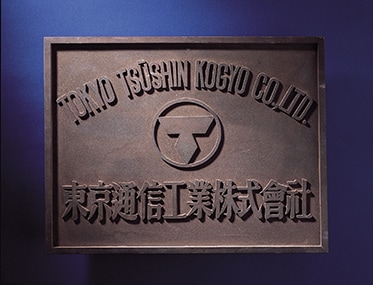
Tokyo Tsushin Kogyo Company Plaque
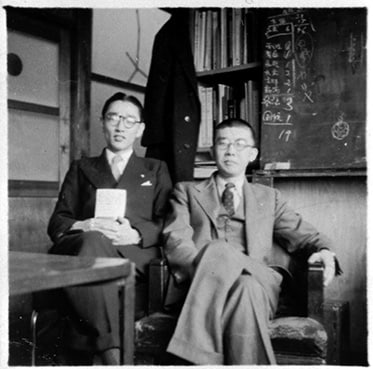
From left, Akio Morita and Masaru Ibuka (1947)
Product demand only increased moving into 1946, especially from the government for vacuum tube voltmeters. To make structuring the company and recruiting new talent easier, and since talks about forming a new company together were already on the books, Ibuka and Morita began preparing to establish the company as a stock company in full.
As much as Ibuka wanted to start working with Morita as soon as possible, however, there were several barriers in the way - the first being that Morita was still a lecturer at the Tokyo Institute of Technology at the time. Morita himself vastly preferred the possibility of working freely at the new company, so when he was alerted by Allied occupation authorities that he would be removed from his position, he quickly took the opportunity to resign. Looking forward to new challenges and with hope in his heart, Morita joined up with Ibuka and the others.
The most difficult barrier, however, concerned his family. As the eldest son of a family of sake brewers since the Edo period, Morita was obligated to inherit the business from his father, Kyuzaemon. With no choice but to meet with him directly, Morita and Ibuka, along with Ibuka's father-in-law Tamon Maeda*3, clambered aboard an overnight train bound for Aichi Prefecture's Kosugaya (current day Tokoname). The aged train car's windows were broken, and the trip was spent covered in soot.
Upon meeting Kyuzaemon, Ibuka immediately began telling of the dreams he had for this new company, and that Morita was utterly indispensable for them. In his heart, Ibuka thought that Kyuzaemon surely would not accept their plan so readily. But his response was quite a surprise:
"I have, for the longest time, always wished that Akio would succeed me and continue the family business. But if Akio thinks he needs to grow and use his skills elsewhere, that's what he should do." Then, smiling as he looked at his son, he said, "whatever it is you want to do the most, do it." Feeling a mixture of shock and relief, Kyuzaemon's three visitors rejoiced together. Now that Morita was on board, they could really begin working on forming their new company.
Tamon Maeda was chosen to become the first president of the new company, as the primary issue was capital. Maeda contacted Michiji Tajima*4, an old friend from his student days with connections in the finance world. A fellow native of Aichi Prefecture, Tajima had known Morita's family well, and welcomed the prospect of both handling the banking negotiations as well as acting as a consultant and supervisor for the company. Tajima in turn then immediately contacted chairman of Teikoku Bank (current day Sumitomo Mitsui Banking Corporation) Junshiro Mandai*5, who quickly gave his support for the new company, finalizing the company's preparations in terms of funding. Alongside Morita's father Kyuzaemon and Ibuka's former colleague Rin Masutani*6, these five men helped keep watch on the company's affairs during its formative years.
At last, on May 7th 1946, Tokyo Tsushin Kogyo (Totsuko), or Tokyo Telecommunications Engineering Corporation, was founded with one hundred ninety thousand yen in capital and just over twenty people. Upon Totsuko's foundation, Ibuka spoke thus:
"We're no match for the industry giants if we do the same things as them. But technology is full of niches for us. By doing what the big companies can't do through the power of technology, let's get to rebuilding this country of ours."
This belief - that although they may not be backed by much capital or have advanced facilities, they still had their skills and their expertise - became Totsuko's guiding principle when it formed.
Around the time Totsuko was formed, Ibuka set about penning the company's founding prospectus. This prospectus took many days to complete as Ibuka, both a manager of the business and an engineer himself, took both perspectives into mind, while also considering how Japan would proceed into the future together with the rest of the world, what satisfaction in one's employment truly entailed, what the spirit of research and engineering was, and the facilities that would be needed to foster these things. "Products which spread across the globe ultimately are born from the development of both unique technologies and harmonious connections between people," is the answer he arrived at. This ideal is exemplified in the foreword to Ibuka's prospectus:
Each of us, no matter how small the scale [of our operation] was, began this journey with great hopes and the confidence that, as long as we set forth with tight bonds between us and a strong foundation of technology, there is no storm we cannot overcome.
Indeed, the opening to the prospectus' Purpose of Incorporation leads:
- To establish an ideal factory that stresses a spirit of freedom and open-mindedness, and where engineers with sincere motivation can exercise their technological skills to the highest level
- To reconstruct Japan and to elevate the nation's culture through dynamic technological and manufacturing activities
This spirit of constructing a free, open-minded, ideal factory, where engineers could utilize their abilities to their greatest extent and contribute to culture with the power of technology became the driving force behind the creation of countless innovative technologies and products over the years - and is the origin of the Sony that exists today.
- *3 Tamon Maeda: Masaru Ibuka's father-in-law, first president of Totsuko, former Minister of Education, Science and Culture
- *4 Michiji Tajima: Second chairman of Totsuko and former Grand Steward of the Imperial Household Agency
- *5 Junshiro Mandai: First chairman of Totsuko and former chairman of Teikoku Bank
- *6 Rin Masutani: Totsuko auditor, former president of PCL (Photo Chemical Laboratory Co.)
COLUMN
Sony's DNA
The Foundation Behind Sony's Social Contribution Activities: Sony's Founding Prospectus
In a 1991 interview circulated within the company, Masaru Ibuka stated that "when we first created the company, I wrote in our founding prospectus that I wanted to contribute to society in ways outside of our work once the company got on its feet. Throughout the more than forty years since, I've always touted societal contribution as one of our business principles." One of the company's first major successes stemmed from introducing tape recorders as audiovisual learning tools for elementary and middle school classrooms across the country. To pay back this debt, Ibuka established the Sony Fund for the Promotion of Science Education in Japan in 1959, beginning Sony's support for advanced scientific education in elementary schools. The fund then moved to include middle schools two years later, continuing today as the Sony Education Foundation. Ibuka also began initiatives assisting people with disabilities early on, forming the social welfare NPO Kibo no Ie ("House of Hope") in 1973 and the subsidiary Sony Taiyo, a company specifically employing disabled individuals, in 1978. While expanding employment opportunities for people with disabilities began picking up steam as a social movement by the time Sony Taiyo was founded, Ibuka pushed for further integration and independence for disabled individuals in society through giving them opportunities to truly succeed. "Create workplaces that do not offer charity, but rather create an environment that makes it possible for individuals with disabilities to manufacture products that exceed those manufactured by individuals without disabilities." This idea is still held as a core belief behind Sony's employment of individuals with disabilities.
- * This phrasing reflects Ibuka's belief that though there are "able-bodied" individuals who don't present noticeable disabilities, no person is healthy at all times.

Part 3 A Bitter Struggle for Funds
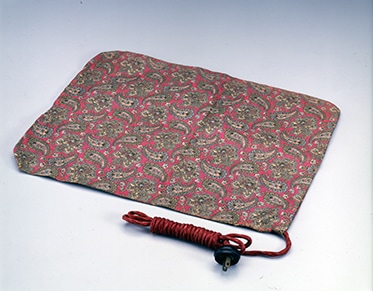
Electrically heated cushion (1946)
Each day after Totsuko's founding kept everyone busy late into the night, and the room atop Shirokiya was beginning to feel quite cramped after not even a month had passed.
Around that time, an order for fifty vacuum tube voltmeters came in from the then-named Ministry of Communications. Vacuum tubes were nowhere to be found on the market, so the only choice was to travel all around the Kanto region, finding people selling the tubes from old military stockpiles on the grey market. The tubes' quality and specs were inconsistent at best, and being able to use even half of the acquired stock was considered a decent rate. The assembled voltmeters needed to undergo Ministry-approved testing as well, and Totsuko had neither the space nor the equipment to conduct the tests. Again faced with no other choice, after gaining approval from a Ministry research laboratory, Totsuko employees carried the assembled voltmeters by hand, one by one, person by person, from Totsuko in Nihonbashi all the way to the laboratory in Higashi Gotanda for testing.
Soldering irons, screwdrivers, and all the other necessary equipment were made by hand; wiring was taken straight from old telephone wires.
The hurdles did not end there. Soon enough, Totsuko received a notice from Shirokiya asking them to vacate the premises once their lease expired. Ibuka and Morita scrambled to find another location for their facilities, but a suitable replacement for the Shirokiya office was hard to come by. With some help from their associates, they were finally able to acquire a factory location in Kichijoji, but this location too was quite small, so they chose to also rent part of a separate factory in Mitakadai. Amidst the continuing post-war confusion, however, the right place to move their office was still to be found.
Among all of this still, the greatest struggle for the fledgling Totsuko was securing funding. Although they had sought a meeting with the head of lending at Teikoku Bank, where Mandai was Chairman, the sudden call was mistaken for a cold call from an enterprising businessman and was left unanswered.
Desperate to increase their total capital to six hundred thousand yen, Ibuka and Morita did what they could in the meantime, with Morita paying another visit to Chairman Mandai for a loan in June 1946, and Ibuka asking his old acquaintance, author Kodo Nomura*7, to invest in the business in October of the same year. Such strict circumstances were not only because of Totsuko's recent founding, but also due to the Emergency Financial Measure Ordinance issued in February 1946, putting restrictions on bank withdrawals in order to curb inflation, while simultaneously attempting to convert the nation's old currency to the "New Yen." Since withdrawals on the funds Totsuko was receiving from its government contracts were restricted, Totsuko had to find a way to acquire New Yen capital by selling a product directly to consumers.
For this purpose, Ibuka designed an electrically heated cushion simply by gluing a grid of thin nickel-chromium wires in between two layers of Japanese paper and attaching a cord. Since Totsuko had no access to textiles, they used fabric meant for book covers as a substitute for the cushion cover, and employees' families worked together to sew the cushions and stitch the cords properly. Since they didn't dare put the Totsuko name on these cushions, Ibuka created "Ginza Nessuru Shokai," or the "Ginza Heating Company" as a cover name to sell the cushions - which flew off the shelves simply for being something in a time when there was nothing. Despite this, the cushion was a problematic product, often burning blankets or leaving scorch marks on futons. In an era when voltage would rise at night as people went to bed because of the rudimentary power grid, Ibuka started losing sleep worrying if the cushions would catch fire.
Still, Totsuko did manage to make some proper products as well. Using scrap iron salvaged from the city's wreckage, Totsuko's record player parts were praised for their good sound quality, and production began on the Clear Voice product line.
Although sales were beginning to look up, the problem remained of finding a new office. Just when they were about to be evicted from the property, Kazuo Iwama, a relative of Morita who joined the company through their relation, secured a thirty-three square meter (about 355 square feet) building through a tip from his uncle. With this, Totsuko's move to the Tokuya Building in Ginza was decided.
- *7 Kodo Nomura: Author and creator of the Zenigata Heiji character
Part 4 To Gotenyama, Shinagawa
Not long after moving offices to Ginza, a new job came in from the NHK (The Japan Broadcasting Corporation). Japan's communications networks were in ruin after the war, and the NHK's facilities were no exception. Urgent to rebuild, they had started repairs on their studios while also looking to reinstall their national network of relay broadcast radio stations. Totsuko's ability to accommodate engineering design changes on the fly, as well as their flexibility when it came to costs made them the logical choice.
Combined with their previous government contracts, the NHK assignment seemed like it would solve Totsuko's financial situation for the time being - but just as this assignment arrived, however, they were hit by yet another eviction notice, this time at their Mitakadai factory. The factory's owner was evidently planning to expand his own business into that section. It was just as well, however, since having Totsuko's factories and office split across three distant locations was both inconvenient and expensive. Finding themselves once again searching for properties in the cold winter air of 1946, Ibuka and Morita talked between themselves of how wonderful it would be to finally have one factory where everyone could work together.
At long last, the two located an old factory in Gotenyama, located in Tokyo's Shinagawa Ward. The factory was in a rough state - holes dotted the floor all around, and you could even see the stars through gaps in the ceiling - but Ibuka and Morita were simply relieved to find a place they could finally stay.
In January 1947, Totsuko's office and two factories were consolidated into this Gotenyama location. Speaking before all the employees, Ibuka said, "This is a time not of plenty, but of scarcity. Were we to sell our items on the grey market, or through other such channels, perhaps we could make a little more money. And were we to do so, perhaps we could work somewhere with better conditions, or better facilities. But that is simply not what we want to do. We are here for one purpose: to pave the way for new technologies that will change and benefit the world, no matter the struggle. It is my foremost desire for you all to join me on this endeavor." This feeling was shared not only by Ibuka, but by every individual standing in the factory that day.
Newly motivated by having everyone together in one place, Totsuko's employees promptly began challenging themselves to create things others wouldn't dare to, and quickly developed a wide range of products. One prominent example was the "Power Megaphone" which used a carbon microphone in place of a vacuum tube. Commonly used by politicians to give speeches on the street, the all-purpose megaphone sold well due to its versatility. Other example products include the Tone Generator Type-2, which made transmitting and receiving telegram signals easier, as well as a teleprinter that recorded electronic signals on paper tape, which never made it to market.
It was around this time that yet another large assignment came in from the NHK: this time, they wanted Totsuko to remake their mixing console. American occupation forces had operated their own broadcasts since the occupation period began, and the NHK needed to reconfigure their studio to operate according to American broadcast standards. Thus, in June of 1947, the mixing console and its related equipment were delivered to Totsuko from Studio Nine at NHK's Tokyo Broadcasting Center (located in Uchisaiwaicho in Chiyoda Ward at the time) and work began on renovating the system. Totsuko succeeded in renovating the console, resulting in more and more assignments coming from the NHK in the future.
Repairs to NHK's studios across the country, including their Tokyo studio and their Tokyo and Osaka-based occupation broadcast studios, were entrusted to Totsuko. Although Totsuko was already busy before, their workload had been raised to a new level with the NHK assignments, and many nights were spent working in the factory. Work on mixing consoles from the NHK did, however, give Ibuka and the others priceless knowledge and experience with audio technology, something that would become a crucial stepping stone for Totsuko's future.
Despite the increasing work, however, the banks were still quite unwilling to lend Totsuko funds. Rushing to collect from their clients, Totsuko's struggles with capital would not be solved for quite some time. Towards the end of 1947, a large order came from the Ministry of Communications for one hundred double balance telegram terminals for eight hundred thousand yen, but the biggest question on everyone's mind was when the money would actually arrive - as if it arrived before payday on December 25, then it could go to employee paydays and bonuses that year. The entire factory got together for the job and managed to ship the order on December 23, but over ten different types of signatory stamps were required to get things approved, and the payment deposit was not expected to finalize until half a month later. But given that it was the end of the year, approval was ultimately granted, and employees were sent home happily with their month's pay and bonuses by the end of the day. Although the business continued scraping by with profits on paper but little real capital, in October 1947 Totsuko managed to record 3.53 million yen in sales, with fifty thousand yen in profit, and distributed its first dividends to its sixty-two shareholders for the year.
As Totsuko's number of products grew, the remaining factory space continued to shrink - and so in 1949, another two-story wooden factory building was constructed on a small plateau in Gotenyama, lovingly named the "factory on the hill." Although the business itself was still just scraping by, Ibuka felt as if he had just finished building his own home as he gazed upon the new factory building. Totsuko's business partners and longtime supporters gathered at the factory's opening reception, including Mandai, Maeda, and Kodo Nomura, totaling a crowd of two hundred.

From left: Higuchi, Iwama, Ibuka, and Morita at the Gotenyama Factory (1947)
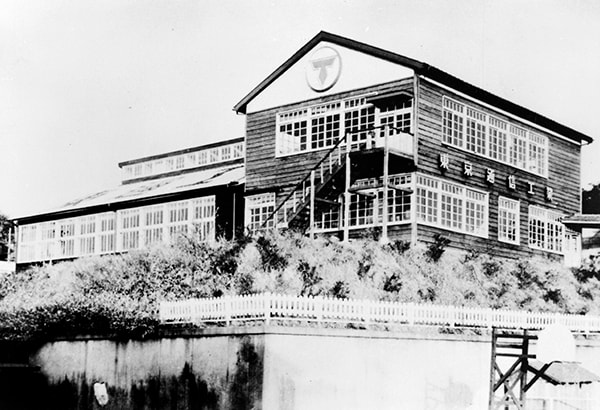
The Factory on the Hill (1949)
COLUMN
Sony's DNA
The Employees' Highlight of the Day: Lunch
In an era of frequent food shortages, companies that provided fresh rice to its employees were few and far between - making lunch a daily highlight for Totsuko employees. Since Totsuko was split between its Ginza office and its Kichijoji and Mitakadai factories, rice would first be made at the Ginza office, then loaded into backpacks and carried onto the crowded and shaky trains to be delivered to the factories. Once noon arrived, factory employees would get out the side dishes they had brought from home, and would reportedly shout from the windows "is the rice here yet?" Through prioritizing its employees, such as by providing these lunches, Totsuko's solidarity became ever stronger.

Photo from a Company Vacation Celebrating the Company's Founding to Misaki, Kanagawa Prefecture (1947)