Pursuing accessibility to enable and empower individuals of all abilities to share Kando
As part of Sony Group's long-term Creative Entertainment Vision, which outlines what Sony aspires to achieve over the next decade, the company has identified "Boundaries Transcended" as one of the vision's key phases-aimed at connecting diverse people and values across boundaries and fostering inclusive communities.
In line with this vision, Sony Group is advancing a wide range of accessibility initiatives to ensure that people of all ages and abilities, regardless of individual characteristics or circumstances, can enjoy its products, services, and entertainment.
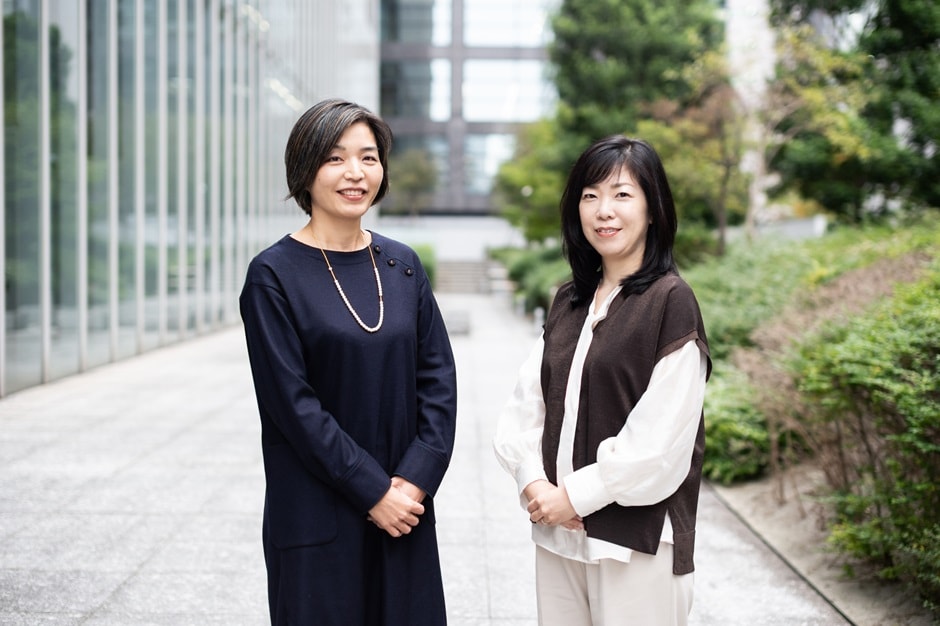
To learn more about the specific efforts being made to create an inclusive future where individuals of all abilities can fully express themselves and share Kando (emotion), we spoke with Mitsu Shippee and Aya Nishikawa of the Sustainability Department, which leads accessibility initiatives across the Sony Group.
Contents
Contributing to the realization of an inclusive society for the future
-Can you please start by telling us why Sony Group is focusing on accessibility?Shippee: Sony Group conducts business based on its purpose, which is to "Fill the world with emotion, through the power of creativity and technology." Approximately 1.3 billion people around the world, which actually corresponds to one in six people, have some kind of disability*, and that number is expected to continue growing in the future due to factors such as aging of the global population. Faced with this reality, we want to contribute to the realization of an inclusive society by enhancing accessibility through a variety of businesses.
* Source: "Global report on health equity for persons with disabilities: executive summary (who.int) Population ages 65 and above, total | Data" (worldbank.org)
Nishikawa: At the same time, we recognize accessibility as an important area that contributes to our business. Presuming that "we can't make our products usable to people with disabilities" is not only a form of discrimination or prejudice but will also lead to missed business opportunities. I believe that Sony's role is to make our products and services more accessible so that more people, with or without disabilities, are provided with opportunities to share Kando.
Shippee: To make this intention clear both within and outside Sony Group, we've formulated a common message for accessibility: "Delivering innovation for an accessible future." In addition, we don't define accessibility as just consideration for people with disabilities and the elderly, but rather as "the ability to use and enjoy products, services, and entertainment regardless of age, disability or other personal characteristics, capability, or environment." We're addressing accessibility on a Group-wide and global basis while leveraging the uniqueness and strengths of each business.

-What specific steps are you taking to make Sony's products and services more accessible?Shippee: We're working to develop environments and mechanisms that will instill the importance of accessibility in everyone, from management to each and every employee. First, as a foundation, we give many employees opportunities to actually experience inclusive design, to foster not only understanding of the importance of accessibility and inclusion but also working environments that will bring about realizations. Inclusive design is an approach in which diverse users, especially those who require accessibility such as elderly people and people with disabilities, participate from the planning, design, and development stages to involve their input in the development of products, services, entertainment, and working environments.
Nishikawa: Once the foundation for this kind of working environment has been solidified, it's time for the next stage, the development of mechanisms. We develop and apply attainment criteria for group-wide accessibility initiatives while also regularly reporting to management and updating our measures through exchanges of views. As a new direction, Sony now incorporates inclusive design into its product commercialization process. We also include specific accessibility requirements in medium-term plans and business plans for each business segment in order to implement accessibility more systematically. Through these cumulative efforts, we create accessible products, services and entertainment apply them to contributing to society through our business.
Creating new value through inclusive design
-You mentioned placing an emphasis on inclusive design to improve accessibility. Could you tell us why that's important?Shippee: Inclusive design is a methodology that allows us to understand the needs of people with disabilities and the elderly and also makes us aware of "overlooked inconveniences." This is against the backdrop of our modern society, in which people's needs are becoming more diverse and complex, and conventional product development, which is based on the needs of majority (average) users, is no longer adequate. At first glance, the needs of people with disabilities and the elderly might seem different from those of majority users, but Sony believes that by addressing these needs and barriers, it is possible to identify essential needs that will lead to increased value for many people.
Nishikawa: While Sony's approach is based on making products for majority users more convenient for users with disabilities as well (lefthand diagram below), we also actively implement inclusive design inspired by realizations gained from users with disabilities (righthand diagram below). When you think about it, there are things we routinely use these days like computer keyboards and movie subtitles that were developed based on realizations gained from the perspectives of people with disabilities but have become widely adopted by everyone. The needs of users with disabilities can serve as a starting point for creating new value.
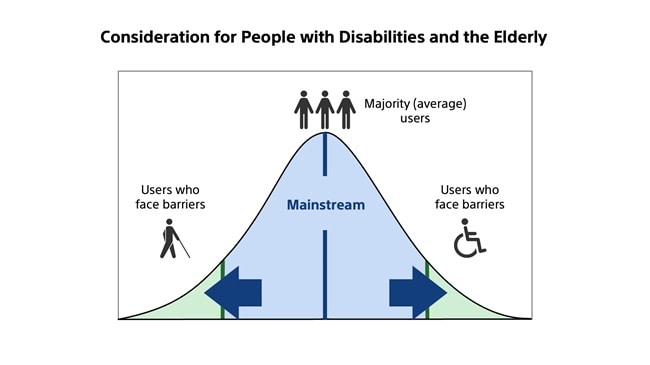
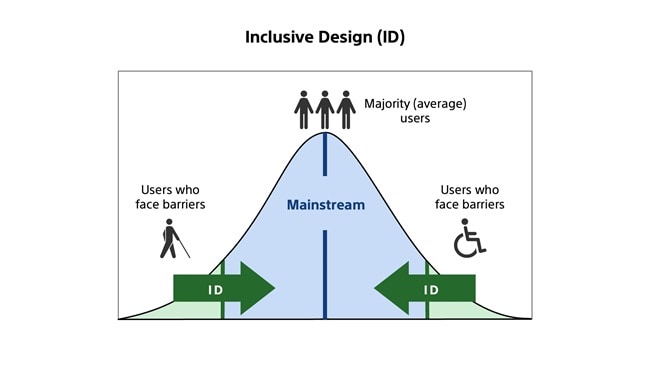
Created based on a lecture by Professor Yasuyuki Hirai in the Kyushu University Faculty of Design. The lefthand diagram depicts conventional product development, in which products for majority users are made more convenient for users with disabilities as well. The righthand diagram depicts inclusive design, a development approach in which products that also have value to majority users are created based on the needs of users with disabilities.
-What kinds of activities are involved in putting inclusive design into practice?Shippee: It involves discovering "overlooked inconveniences" while observing the behavior of users with diverse needs, such as the elderly and people with disabilities, to gain new realizations from the barriers they face. However, it's important to note that if you immediately come up with solutions at this stage, those solutions will have too much of a philanthropic component and tend to be unsustainable in business terms. By reframing the inconveniences in the context of our own daily actions, we can extract essential problems that affect everyone. Our approach to inclusive design is to try and solve those problems through the power of creativity and technology.
Nishikawa: Let me explain those steps in more concrete terms using the example of taking photos with a smartphone, Xperia™. This inclusive design was inspired by observing the everyday experiences of an employee with low vision. While walking around with the employee, the smartphone developers learned that she frequently takes photos to communicate with her family and friends. The developers also realized that because she brings her face very close to the screen when taking photos, she can't check the overall composition of the shot. Reframing this inconvenience in the context of their own daily actions, the developers envisioned situations such as holding their smartphones high and taking photos without looking at the screen when there is a crowd of people lined up in front of them. This made the developers realize that the difficulty of taking photos without looking at the screen is a problem to be solved for everyone, not just people with disabilities. They applied that realization to the development of a feature that helps users take photos by notifying them via sound when the smartphone is tilted and when it is level.

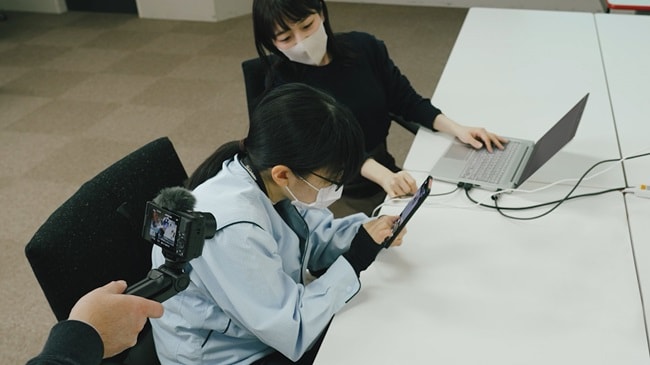
An employee with low vision takes a photo with a smartphone (left), and a smartphone developer and an employee with low vision verify (right).
Shippee: We hold workshops so that employees can experience the value of this kind of inclusive design. Over 2,500 employees, including management, have participated in the workshops to date. The participants are not just employees involved in product development but also other areas. They form mixed teams with people with various disabilities to conduct fieldwork. Sony positions these activities as a highly important measure, and they have borne fruit in recent years, with cases of accessibility being implemented in a variety of businesses.
Sony Group's inclusive design examples:
An era in which accessibility gives companies a competitive edge and benefits users
-How do you plan to expand your accessibility initiatives moving forward?Nishikawa: Earlier, I mentioned that accessibility contributes to our business. I believe that this tendency is going to become even stronger going forward. One example is Sony's seating management solution, SEATouch. We implemented inclusive design involving employees with visual disabilities to develop an app that is easy for anyone, including people with visual disabilities, to use. During sales, there were companies that decided to adopt it because the inclusive design story itself resonated with them, in addition to the accessibility considerations. We also recently heard from a customer, "When choosing between Sony and other manufacturers, I prefer Sony because of your commitment to accessibility and inclusive design." In light of this growing interest, we feel confident in pursuing accessibility even further.

-Lastly, do you have a final message you'd like to share with our readers?Shippee: Our society is made up of diverse individuals, including people with disabilities and the elderly. As long as accessibility is inadequate, there will be people who can't realize their true potential or achieve what they want to achieve. Our goal is to develop products, services, and experiences that will allow these diverse individuals to interact, circulate, and participate fully in society. That's why we'll continue to actively practice inclusive design, develop working environments that pursue accessibility, and create and share products, services, and experiences that everyone can use and enjoy. These things cannot, however, all be accomplished by Sony alone. As more individuals and organizations join us in championing and strengthening accessibility, we hope to bring benefits both to the realization of an inclusive society and to our partners' business.
Mitsu Shippee
Senior General Manager, Sustainability Department After working at a private foundation, Mitsu joined Sony in 2000, and has since been involved in the company's sustainability and CSR initiatives, which include planning and implementing joint projects with UN agencies and NGOs. She has held her current position since 2021.

Aya Nishikawa
General Manager, Accessibility & Inclusion Section, Sustainability Department As a certified human centered design professional, Aya has been involved in the operation and implementation of user research schemes globally within the company. Currently, she is dedicated to promoting accessibility and inclusive design throughout Sony.