In Celebration of Earth Day — Sony's Commitment to Renewable Electricity Adoption

Keiko Shiga, General Manager, Environment Section, Sustainability Department, Sony Group Corporation (right), Narin Yamada, Sustainability Communication Team, CSR Section, Sustainability Department, Sony Group Corporation (left)
Every year on April 22, Earth Day provides people around the world with the opportunity to think again about the importance of protecting the global environment, each in their own way. Established in 1970 following an oil spill in the United States, Earth Day marks its 55th anniversary this year, with over one billion people expected to participate in events from 192 countries and regions.
The official theme for Earth Day this year is "Our Power, Our Planet™." This message underscores the global goal of tripling the adoption of renewable energy by 2030 so that everyone can enjoy a healthy, sustainable, equitable, and prosperous future.
Aligned with this theme, a second-year Sony Group Corporation employee Narin Yamada of the Sustainability Department sat down for an interview with Keiko Shiga, who leads the department's Environment Section, to discuss Sony's environmental initiatives and progress in adopting renewable electricity.
Contents
Sony's Environmental Initiatives Since the 1970s
Yamada: I've always had an interest in sustainability, and in my current role. I'm engaged in communicating Sony's sustainability initiatives in a way that's easy for everyone to understand. Thank you for joining me today.
Shiga: Thank you for having me. Environmental topics are often seen as complex, so I hope we can have a clear and accessible conversation today, drawing on your perspective.
Yamada: Back when I was a student, I didn't associate Sony strongly with the global environment, but in fact, Sony has been addressing them from quite an early stage, hasn't it?
Shiga: That's right. Sony began its environmental efforts relatively early—in the 1970s. In 1976, we established the Environmental Conference chaired by then-President Iwama, with the aim of preventing pollution at our sites in Japan. In 2010, Sony also announced its global environmental plan "Road to Zero," and we are currently working on environmental activities in line with this plan.

Yamada: What exactly is "Road to Zero"?
Shiga: It's a global environmental plan that aims to achieve a zero environmental footprint throughout the life cycle of Sony's products and business activities by the year 2050. We asked ourselves what Sony can do to ensure people can lead enriched lives in the future. Based on that, we established goals in four key environmental perspectives—climate change, resources, chemical substances, and biodiversity. We are working to reduce our environmental footprint to zero in all of these perspectives. To steadily achieve this goal by 2050, it's important to use backcasting and determine what needs to be done by when. That's why we also set medium-term environmental targets every five years.
Currently, we're working under our medium-term targets "Green Management (GM) 2025," which covers the period from FY2021 to FY2025.
Global Initiatives Toward 100% Renewable Electricity
Yamada: This year's Earth Day focuses on renewable electricity. Could you tell us about Sony's initiatives and progress in this area?
Shiga: At Sony, we are engaged in diverse businesses and our ability to continue these activities is based on the existence of a society where people can live with peace of mind, and a healthy global environment. For this reason, the adoption of renewable electricity is a critical issue for us. One of our goals is to power all of our business sites with 100% renewable electricity by 2030. In fact, our sites in Europe switched to 100% renewable electricity as early as 2009—before we even launched our Road to Zero plan. Our sites in China also made the switch in 2020, and we are continuing to expand the use of renewable electricity in other regions as well.
Yamada: I didn't know that our sites in Europe and China had already transitioned to 100% renewable electricity! Are there any other specific initiatives for renewable electricity?
Shiga: Sony is a member of RE100, a global initiative of companies committed to using 100% renewable electricity in their business operations. The initiative defines its global criteria, and purchasing renewable electricity which complies with the criteria helps Sony to utilize reliable one. In addition, connecting with other companies who share the same goal significantly supports our efforts to expand renewable electricity use.

Yamada: What is the current renewable electricity adoption rate across the entire Sony Group?
Shiga: As of FY2023, approximately 35.3% of the total electricity used at our business sites worldwide comes from renewable sources. Initially, we had set a target of 15% by FY2025, so we're actually ahead of schedule.
Yamada: Sony runs a variety of businesses, so what specific methods are being used to introduce renewable electricity?
Shiga: We tailor our approach depending on the country or region, using methods such as installing solar power systems at business sites, purchasing renewable electricity from power companies, and using renewable energy certificates. For solar power, for example, we've installed systems at various business sites around the world, including Sony Pictures Studios in Culver City, California, USA; the Sony DADC Europe plant in Thalgau, Austria; the Sony Technology (Thailand) plant in Chonburi, Thailand; and the Kumamoto Technology Center of Sony Semiconductor Manufacturing Corporation in Japan.

Sony Pictures Studios in Culver City, California, USA

The Sony DADC Europe plant in Thalgau, Austria
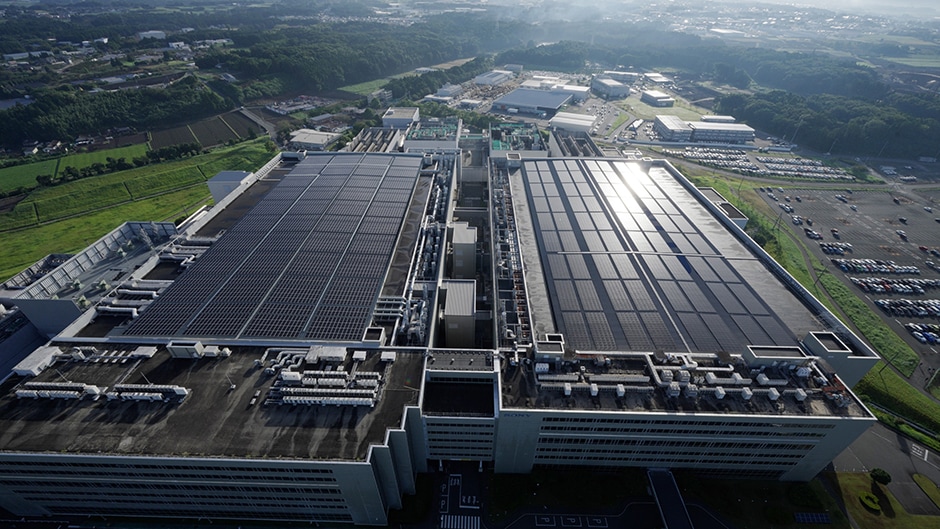
The Kumamoto Technology Center of Sony Semiconductor Manufacturing Corporation in Japan

The Sony Technology (Thailand) plant in Chonburi, Thailand
Yamada: I love watching movies, so it's really exciting to hear that Sony Pictures Studios is also using renewable electricity. Knowing that renewable electricity might be used in the process of making the Sony products and services I use every day makes it feel a bit more personal!
Shiga: Exactly. Renewable electricity can seem like a difficult or distant concept, but it's actually being adopted in many places, not just at Sony. It's quite interesting once you start looking into it.
Toward Further Adoption of Renewable Electricity
Yamada: Earlier, you mentioned that Sony's sites in Europe and China have already switched to 100% renewable electricity. Does that mean there are still sites in other countries or regions that have not yet achieved this? Are there any challenges to further expanding renewable electricity use?
Shiga: Electricity from renewable sources tends to be more expensive in Japan compared to Europe and the U.S. This presents a challenge when trying to implement it at Sony's sites in Japan. However, as I mentioned earlier, we are continuing to increase the use of renewable electricity by combining various approaches—such as installing solar power systems, purchasing renewable electricity from power companies, and using renewable energy certificates. At the same time, we are also promoting energy conservation efforts to reduce overall energy consumption. When it comes to tackling climate change, it's essential to start by reducing energy use, and then use renewable electricity for the energy needs we cannot eliminate.
Yamada: So, the aim is to balance both energy-saving efforts and renewable electricity adoption. I also heard that preparations are underway for Sony's new medium-term environmental targets, GM2030, covering FY2026 to FY2030. Will further renewable electricity adoption be included in that plan?
Shiga: Yes, I mentioned that Sony sets five-year medium-term environmental targets to achieve our Road to Zero plan, and under the current GM2025 targets, about 70% of the targets are progressing as scheduled as of the end of FY2023. We are now formulating GM2030, which we aim to unveil around this fall. It will include further expansion of renewable electricity use, of course, but we will also focus on reducing absolute greenhouse gas emissions and accelerating the use of recycled resources.
Yamada: It's great to hear that Sony will continue to drive forward its environmental initiatives. Thank you very much for your time today.
Shiga: Thank you as well.
Keiko Shiga
General Manager, Environment Section, Sustainability Department, Sony Group Corporation
Keiko Shiga joined Sony in 1992 and was engaged in reliability testing and development. Since 2007, she has worked in environmental management systems and environmental information disclosure. She has held her current position since 2020.

Narin Yamada
Sustainability Communication Team, CSR Section, Sustainability Department, Sony Group Corporation
Narin Yamada joined Sony in 2024 and is responsible for internal and external sustainability communications, including employee seminars and internal newsletters.