May 13, 2025
Bringing lasting change to society through accessible technology
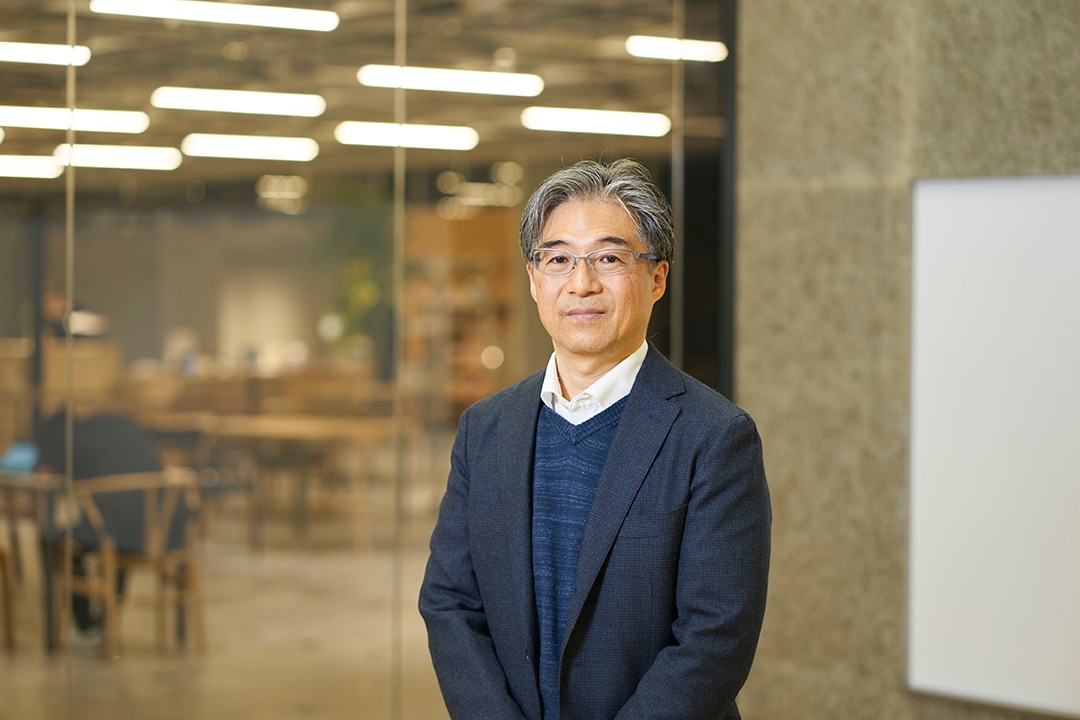
Distinguished Engineer Kazuyuki Yamamoto leads technological innovation across the Sony Group in the areas of interaction and accessibility. We sat down with him to discuss his career and passion for technology.
-
Kazuyuki Yamamoto
Distinguished Engineer
Sony Corporation
Bringing “lasting change” to society is what it means to “be useful”
──Please tell us about what made you join Sony. What did you study during your university years?
When I was a student, I majored in mechanical engineering and worked on the development of microrobots. At that time, I had a vague idea that I wanted to “be useful to the world” when I ventured out into society in the future, but when I started thinking about getting a job, I decided to think more specifically about what “being useful” meant to me. I wanted to give form to ideas, provide them to the world, and bring about “lasting change” to the society, even if just a little. I wanted to work at a place where I could realize that vision.
I continued to redefine what it means to “be useful” as I progressed in my career. Today, “being useful” to me means building products and experiences that bring value to people, and to foster positive change in the world, even if the change is gradual. This has become a compass for how I live my life.
Early in my career, I was drawn to Sony's corporate culture because it valued big challenges, and I felt that I would be able to “be useful” there. I also received support from my professors and senior colleagues, who told me that Sony is a good fit for people who value freedom so I decided to join Sony.
──What have you worked on since joining Sony?
I joined in 1992, and my first placement was in then Corporate Research Laboratories. The topic of my research was the fundamental technology of high-density magnetic recording. At first, it seemed mundane, but as I understood the depth of the technology, I became fascinated with it, and I arrived at work earlier than anyone else every day to immerse myself in its development.
Meanwhile, as development progressed, I had a hunch that if a high-speed, digital recording device, became available to consumers, the user interface (UI) for this device would surely evolve. For example, I thought that if this were introduced into VCRs, the way recordings are scheduled would change. I used to record weekday TV shows and watch them all on weekends, but I was dissatisfied when sports broadcasts would often be extended, and the programs would not be properly recorded. Combining that seed of desire to evolve the UI and address the technology’s shortcomings, I came up with a system in which the user could select the program they wanted to record from the program guide on the TV screen and schedule the recording not by time slot but by program unit. This is the fundamental principle behind today’s electronic program guides.
At the time, in Corporate Research Laboratories, there was a project for patenting ideas that held promise to be useful 10 years in the future even if they were unrelated to one’s current work. I submitted the electronic program guide. As a result, we were able to obtain the basic patent, and the electronic program guide was later introduced to nearly all televisions and VCRs. This was my first successful experience bringing lasting change to the world. This comes from the philosophy of coming up with ideas by thinking about what problems people are facing, what would make them happy, and how we could change the world as a result, then connecting these ideas with the seeds to make them a reality—in other words, the idea of “being useful.” I maintain this philosophy to this day.
Around 2004, a future where consumer devices could be computerized became clearly visible. As a result, the way these devices were operated would also begin to resemble computers. However, introducing a complex computer UI into consumer devices was difficult, and I thought it would be necessary to introduce a more intuitive UI, so I switched my focus to interaction technology development.
I believed that technologies such as haptics (tactile feedback), acoustic AR (augmented reality), and operational input using inertial sensors would be needed in the future, so I started developing them. After more than 10 years of twists and turns, as a result of developing these together with our research and development team and business unit, we have been able to bring these products to the world in the form of the DualSense wireless controller; the Sound AR service Locatone™, a new acoustic experience that blends the real world with sounds of the virtual world; controllers for industrial head-mounted displays; and an Xperia™ vibration system that links to sound.
Up until this point, the main theme of development had been interactions between humans and machines, but now we are also focusing on human-to-human interaction via the internet and virtual spaces. For example, why is there now a trend back toward working in the office after telework became so widespread during the COVID-19 pandemic? We want to identify that root cause and find a solution in virtual space.
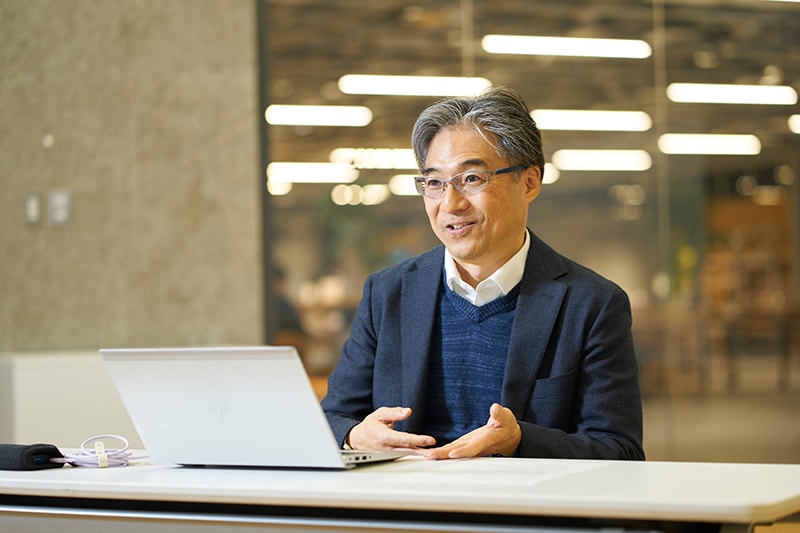
Intuitive UI
──Could you also tell us about another major development theme for you, accessibility? What are you working on within this area?
My starting point with accessibility was the revision of the Sony Group Code of Conduct in 2018. Sony has established unified standards for accessibility, but we took this one step further and incorporated a technological perspective that makes what was previously impossible possible, and we started development with the idea that Sony's technology could be useful.
Volunteers, including employees with disabilities, gathered from multiple departments. This included team members from design, R&D and accessibility promotion. We carried out intensive discussions about areas where Sony could make unique contributions to the field of accessibility. The theme of extending vision and hearing was determined as a key priority that aligned with Sony’s strengths. An idea was born that Sony, with its expertise in sound and video, could create something that would enable people both with and without visual or hearing disabilities to have fun experiences together. This also perfectly matched my philosophy of “being useful.”
The keyword is “Intuitive UI.” The idea is to apply video and audio technology to substitute for senses that cannot be experienced, thereby enabling intuitive understanding. For example, we have been researching whether it is possible to apply the haptic technology for people with hearing disabilities, substituting haptics for sound by providing tactile stimuli (broadband, highly dynamic range vibrations) that are similar to sound as physical phenomena and in sensory reception.
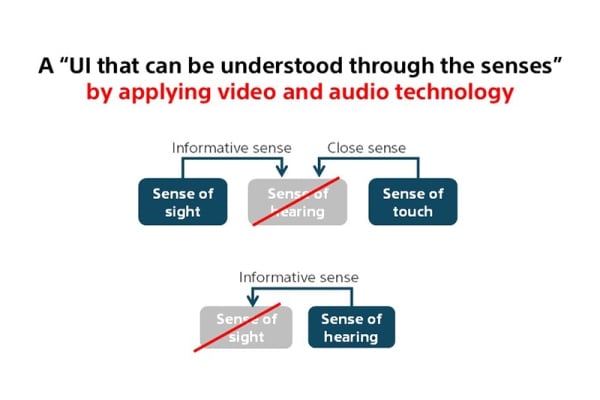
“Intuitive UI” Substitution modals
Additionally, based on the hypothesis that three-dimensional sound can help people understand a space even in situations where they cannot rely on vision, we created a space where people could experience auditory information as a substitute for vision using technologies such as acoustic AR. By using a system that simulates the experience of various spaces in darkness, such as an elevator, a basement, or a cave, we created an experience that everyone can enjoy, regardless of whether they have a disability. As part of this series of experiences, we planned a music session that people with hearing disabilities could also enjoy by transmitting the sounds around the handles they gripped as vibrations.
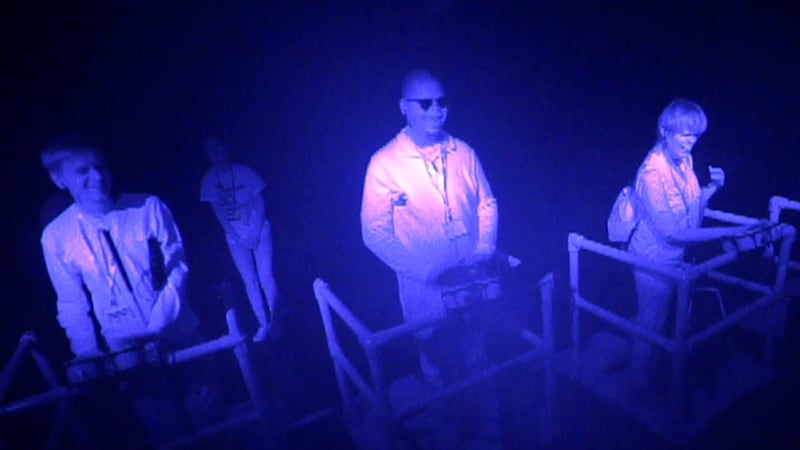
An experiential exhibit where visitors could enjoy Sony's audio and haptic technology in the dark without relying on their eyesight was unveiled at SXSW (South by Southwest) festival in 2019.
Understand intuitively and enjoy the experience
──What are the characteristics of Sony’s accessibility development?
In my understanding, while the goal of accessibility is generally to “transmit and receive information,” Sony also aims to “transmit and receive senses.” I think this is a big difference.
Sony is a company providing entertainment that people can feel and enjoy. In addition to “being useful,” we strive to create experiences that can enrich people’s lives.
At Sony, we are dedicated to implement inclusive design into our product commercialization process. I am involved in running training sessions for engineers to put this into practice, and I make sure to convey that this is not simply an obligation, but rather a challenge that engineers can become passionate about.
In fact, many great products have emerged that have overcome challenges. For example, the Access controller enables players with disabilities to enjoy games, more comfortably through a highly adaptable controller. Other products that have been put into practical use include the Wireless Handy TV Speaker, which makes it easier to hear clearly by outputting TV sound from a speaker in the user’s hand; the LinkBuds, which use a ring-shaped driver unit that allows the user to clearly hear surrounding sounds even when wearing earphones; and the Retinal Projection Camera Kit, which projects images directly onto the retina when taking photos with a camera. One product currently in the development stage is the Hug Drum, a "yuru" musical instrument ("yuru" in Japanese meaning free, generous, flexible, and approachable, amongst a range of other nuanced meaning). At Sony, various departments, including business, technology development, and design, are committed to creating products and experiences that take accessibility into consideration.
Making accessibility a sustainable business
──Moving forward, what would you like to work on in the field of accessibility?
As a company that creates an interface between people and content, Sony pursues accessibility that enables everyone to have fun, focusing on senses and experiences. Moreover, Sony's audio and video technologies have the advantage of being well suited to accessibility. With that in mind, I believe we should be able to provide accessibility in ways unique to Sony.
The third Thursday of May every year is Global Accessibility Awareness Day (GAAD), a day for talking, thinking, and learning about accessibility. This year, it will be on May 15.
Sony wants to convey a vision of a future in which everyone can enjoy experiences, regardless of whether they have a disability, through technology that enables people to do things they couldn't do before. Although there are still technical limitations and areas where our ideas have not caught up, we want to bring lasting evolution.
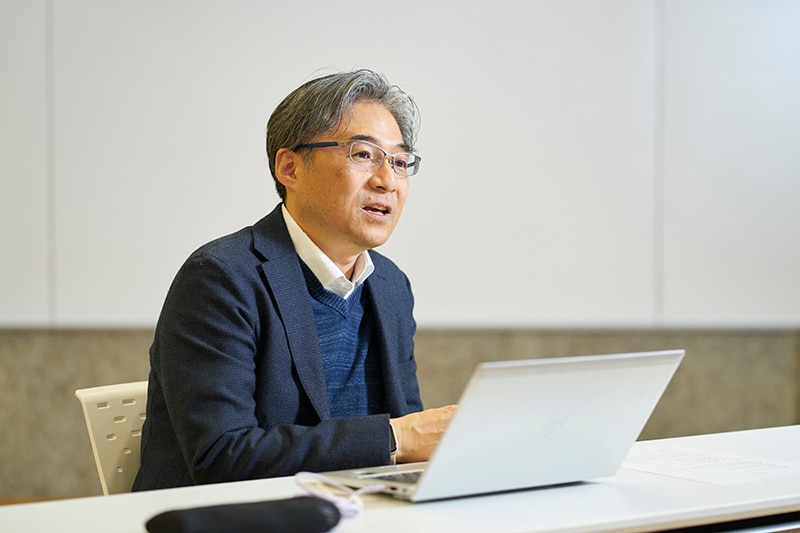
I believe that in order for accessibility to contribute to business, it needs to have sustainable growth, and this is the most difficult part. The key to success is whether it leads to a more enjoyable and rich experience for everyone. If we can break through this barrier, I think a huge world will open up in a few years.
Thinking about what users want and what they will want to continue using
──Tell us about the principles you think are important as an engineer and how you come up with your ideas.
As I mentioned before, I spend literally all day thinking, “What do users want and what is something that, once they use it, will be so convenient, easy to use, and enjoyable that they won’t be able to go back to not using it?” Once I've discovered that, then I think about the technology best suited for it, and if it requires skills that I don't have, I acquire them. My original area of expertise was mechanical engineering, but I felt that interaction would be the next technology to change the world, so I studied it from scratch. I think that kind of attitude is important.
──How do you feel about Sony as a workplace?
This is my personal experience, but Sony is a company that really listens to the proposals of new employees. If an idea is interesting or a proposal is convincing, Sony embraces it. I myself was enabled to obtain a patent for the electronic program guide I had come up with while also pursuing my main work in magnetic recording development.
Now, with the intent of giving back, I support young employees by listening to their unexpected and unique ideas, encouraging them to pursue their own side projects, and connecting them with key people within the company if necessary. I myself used to utilize my managers’ connections to meet with those key people, make heartfelt presentations to them, and ask for their advice. I would like to pass that environment on to the next generation as well.