
Effective in removing PFAS (organic fluorine compounds)
Triporous™ shows superior adsorption ability for PFAS (Per- and Polyfluoroalkyl Substances).
What is PFAS?
The PFAS structure comprises fluorine atoms that are bonded to carbon chains (e.g., CF2 and CF3).
It is waterproof, water repellent, and fireproof*1.
Owing to these properties, PFAS has been used in various applications, such as clothing, cooking equipment, and building material.
However, in recent years, there have been concerns over the impact of PFAS on health and the environment.
It has been suggested that exposure to high-concentration PFAS might be associated with suppressed immune functions, which resulted in concerns over the safety of drinking water and agricultural water.
-
*1
Reference OECD. Series on Risk Management No. 61, 2021 (PDF)

Effectiveness of Triporous™ in PFAS removal
The unique pore structure of Triporous is highly effective in PFAS adsorption.
Compared to activated carbon made from coal or coconut shells, Triporous adsorbs various types of PFAS more effectively and rapidly.
Comparison of residual PFAS concentration after inputting each adsorbing material
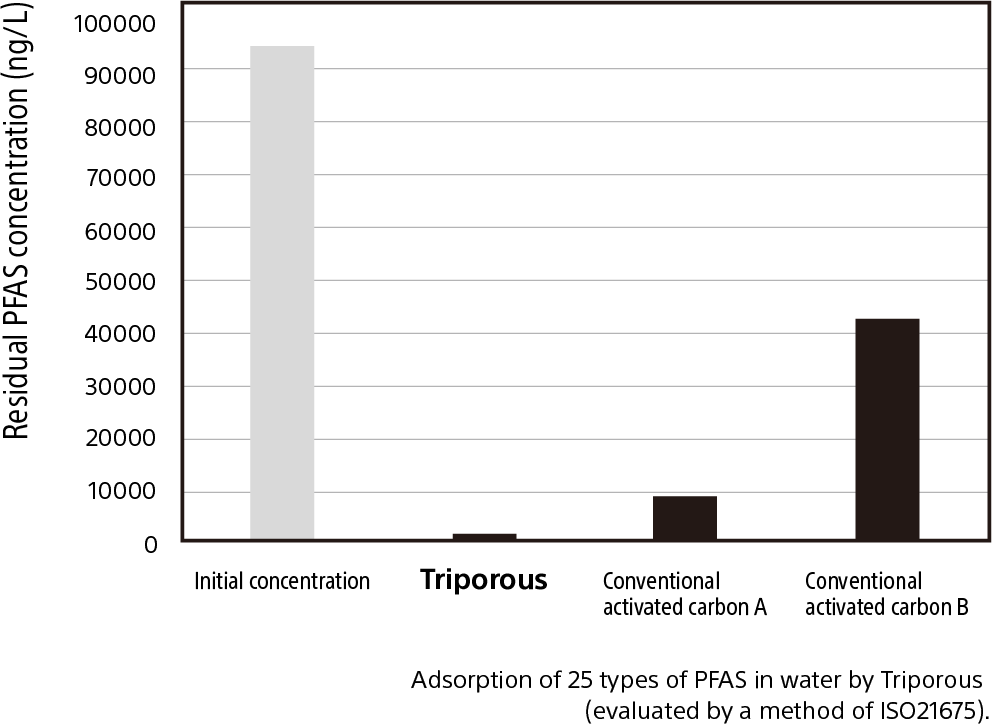
PFAS removal rates of Triporous and conventional activated carbon
| Types of PFAS | Triporous | Conventional activated carbon A | Conventional activated carbon B |
|---|---|---|---|
| PFEtS | 97.9% | 95.9% | 56.1% |
| PFPrS | 98.6% | 94.9% | 53.4% |
| PFBS | 99.2% | 93.8% | 51.6% |
| PFHxS | 99.7% | 92.8% | 52.7% |
| PFHpS | 99.8% | 93.1% | 57.3% |
| PFOS | 99.8% | 93.4% | 63.0% |
| PFDS | 99.9% | 91.4% | 71.0% |
| 6:2FTSA | 99.4% | 92.2% | 41.8% |
| 8:2FTSA | 99.5% | 90.6% | 64.1% |
| FOSA | 99.9% | 83.5% | 55.8% |
| N-MeFOSAA | 99.6% | 77.5% | 49.8% |
| N-EtFOSAA | 99.7% | 76.2% | 46.1% |
| TFA | 97.1% | 96.2% | 58.9% |
| PFPrA | 97.6% | 95.1% | 54.1% |
| PFBA | 97.6% | 94.1% | 51.9% |
| PFPeA | 98.2% | 93.3% | 51.1% |
| PFHxA | 98.8% | 92.2% | 48.4% |
| PFHpA | 99.2% | 91.5% | 48.5% |
| PFOA | 99.5% | 91.6% | 51.6% |
| PFNA | 99.6% | 91.8% | 54.7% |
| PFDA | 99.8% | 92.0% | 59.9% |
| PFUnDA | 99.8% | 91.1% | 65.7% |
| PFDoDA | 99.9% | 81.4% | 57.0% |
| PFTrDA | 99.8% | 47.3% | 29.5% |
| PFTeDA | 99.8% | 25.7% | 38.6% |
The Best in PFAS Adsorption
A comparative adsorption study of PFAS conducted by the National Institute of Advanced Industrial Science and Technology (AIST) in Japan and Örebro University in Sweden showed that Triporous was the most effective material for PFAS adsorption among the 15 substances examined.
Please find the full text of the paper below.
Chemosphere
Breakthrough Curve of PFAS Adsorption
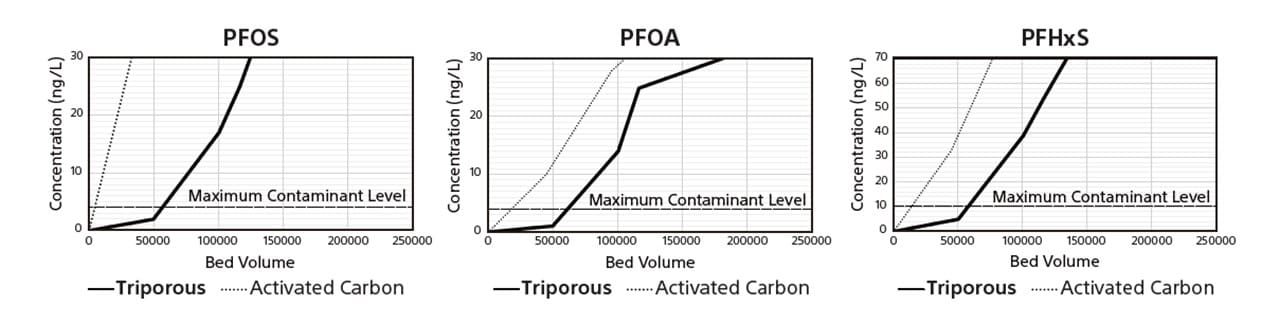
This result is based on RSSCT data using water from Kakamigahara City, Japan, assuming a space velocity of 24 h-1 and an activated carbon particle size of 1 mm in a full-scale facility. The Maximum Contaminant Level is a standard set by the US Environmental Protection Agency (EPA).
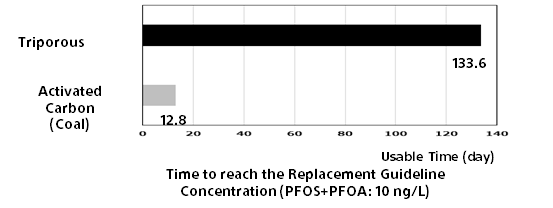
Longer-Lasting Filters
Triporous showed about 10 times longer life by volume and about 15 times longer life by weight compared to conventional activated carbon
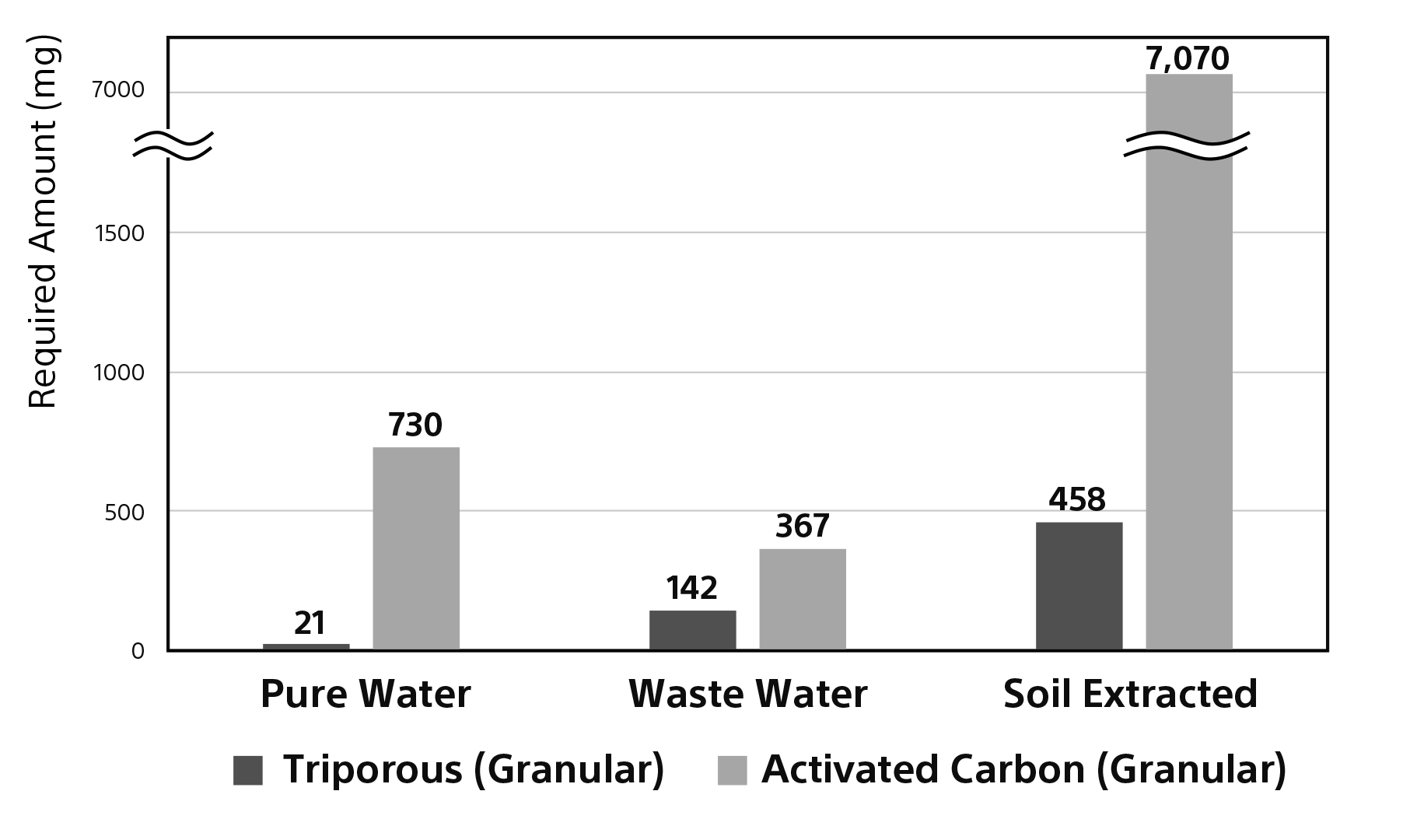
Sustained Adsorption Performance in Wastewater, Groundwater, and Soil
The results show excellent adsorption performance even in complex media such as wastewater, groundwater, and soil, which contain various impurities.
Required Amount of Each Adsorbent to Satisfy US EPA Standards
(PFOA and PFOS: 4ng/L each)
Wide range of potential applications
In recent years, regulations on PFAS have become stricter in Western countries*2; therefore, the regulations in Japan could become strict as well.
Under such a circumstance, the PFAS adsorption ability of Triporous is expected to play a more significant role in the future.
For example, Triporous is the first commercial product in the field of water which adsorption ability has been confirmed using the method of ISO21675.
Its use as the adsorbent for soil remediation is also expected.
- *2 Reference International trends on PFOS and PFOA
-
PFAS countermeasures
