
Chapter 4
Expanding Overseas and Acquiring Capital
Part 1 Liftoff for the Sony Brand: The TR-610's Success Overseas
Due to Sony's success with the TR-63 "Pocketable Radio" both in Japan and as its first export product overseas in 1957, as well as its expanding sales network created through the partnership with American retailer Agrod Electronics in the same year, the Sony name soon became synonymous with top-of-the-line transistor radios across the world.
Some sudden and shocking news came in January of just the next year, when it was reported that a shipment of Sony's radios had been stolen from a warehouse in New York. Not bothering with any other company's radios, the perpetrators had evidently only stolen the four thousand TR-63 radios that had been stored there. While the offices in Tokyo rushed to send out supplementary orders and track the stolen radios' serial numbers, local newspapers reporting on the robbery increased Sony's fame in America.
In June of that year, Sony released the yet smaller and lighter TR-610 radio, beginning export shipments to the United States and Europe before even domestic sales. The radio's fresh design and superior performance created another massive success, selling five hundred thousand units across the globe in just two years. High-end department stores and specialty shops scrambled to display the TR-610 at their storefronts, which, alongside the TR-610's premium status and the many knockoff products and brands it spawned, served to only further grow the Sony name abroad.

The TR-610 Transistor Radio (1958)
COLUMN
Sony's DNA
Sony, the Guinea Pig
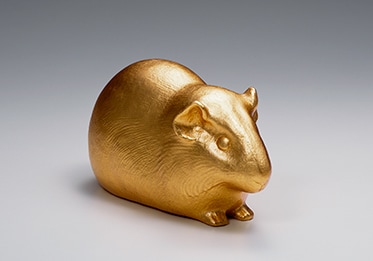
The Golden Guinea Pig Statue Presented to Ibuka
at his Blue Medal of Honor Celebrating Event
In 1958, a famous journal article was published calling Sony a guinea pig.
Referencing Sony in an essay about Toshiba, the article stated that "Although Sony had been the leading transistor manufacturer, Toshiba has since taken that title, producing over twice as many transistors as Sony does now. We can observe from this that Toshiba's dominance came from its ability to invest heavily once transistors were proven to be profitable; in other words, Sony served as none other than Toshiba's guinea pig."
Although Ibuka was initially incensed by the article, in later years he proudly proclaimed that "One of our most important jobs in electrical engineering is to continue finding ways to incorporate new discoveries into our products, and chasing what's constantly evolving has become like second nature to us. There are surely countless more potential industries just waiting for someone to start building them from the ground up. If we only do our jobs the way it's always been done before, we'll only fall behind the times; if we instead invoke on our guinea pig spirit, then doors will keep opening for us left and right." He would also remark "I don't think there's anything wrong with the guinea pig spirit," and that "with how much passion we have for pioneering the future, I wish I could say to all of Japan, 'come follow the guinea pig.'" Ibuka and the rest of Sony's management were perfectly fine being known as a guinea pig, as that was what led them to open up Japan's electronics industry and make the lives of countless consumers all the more colorful.
Two years later, and one year after Ibuka was awarded Japan's Blue Medal of Honor, employees from around the company celebrated the occasion by presenting Ibuka with a golden guinea pig statue. The golden guinea pig statue is still kept as a symbol of Ibuka's pioneering spirit to this very day.
Part 2 Founding Sony Corporation of America
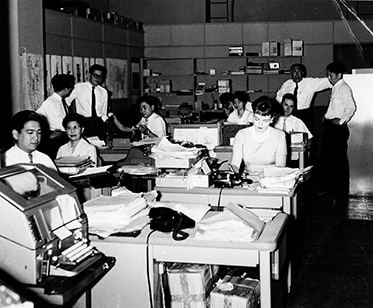
Photo from within Sony Corporation
of America's Office circa its Founding
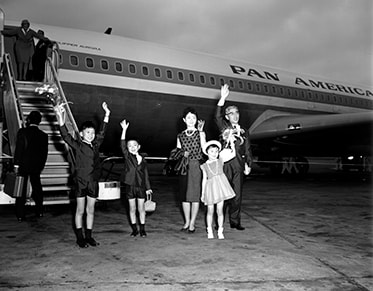
Morita and his Family Departing for the United States (1963)
Having long since dreamed of expanding overseas, Morita quickly began preparations for establishing offices in New York, Hong Kong, and Zurich.
Sony's second biggest market at the time after Japan was the United States. Sales were split between the companies Agrod and Superscope, with each company taking on specific lines of Sony products. Agrod specifically sold transistor radios with Delmonico International as a distributor, but was hesitant to further develop their markets outside of New York. Then, in January of 1960, an incident occurred: Delmonico announced that they would be selling the world's first transistor television, Sony's TV8-301, and had even begun accepting preorders. Nowhere in Sony's contract with Delmonico mentioned transistor televisions. This incident ultimately led Morita to end business relations with Delmonico, believing this to be a good opportunity for Sony to establish its own distribution in the United States.
Thus, in February of that year, Sony Corporation of America (SONAM) was founded in New York, beginning Sony's journey into direct sales overseas. Many within Sony were wary of establishing a wholly owned subsidiary overseas without local capital supporting the project. No other Japanese electronics company had made that sort of move yet.
But Morita made it clear that the time was now. No matter how tough it would be, action was to be taken, and opportunities were not to be passed up. This was Morita's way of doing things.
After establishing SONAM, Morita hired his old lawyer acquaintance Edward Rosiny to represent Sony in negotiations with Delmonico, who sought compensation for terminating the contract. Morita, unwavering in his decision and quick to point out Delmonico's contract violation, managed to talk them down from their compensation demands to less than one tenth of the original amount, assisted by Rosiny's hard bargaining.
The entire SONAM office was a measly thirty-three square meters (355 square feet) at this point. But being only two and a half years out since they were using Yamada's home as their base of operations in New York, Morita was deeply moved at SONAM's founding nonetheless.
Morita's first task at SONAM was to begin promoting their transistor radios. Just as with their tape recorders, Morita started off by explaining to each salesperson, why a portable radio would be necessary. "America has a massive catalog of radio stations to choose from that are all broadcasting constantly. With a transistor radio, anyone can listen to anything they like, whenever and wherever they like." This was the pitch Morita taught his first sales manager, but soon after coming onboard and learning the ropes, the sales manager was headhunted by another rival company. In other words, Morita's business acumen had just been snatched away by a competitor.
Morita now realized how different the Japanese and American ways of thinking could be. After spending time and resources on training his employee, only to have them promptly headhunted away, Morita learned that things were done differently in the United States.
SONAM continued struggling to expand its transistor radio sales, but unable to sell tape recorders due to the remaining contract with Superscope, SONAM's revenue showed little progress for the time being. But their fortunes took a sharp upwards turn when, in October 1962, the only three thousand units stocked of the new TV5-303 Micro-TV sold out in an instant. Once again needing charter planes to satisfy customer demand, the Micro-TVs succeeded far beyond Morita's expectations.
Amidst this sudden success, Morita decided to move together with his family to the United States. "Simply establishing a company in America is insufficient for understanding American life and success in the American market. Only by actually living there with family can we truly understand the American consumer," thought Morita, who pushed past the outcry from the rest of Sony's upper management as he departed from Japan in June the following year. Setting new roots in the United States, Morita took command as the SONAM President, slowly building his connections by going as far as to invite clients to his own New York apartment. Morita's willingness to put his own private life on the line created Sony's foothold in the American market.
Part 3 ADR Issuance and Listing on the New York Stock Exchange
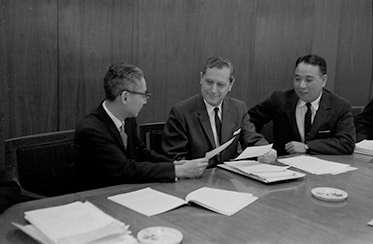
ADR (American depositary receipt) Issuance Proceedings

Listing on the New York Stock Exchange (1970)
Sony's growth continued ever since selling its first transistor radio.
The company's stocks were first listed on a minor section of the Tokyo Stock Exchange under the Totsuko name in August 1955, and in December 1958, after the company's name change, Sony's stocks were promoted to the Exchange's First Section. Sony's success and future promise were undisputed.
Sony's rapid growth could be attributed to Ibuka's foresight, Morita's initiative, employees' teamwork, and the many contributions from Sony's cadre of endlessly inquisitive engineers and scientists.
In 1960, Sony's monthly transistor production surpassed one million units. As production capacity continued to expand, the Gotenyama factory started running out of space once again. Talks began concerning the construction of another new factory.
Sights were ultimately set on Atsugi in Kanagawa Prefecture. The distance to either Tokyo or Yokohama would be perfectly manageable with a future highway, and the need to secure a large space came above all else. Sony's Atsugi factory was thus opened on November 1, 1960. In the same month, construction began on a central research facility (the Sony Research Center) in Hodogaya, another area in Yokohama. The company's growth was unyielding.
As a result of this rapid growth, Sony now had four thousand employees in 1961, compared to the five hundred employees five years earlier in 1956. The company was no longer a small company where everyone knew each other. Indeed, the company labor union, formed in 1956, began gathering steam in concordance with the general tumult that characterized the start of Japan's 60s. This culminated in a strike organized by the union's progressive faction in May 1961, on the company's fifteenth anniversary. Reflecting on how much things had changed from that tiny company starting out with just over twenty employees, Ibuka and Morita now took this opportunity to face the company's internal labor issues head-on.
Additionally, with the increased investment Sony was putting into research, development, and equipment, Morita, Sony finance executive Noboru Yoshii, and the others from the finance team needed to start seriously considering ways to acquire more funding.
Their answer was to further rely directly on the markets: instead of borrowing from the banks, it was time to source funding from the international market itself. This became possible when the Japanese government gave companies approval to issue ADRs for the first time in January 1961.
ADRs, or American depositary receipts, are negotiable securities traded in the United States, which represent shares of an overseas (in this case, Japanese) company held by a bank. For a Japanese company, having the company's stocks traded as ADRs in the United States leads to increased recognition of not only the company name, but also of the company's products. Over one hundred companies applied for ADR certification, but only sixteen were ultimately selected by the Ministry of Finance. These sixteen were almost all large corporations originating from Japan's prewar period; Sony was the sole newcomer with a comparatively measly nine hundred million yen in total capital. At a special board meeting in February 1961, Sony's directors made the decision to grow Sony's capital by issuing new stock. As part of this stock issuance, two million shares were to be offered through ADRs on the American market.
Although Sony had received government permission to issue ADRs, another six months of complicated negotiations and procedures were to follow. Morita, who served as project manager for the ADR issuance process, himself stated later that "among all the things I've done, this project was the hardest."
The Securities Act of 1933 regulates and requires the proper disclosure of information to investors in the United States, and new stock issuers must submit a huge volume of registration statements to the SEC (Securities and Exchange Commission). Thus, Morita's work started from first translating Japanese commerce law into English. Then, Sony and its subsidiaries needed to create a consolidated financial statement in accordance with American accounting practices, after which the company's accounting for the last three years and four months would need to be independently audited by American certified public accountants. Up until then, however, Japanese companies did not operate under a consolidated basis, and the concept of consolidated accounting did not exist. Starting from first understanding what consolidation meant, Morita and his team spent days and nights poring through Sony's past finances, consolidating the company's separate financial statements into the appropriate documents. Furthermore, all the contracts, regulations, and proceedings had to be translated into English, and the accuracy of those translations needed to be all be reviewed and attested to by Sony's executives and lawyers.
After several months finishing these proceedings, Sony's application for its stock to be listed in New York's finance markets was finally approved in June.
Sony's ADRs were offered at a starting price of $17.50 (6300 yen at the time), with one ADR representing ten units of Sony stock. In just one hour after listing, however, all two million shares had been sold, with the share's popularity causing its market value to rise to between 23 and 24 dollars. Everyone involved breathed a sigh of relief at the successful listing. The stock certificates were finally delivered and transactions finalized on June 15 at the Bank of Tokyo (current day MUFG Banking Corporation), which operated as Sony's trustee, and the transactions were then confirmed over international telephone and teletypewriter from New York. With this, Sony's ADR issuance was made official, and they now had 2.1 billion yen in capital.
Sony's attempt to proactively recruit new shareholders and expand its foreign capital with ADRs in America, its then-second-largest market, was a massive success, leading countless other investors and consumers to learn the Sony name as a result. This success also served as a model for other Japanese companies in the future.
Sony continued sourcing funding from abroad afterwards, conducting another round of ADR issuance in 1963. Morita, eager for further international expansion, hoped to list Sony's stocks directly onto the New York Stock Exchange, which at the time accounted for 75 percent of the global stock market. Just like with the ADR listing, preparations thus began under Morita once again - and changes to Sony in accordance with American regulations were introduced one by one, such as the onboarding of external company directors, which was not required for Japanese corporations. After yet another strict round of company and financial inspections, Sony finally became the very first Japanese company to be traded on the New York Stock Exchange in September 1970.
Listing its shares on the world's largest stock exchange was not purely a financial decision for Sony, but also symbolized Sony's status as a truly international company. Speaking before a crowd of reporters at the listing's press conference, Morita told reporters, "This listing serves as our company's first step as an international corporation. We plan on also listing our shares in the European market and making Sony a truly globe-spanning business."