
Chapter 5
Developing the Video Tape Recorder
Part 1 Developing the Industrial Video Tape Recorder
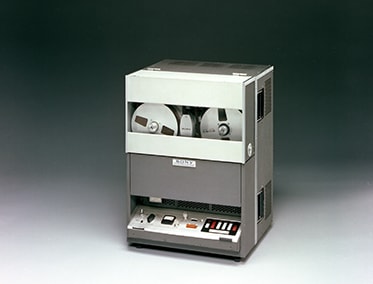
The PV-100 All-Transistor Industrial Video Tape Recorder (1963)
First invented in 1957 by Ampex and capable of recording both audio and video to tape, the video tape recorder (VTR) quickly came into use by 1958 at both the NHK and various commercial television stations, and Japanese electronics companies soon began their own VTR development. Aiming first and foremost to catch up to Ampex's technology, Sony's VTR development team was spearheaded by tape recorder expert Kihara, who through much trial and error managed to produce a VTR prototype in just under two months.
Ibuka was ultimately dissatisfied with the size of Ampex's VTR, however, which used bulky vacuum tubes. Unless the VTR could be made smaller and lighter, nobody would see them as an item for daily life, he thought. Taking on this challenge, Kihara's development team ultimately succeeded in converting the VTR to a transistor type in November 1959, setting their sights on shrinking the device even further.
Sony and Ampex had started to exchange research information on their respective VTR technologies by 1960, but Ampex's models ultimately suffered from high running costs due to using four recording heads that all needed to be replaced when the heads wore down. Kihara's team thus sought to create a transistor VTR using only two heads, saving on both cost and ease of installation.
Kihara's product was the world's first transistor-type VTR, the SV-201. Using two recording heads, the helical scan VTR ran tape at seven inches per second, the same speed as a normal tape recorder, and was quite advanced compared to other VTRs at the time. Broadcast stations were unreceptive to the device, however, as they were already using Ampex models with four heads, and the machine was far too bulky and expensive for the home market.
Shifting their focus to alternative markets, Kihara's team then created the PV-100. A mere fiftieth of the size of machines used in broadcasting stations up to that point, the PV-100 was revolutionarily small for its time. Starting with a price tag of 2.48 million yen in July of 1963, orders began in the United States in August, where the machine was quickly picked up for use in hospitals, schools, and surprisingly, airline companies. Films shown inside aircraft used eight-millimeter or sixteen-millimeter film, but technical issues were common and play times were short. The PV-100 was thus marketed as an alternative to using film reels and was adopted by both American Airlines and Pan American Airways in 1964. To provide new video content each week, an "In-Flight VTR Service" dubbing facility was even constructed in the outskirts of New York.
Although the PV-100 was sold to be used in industrial contexts, by expanding its market outside of solely television broadcasting, the device moved one step closer to being something "usable in daily life" like Ibuka had originally wished. Simultaneously, transistor VTR developer Kihara and Masahiko Morizono, the person in charge of exchanging technology research with Ampex, were together accumulating foundational research on VTR technology within the company. This research would eventually lead to the future 1-inch VTR and half-inch Betamax VTR technologies.
Part 2 Developing the World's First Home Video Tape Recorder
Despite the fifty-fold decrease in the PV-100's size compared to previous machines, Ibuka was still dissatisfied. "A machine weighing sixty kilos and costing several million yen just isn't the spirit of what we do," he said, demanding a model that was light and cheap enough to be used at home.
To meet Ibuka's stringent requirements for a consumer product, Kihara began revising the machine's design and optimizing everywhere he could, from the motors to the very processing technology used in the machinery. The end result was announced in October of 1964: the CV-2000. Kihara was able to reduce both the device's size and price by using rotating heads and skip field recording.
Although the CV-2000 was brought to market in 1965 for home use, it ended up selling far better in the medical, engineering, and educational fields than in the home market. Requests came in from the sales teams, asking to switch from black-and-white recording to color, as well as to simplify the user experience by using cassettes instead of open reels. With these goals in mind, Sony set out once again to develop a new VTR, this time aiming to truly penetrate the home market with a cassette-type device. The most important task was to automate the tape feeding process while minimizing wear, a process that came to fruition with the U-loading system, so named for the shape of the tape path inside the cassette. After announcing the new format and line of Sony Color Videoplayers in 1969, expectations were high from the public.
As VTRs were finally poised to reach the home market, Sony, Matsushita Electric Industrial Co. (current day Panasonic), Victor Company of Japan (JVC), and five companies from outside Japan met to discuss standardizing the VTR cassette format in March 1970. Eventually agreeing to use the U-loading standard, Sony began sales of the new U-matic color videocassette and player in 1971, and its recorder device the following year.
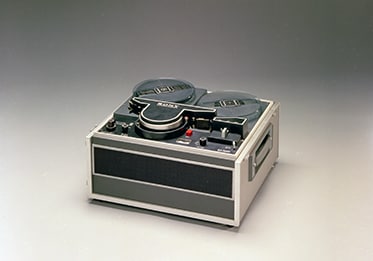
The CV-2000 All-Transistor Home Video Tape Recorder (1965)
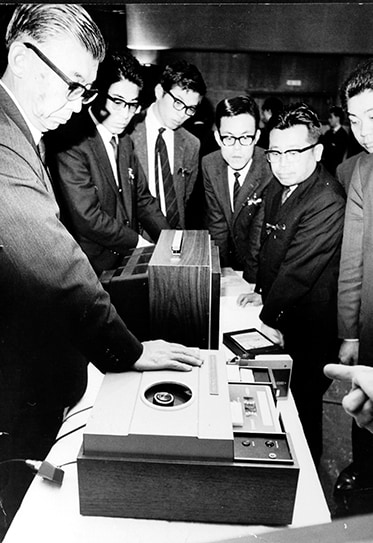
Ibuka Displaying the U-matic Prototype