
Chapter 9
The PlayStation
Part 1 Ohga's Decision: "Do it!"
The video game market throughout much of the 1980s was dominated by Nintendo's Nintendo Entertainment System (NES), and after news of Nintendo starting development on the next-generation Super Nintendo Entertainment System (SNES) reached the ears of Sony, discussions arose concerning a potential technological collaboration between the two companies. Although Sony had not expanded into the video game market yet, the possibility of using the Sony-developed CD-ROM in place of the ROM cartridges used in the industry up until that point gave the two companies the chance to create a truly new type of gaming console.
Thus, a contract was finalized in early 1990 on the joint development of what would later be referred to as the Super NES CD-ROM, a fully integrated CD-ROM gaming console, between Sony and Nintendo. This proposed console was tentatively named the "PlayStation," though the collaboration ultimately never came to fruition. Yet despite the project going up in smoke, project leader Ken Kutaragi strongly believed that Sony needed to continue development independently on a CD-ROM-based console. Looking towards the future, he knew that Sony could not afford to give up on this new business venture.
The project's cancellation nevertheless fueled sentiments within the company that Sony should withdraw from video games altogether, but a turning point came in 1992 during a mid-year management meeting. Questioned on his project team's future direction, Kutaragi spoke candidly and insistently: "Sony must pursue the creation of its own game console and format. Separate from the collaboration with Nintendo, we've actually been independently developing our own original three-dimensional computer graphics (3D-CG) system in secret. With this technology, we'll be able to render 3D images that would blow the SNES out of the water." Clearly seeing Kutaragi's ardor for the project, Ohga responded, "if that's what you're claiming, then prove it!" Then, slamming his fist down on the table, he shouted in English that fateful command at Kutaragi: "Do it!"
This moment marked the instant that Sony's video game business would start to take off.
Part 2 Founding Sony Computer Entertainment (SCE)
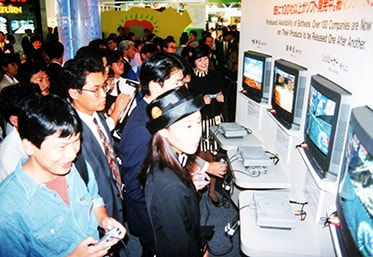
The PlayStation Prototype Demo Event (1994)

Ohga's Speech at the Third-Party Developer Seminar (1993)
The name "PlayStation" for Sony's new gaming platform was chosen to contrast with the word "workstation," differentiating "computers for work" and "computers for play." Concerning the novel combination of computers and entertainment with 3D-CG, Kutaragi himself explained that "we really wanted to make a computer meant solely for entertainment and create the wholly new and unprecedented market of 'computer entertainment.'"
As the development team around Kutaragi prepared to start work on the project in earnest, they set up the "Computer Entertainment Business Preparations Room" in the Shin Aoyama building in Tokyo's Aoyama neighborhood. Engineers from Sony came to join the project, as well as Epic/Sony founder Shigeo Maruyama from Sony Music Entertainment (SMEJ).
One significant barrier had to be overcome at the very start, however. Since Sony didn't have any video game software titles of its own, creating these titles for the PlayStation would have to be left to third-party developers. In stark contrast to its competitors who already had an established catalogue of titles, the PlayStation was incapable of launching a whole new format on its own. At the project's outset, both Kutaragi and Maruyama traveled all across the country to negotiate with various developers, but responses were far from enthusiastic. If anything, their words were more often met with disbelieving looks, clearly reflecting doubts that what they were proposing was even possible in the first place.
This all changed in October 1993.
As a joint venture between Sony and Sony Music Entertainment (SMEJ), the two companies announced on October 27 that they would together launch a new company, Sony Computer Entertainment (SCE), in November of that year. The new company would develop and sell both home video game consoles and its respective software, while also managing licenses with external developers. Their stated purpose was to differentiate themselves from other video game companies by implementing high-quality 3D-CG on par with the most powerful graphics workstation computers of the day, thereby creating an entirely new kind of computer entertainment.
The next day, on the 28th, a tech demonstration on the new PlayStation aimed at third-party developers was held in hall 10 of the Sony Headquarters building.
The stars of the show were four prototype devices containing countless electronic components hardwired together. Ohga stood before the many software developers who had gathered from all across the country and delivered a welcome address, beckoning to them, "Our new company could never succeed if we decided to concentrate purely on software or hardware. We want to use the technological prowess we've built up so far to transform the very forefront of the world of gaming consoles. I ask you all to come see what we can make happen together."
Once Ohga concluded his speech, a tech demo combining all of the development team's efforts began playing, first displaying spheres, cubes, and other 3D shapes properly rendered with shadows, and ending with a large 3D model of the T. rex. The dinosaur model was brought to life with rendering down to its skin, and responded to controller inputs to walk, roar, and glare. Venue attendees were stunned, standing both motionless and speechless as they gazed at the screen. Calls from developers all over came flooding in the next day: the tech demo was a smashing success.
As more and more developers were invited to create games for the PlayStation, efforts were constantly made to create an environment for engineers and developers working with the PlayStation to maximize their expressive creativity in their work: the PS Library was a collection of basic fundamental programs offered to developers with no experience working with 3D-CG, and a sample codebase was created to assist with programming. Through these efforts, a steady stream of third-party games was secured for the PlayStation's future.
SCE was officially founded on November 16, 1993. Ozawa, then-Chairman of SMEJ, would become the company's first President; Teruhisa Tokunaka from Sony and Maruyama from Epic/Sony would become Vice Presidents.
Kutaragi, now a company Director, provided his outlook for the company by predicting that "if the last ten years can be called the age of 2D-CG for video games, then the next ten years will surely be the age of real-time 3D-CG." Ozawa meanwhile asserted that "SCE will step into the world of video games backed by the hardware prowess of Sony and the software prowess of SMEJ, its two parent companies. Just as the CD's digital technology transformed the music market, we hope to transform the video game market with the PlayStation."
COLUMN
Sony's DNA
PlayStation's History with the Ibuka Award
In May 1976, the Ibuka Award was created in order to commemorate the 30th anniversary of Sony's founding. Awarded to individuals who had made great contributions to Sony either through their inventions or technological advancements, the inaugural award was presented to tape recorder and video recorder developer Nobutoshi Kihara (then-Managing Director of Sony). This would be followed by awards given to the Trinitron system, CCD, CMOS image sensor, the Sony α camera, and other outstanding technologies and products that supported and represented Sony. The award is still the most renowned technology-related award given and aspired to by engineers at Sony.
The PlayStation received an Ibuka Award for the first time in 1997. Upon receiving the award, Kutaragi said that "As an engineer, receiving the Ibuka Award is a great honor. With the PlayStation, all of us engineers were able to make our dream a reality and produce unbelievable results around the world. I truly feel like we were able to implement Ibuka-san's goal `to establish an ideal factory that stresses a spirit of freedom and open-mindedness, and where engineers with sincere motivation can exercise their technological skills to the highest level' that he wrote in Sony's founding prospectus." Tokunaka meanwhile stated upon receiving the award that "I must be thankful to Morita-san, Ohga-san, and all the senior management who first established the foundation on which we were able to expand our own business, something which is inevitably tied to our success. It was only because Sony Group possessed both hardware and software businesses that we were blessed with the expertise that allowed the engineers under Kutaragi-san to make their dream into a reality." After the PlayStation created its new market through its superior technology and unique business strategy, the future PlayStation 2 and PlayStation 4 would also go on to receive Ibuka Awards, continuing to provide monumental contributions to Sony Group's business.
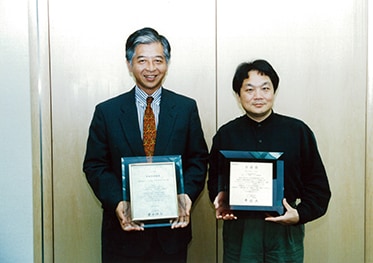
From left, Sony Computer Entertainment President Tokunaka and then-Senior Managing Director Kutaragi holding the 18th Ibuka Award and 1996 Excellent Performance Award
Part 3 Now Available: the PlayStation
In the winter of 1994, one year after SCE's founding, Sony's independently developed and long-awaited PlayStation video game console was finally born, created from the fusion of Sony's hardware and SMEJ's software expertise. Sporting high-resolution backgrounds and the ability to render multiple 3D-CG characters in real-time through a proprietary 32-bit CPU, the PlayStation was also capable of producing high quality sound which rivaled that of a music CD. Before development was fully off the ground, many people throughout the company were of the opinion that the device was simply a toy, sometimes explicitly questioning why Sony was working on children's toys all of a sudden. It was clear once the device was finished, however, that this was far beyond the level of a mere toy.
Featuring specs rivaling that of any high-end workstation of the day, the PlayStation was put to market on December 3 that same year at the shockingly low price of 39,800 yen, accompanied by a fresh and striking marketing campaign. Though the Sony brand name held little weight in the video game industry, the first one hundred thousand units sold in the blink of an eye, and the device soon went on to sell one million units within just half a year, becoming an era-defining hit in the world of video games.
The PlayStation's success could not entirely be chalked up to its beautiful graphics or vast library of titles, however. Utilizing CD-ROMs as its primary media format gave the device a significant edge when it came to distribution.
ROM cartridges, the standard form of video game media up until the PlayStation, took more time to produce than CD-ROMs, meaning it would take several months after stock was depleted before the product could be made available again. Since the PlayStation used CD-ROMs, for which SMEJ already possessed a strong production and distribution system, it took a maximum of six days - the same turnaround time as music CDs - for an order to be fulfilled, even when ordered in small lots. Production costs were minimal, especially when considering the vast amount of data required to support 3D-CG. SCE was also able to revolutionize distribution methods for video games, as instead of selling through wholesalers according to the industry norm, SCE established a distribution system which allowed game developers to sell their games directly to retailers. By enabling high-speed production and low costs, and with its improved distribution methods, the CD-ROM played a crucial role in the PlayStation's explosive success.
The device's advanced hardware design also caught the eyes of many. Featuring an exceptionally simple design - a round CD drive mounted on top of a rectangular body - the controller was also made with the user's hands in mind, sporting handles for users to grip. This controller shape was a striking departure from the standard flat controllers of the time. The symbols adorning the controller's buttons would go on to become a famous iconic aspect of the PlayStation in the future and were originally chosen by designer Teiyu Goto, who cited his desire to use "simple shapes that could easily be used as icons."
Receiving raving reviews across the globe, the PlayStation would achieve ten million units sold by the end of November 1996. Selling this many units in such a short amount of time was a record among all of Sony's products up until that point.

The first PlayStation (1994)

10 Millionth PlayStation Shipment Ceremony at Sony Kisarazu