
Chapter 8
Global Expansion of the Music and Film Businesses
Part 1 Acquisition of CBS Records Group
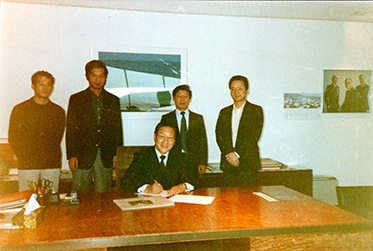
Norio Ohga Signing the Agreement with CBS (1988)
In November 1987, 19 years after the establishment of CBS Sony Records in Japan, Sony's music business reached a crucial turning point. Sony acquired CBS Records Group (US) which had been under the umbrella of Sony's joint partner, CBS Inc.
In 1988, at a ceremony celebrating the 20th anniversary of CBS Sony Records, Morita remarked, "We have welcomed CBS Records Group, our longtime business partner, into the Sony family. To make good use of new hardware, we must have matching software capabilities as well. Ten years from now, when we celebrate the 30th anniversary of CBS Sony, I hope that we will have developed our software business to be ever larger and broader in scope than before." Talks for the acquisition had begun in November 1986, when Ohga received word from Michael P. Schulhof at Sony Corporation of America.
In the fall of 1986, CBS CEO Laurence Tisch was planning to separate the record business from the CBS Group as part of a company restructuring. Upon learning about this, CBS Records President Walter Yetnikoff raised objections to the sale but, unable to change Tisch's mind, he then turned to Schulhof for advice.
A clause in the original CBS Sony joint-venture agreement proved crucial at this moment. To ensure Sony would not abandon the venture, CBS had included a condition stating that if either party wished to sell its shares in the joint venture, the other party would have the first option to purchase them. As a result, CBS first informed Sony of its intent to sell its shares in CBS Records.
Though this was how negotiations began, things would not go so smoothly. CBS Chairman William S. Paley and the board of directors staunchly opposed the sale. Their stance was firm, causing the sale plan to stall for the next 10 months.
A turning point came in October 1987, when the largest stock market crash in U.S. history occurred, commonly known as "Black Monday." As a result, Paley reversed his stance and agreed to the sale. After negotiations in New York, it was announced on November 19, 1987, that Sony and CBS had reached an agreement on the acquisition. The agreed upon price was two billion USD, amounting to approximately two hundred seventy billion yen at the time. While this was an extraordinary amount for an acquisition by a Japanese company, Ohga believed CBS Records was worth the price. "Considering CBS' 50% stake in CBS Sony and the full assets of CBS Records, with its fifty-year history, this is far from a bad deal. The 21st century is predicted to be the era of software (content). Hardware and software (content) are like the two wheels of a car, and only when they are in balance can a business succeed. We want to nurture both wheels and create a company that will thrive in the 21st century," Ohga explained the move.
By acquiring CBS Records, one of the largest record companies in the world, Sony took its first step toward expanding its content business globally, paving the way for the acquisition of Columbia Pictures two years later.
Part 2 Growing as a Comprehensive Entertainment Business
After acquiring CBS Records and Columbia Pictures, two giants of music and film, Sony's business portfolio changed significantly. In fiscal year 1990, the music business had reached approximately 470 billion yen in sales, accounting for 13% of Sony's consolidated revenue. The film business meanwhile amounted to about 260 billion yen (7%), bringing the share of entertainment business in Sony's total revenue to 20%.
In January 1991, CBS Records was renamed Sony Music Entertainment Inc. (SMEI), while in Japan, CBS Sony Group Inc. was renamed Sony Music Entertainment (Japan) Inc. (SMEJ).
In the same month, Sony Software was established with headquarters in New York as a parent company to both SMEI and Columbia Pictures. Under the leadership of Chairman Ohga and President Schulhof, who was also the chairman of SMEI, the company structured itself to focus on the global expansion of its content business.
In terms of their artists, Mariah Carey debuted in the United States in 1990, winning the Grammy Awards for Best New Artist and Best Female Vocalist in 1991, and eventually topping the U.S. charts with both her singles and albums, such as Music Box (1993). Michael Jackson's Dangerous (1991), meanwhile, redefined the possibilities of pop music by blending disparate genres. Celine Dion's Falling Into You (1996), Britney Spears' …Baby One More Time (1999), and Santana's Supernatural (1999) also became some of the best-selling and most influential albums of all time.
In Japan, Toshinobu Kubota's "The BADDEST" became a million-seller in 1989, and Kome Kome Club's single "Kimi Ga Irudakede" achieved double million status in 1992. In 1993, DREAMS COME TRUE's "The Swinging Star" sold over three million units, while songs by Princess Princess, Yutaka Ozaki, and many others became major hits.
Sony, once known only for its electronics, had established itself as a global force at the cutting edge of music by the turn of the century.
Part 3 Criticism from the United States
After music, Sony moved on to film. Following the acquisition of CBS Records in January 1988, the company purchased the major U.S. film production company Columbia Pictures Entertainment, Inc. in November 1989 through a tender offer. Costing 4.8 billion USD including liabilities, the acquisition became the most expensive purchase of a U.S. company in Japan at the time. Through these two major acquisitions, Sony came to hold content assets and business foundations in both the film and music sectors, drawing strong reactions from both the United States and Japan.
The acquisition of Columbia Pictures was covered particularly extensively in U.S. magazines and newspapers. A great deal of public criticism was raised across the country, especially because anti-Japanese sentiment was spreading in the United States at the time due to rising trade friction between the two nations. One issue of the major weekly magazine Newsweek notably featured an illustration of the iconic Columbia Pictures' torch lady in a kimono on its cover, with the title reading "Japan Invades Hollywood." The article claimed that "a Japanese company had bought the soul of the United States."
Based on these events, Morita held a press conference to properly address Sony's intentions for the acquisition. Morita explained that with CBS Records, which it had acquired the previous year, "Sony has minimal involvement in management and strives to create an atmosphere where it is easy for its excellent employees to work," and promised to "make every effort to ensure that the employees of Columbia Pictures do not feel insecure and that they are happy to be part of the Sony Group." He also mentioned the media coverage, such as newspapers and magazines, saying, "This issue is being handled emotionally and politically due to the lingering Japan-U.S. trade friction," expressing his regrets. He went on to emphasize his point by saying, "By demonstrating that Sony can be a true partner, I believe the United States' views of Japan will change. Sony can do this, and, if we don't, the wall will never be torn down." Embedded in these words was his desire to break down the barrier between the United States and Japan, especially the wariness Americans felt toward Japan, and deepen the countries' mutual understanding.
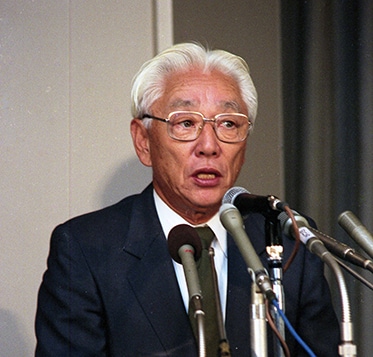
Morita at the Press Conference Announcing the Acquisition of Columbia Pictures (1989)

The Main Entrance to Sony Pictures Entertainment, Culver City (1996)
Part 4 Synergy of Hardware and Content
Looking towards the company's future business segments, Sony's management was aware of the importance of owning both hardware and software (content) assets, communicating this both internally and externally from time to time. Once CBS Sony Records was established in 1968, work immediately began within the business group to accumulate both management expertise and capabilities in the music industry. Furthermore, the two major acquisitions of CBS Records and Columbia Pictures opened up the pathway for Sony to become a comprehensive entertainment company.
Parallel to the acquisition of Columbia Pictures, Sony also purchased Guber-Peters Entertainment for approximately 200 million USD. Peter Guber and Jon Peters, co-producers of Rain Man (1988) and Batman (1989), were brought on as executives.
Columbia Pictures Entertainment was then renamed to Sony Pictures Entertainment (SPE) in August 1991, two years after the acquisition. By emphasizing itself as a member of Sony, the company aimed to further enhance synergy between hardware and content, as well as to strengthen its management structure and expand its business by increasing its independence as a motion picture company.
SPE's business was not limited to film production and distribution. Its operations also included the production and distribution of television programs, operation of television and digital networks, distribution of programming over digital channels and physical media, and the operation of a studio lot in Culver City, California.
Additionally, Sony Pictures Imageworks (SPI) was established in 1992 and took part in producing a variety of works with special effects technology and computer graphics, both inside and outside Sony. Together with SPE's studio, equipped with Sony's latest hardware and technology for post-production, SPI provided a crucial value-added service to all of Hollywood.
On the other hand, SPE faced issues in profitability. In the second quarter of fiscal year 1994, Sony announced a one-time write-off in the amount of 265.2 billion yen for the film division. For the first few years after its acquisition in 1989, SPE's film production studio had seen great success, achieving the industry's leading performance in the North American theatrical box office for three consecutive years up to 1993. Its performance had become sluggish, however, and it could no longer generate sufficient returns to justify large movie investments. Seeing the necessity for additional investments in the company to improve SPE's performance - and also taking this as an opportunity to renew its top management - Sony reevaluated its investment in the film division and modified its accounting process.
In October 1996, SPE brought in John Calley, then-President and COO of United Artists Pictures, to become President and COO of SPE and began operations under this new structure. Reforms began in integrating Sony's technological capabilities with SPE's content in order to maximize profitability.