
Chapter 6
Early Stages of an Imaging Business
- Part 1 The Rise of Betamax and Declaring the "Year Zero of Video"
- Part 2 Transitioning to a Full-Line VTR Manufacturer
Part 1 The Rise of Betamax and Declaring the "Year Zero of Video"
Sony had managed to bring the CV-2000, the world's first home VTR, to market. They succeeded too in addressing the various issues accompanying the CV-2000, such as color functionality, transitioning to a cassette format, and tape autoloading, with the U-matic. Though both products were exemplars of Sony's technological prowess, neither product managed to truly become a household item. Given that fewer than 40 percent of households even had a color television at home in the early 70s, technology had not yet progressed to the point where the idea of enjoying recorded movies and TV shows at home made sense.
Yet looking forward to when such a reality would inevitably come to pass, it was clear that Sony needed to stick the landing with their next home VTR. "We'll need to be able to handle a cassette at least this big," said Ibuka when considering the issue, holding up the Sony company notebook - the same size as a standard Japanese paperback novel. The development team immediately jumped on developing a new VTR able to handle this requirement.
Making use of their experience with the U-matic, the first VCR to use the new paperback-sized videocassette, the SL-6300, was soon made commercially available in 1975, debuting under the new name "Betamax." Color TVs had reached a 90 percent adoption rate by this point, and with the birth of the Betamax, the era when TV shows could only be viewed live was in the past. Viewers could now bend time as they pleased, Morita defined this new technology's ability as "time-shifting," since now TV shows could be recorded and enjoyed whenever and as many times as one pleased, far after the live broadcast had ended.
Soon enough, it was 1976. On top of being Sony's thirtieth anniversary, Morita boldly declared the year to be the "year zero of video," predicting the coming age of VTR technology, despite domestic VTR demand still wavering below one hundred thousand total units for all of Japan.
Doubt remained throughout the industry that VTRs would ever proliferate to the home setting, until an event that would define a generation came sweeping the world off its feet: the Victor Company of Japan (JVC), Sony's former collaborator on the U-matic format, announced their new and independently developed VTR format - the VHS.
The Betamax and VHS formats were not compatible with each other's devices, and while Betamax prioritized compactness and image quality, the VHS boasted a hefty two-hour-long recording capacity per cassette. The launch of these two cassette types nearly simultaneously onto the market marked the beginning of a legendary format war.
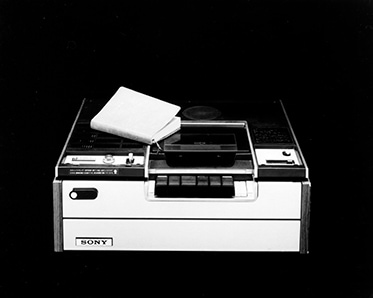
Sony Company Notebook and the Betamax SL-6300 (1975)
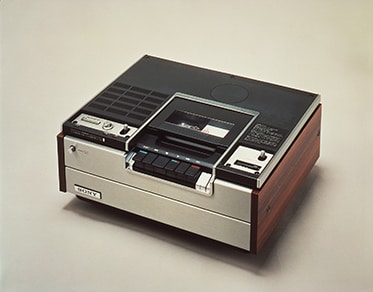
The SL-6300, the First Betamax Video Tape Recorder (1975)
Part 2 Transitioning to a Full-Line VTR Manufacturer
By 1979, three years after Morita declared the "year zero of video," the domestic VTR market had grown almost eightfold, with the industry now totaling 2.2 million units produced in that year alone. Morita's prediction of a new age of video had indeed arrived.
Amidst this rapid market growth, both the Betamax and VHS teams were in a mad dash to rush new products out to market, making leaps and bounds in improving image quality, recording capacity, machine functionality, and ease-of-use to try and outcompete the other. The VHS team, however, made the strategic decision to supply their equipment to major electronics manufacturers in the United States and Europe, and combined with their vast catalog of software titles, Betamax's market share began to dwindle steadily. Acknowledging this in 1988, Sony made the decision to also start selling VHS-compatible products, supporting two different formats simultaneously.
After years of effort spent promoting Sony's own domestic VTR, Sony Vice President Masaaki Morita explained the decision to employees: "We can't do business simply out of stubbornness. The market is clamoring for a Sony-made VHS machine, and it is our duty to answer their demands. Even if it may be a temporary blow to our pride, we decided that this is what we have to do for the future of our video business."
At the same time, however, Morita also made it clear that Sony would still be making new moves in the VTR market. "If we'll be working on VTRs anyway, we might as well aim to be the best VTR manufacturer out there, for any format," he proclaimed. Emphasizing the superior video quality of Betamax, the compactness and ease-of-use of 8mm tape, and the adaptability of the VHS to new video rental business models, Morita lit a new fire of encouragement under Sony employees.
Although Sony was ultimately unable to establish its own standard for half-inch VTRs, many important lessons were learned from the format war about the process of standardization. These lessons would prove invaluable for Sony when, in response to new demand for home videos, they would combine their experience in manufacturing cameras and tape decks to develop the all-in-one camcorder device.
Part 3 Transforming the Reporting Landscape: the Betacam
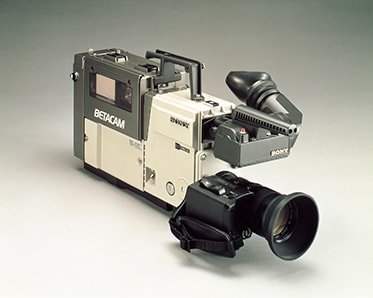
The BVW-1, the First Betacam Broadcast-Use Combined Camera and Video Tape Recorder (1982)
Since Sony introduced the U-matic portable video cassette system in 1974, news reporting had steadily transitioned from using film to electronic news gathering (ENG), improving efficiency across the board. As ENG increasingly enabled opportunities for up-close and on-site reporting, however, the need for even smaller and more portable devices grew steadily as well.
Sony's response to this demand was to announce in 1981 the new integrated professional VTR camera, the Betacam. Sporting identically sized cassettes to the consumer Betamax, the Betacam format was uniquely tuned to meet the stringent requirements of broadcast networks for high image quality and portability. Riding on the back of Sony's many years of experience working on broadcast technology since the 70s, as well as the trust the Sony brand held among users in the industry, the first Betacam device, the BVW-1, quickly made its way into news stations around the world after it was released in 1982.
Sony cemented the Betacam format as a staple of the broadcasting industry with the BVW-40 released just the following year in 1983, as it brought with it editing capabilities integrated into the device. Betacam was no longer simply a recording device, instead now providing end-to-end support for the entire reporting process, including filming, editing, and finalizing the tape. This led to Betacam occupying about 95 percent of the ENG market, becoming an industry standard and firmly establishing the power of the Sony brand in the sector.
By the turn of the decade, digitization was beginning to influence on-site ENG, prompting Sony to release the Digital Betacam component digital VTR in 1993. While maintaining compatibility with the previous component analog Betacam format, the Digital Betacam enabled high image quality at a reduced price due to its use of new image compression technology.
The new Digital Betacam was immediately given the spotlight the next year at the 1994 Winter Olympics in Norway, where it formed the core of the event's broadcasting system. The same combination of equipment would be used at countless international events, ultimately leading to the Digital Betacam winning an Emmy Award, the most prestigious award in the realm of television, in 1995. Trust in Sony's technology and its influence on the TV industry had become a worldwide phenomenon.
Part 4 The CCD-V8 and Further Format Competition
Even after the development and release of both U-matic and Betamax, Sony continued to take on new challenges in the video industry. Amidst a push for greater recording density using even smaller equipment, Sony chose the daring plan to differentiate itself and establish another new market by halving the dimensions originally used for the Betamax. "We might as well try to increase the recording density by tenfold as well," Ibuka boldly declared. It just so happened that semiconductor CCDs, which would come to replace the camera pickup tube as the new "eye" for cameras around the world, were then starting to get off the ground (see Volume 2 Chapter 5). Iwama had also given the green light to use CCDs to develop an integrated video camera capable of both recording and playback.
Once again starting development from scratch, Sony would announce their work on the VideoMovie simultaneously in New York and Tokyo in July 1980. The revolutionary device combined a CCD color camera with an 8mm videocassette recorder into one device, weighing only two kilograms (about 4.4 pounds). The event served as more than a simple announcement, however. "From our experience with Betamax and VHS, we would like to avoid incompatibility issues moving forward," said Sony, inviting other companies to meet and decide on a standard for the next generation of recording devices. One hundred and twenty-two companies answered the call, attending a meeting held in March 1982 to standardize the 8mm video format, eventually leading to a finalized standard in April 1984.
In parallel to these efforts, the development and design teams were hard at work developing their first 8mm model video camera.
Minoru Morio and other development team members made the move to the Atsugi factory in November 1981, joining up with Shigeyuki Ochi's team, which had already started work on image sensors by then.
Development was initially conducted on both the CCD device and Sony's Trinicon camera pickup tube simultaneously, the latter of which was treated as a contingency plan in case CCD development failed to be completed on time. Yet as the Trinicon version of the product was just about to be finished, Ochi's team received a new order: "Forget about the backup option, we need the CCD's superior image quality." With their backs against the wall, Ochi's team put in blood, sweat, and tears in order to finally succeed in producing a 250,000-pixel CCD for the project.
Once the grueling development process was over, it was finally time to announce the first 8mm video camera, the CCD-V8, in January 1985. After conducting a live demonstration of the camera at the announcement event, reporters were amazed at the superb image quality provided by the CCD. The excitement was palpable for the new product, which was set to go on sale on the 21st of that same month for two-hundred-eighty thousand yen.
Although Sony had now established the 8mm video format with its own CCD-V8, JVC was quick to fire back with its own VHS-C integrated video camera, which used the titular VHS-C cassette format, a cassette one fourth the size of a standard VHS tape. Inviting electronics manufacturers worldwide to instead adopt the VHS-C format, the format wars between Sony and JVC only intensified as each sought to outdo the other in terms of product size and weight.
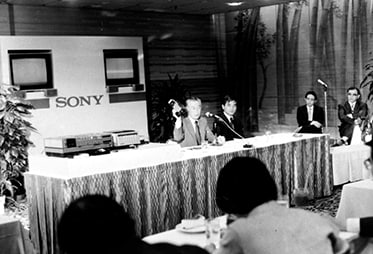
From Left, Iwama and Morio at the VideoMovie Announcement Event (1980)
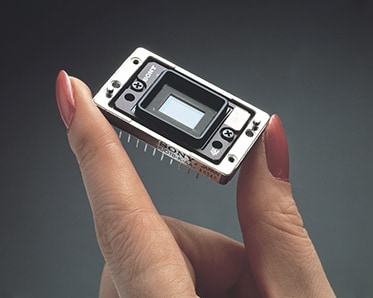
CCD Color Camera Capture Chip
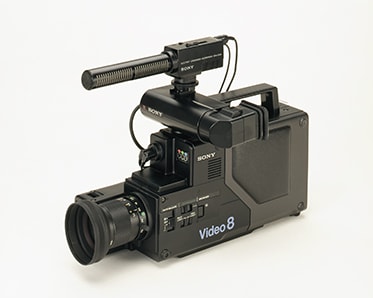
The CCD-V8, the First 8mm Video Camcorder (1985)
Part 5 The Massively Successful CCD-TR55
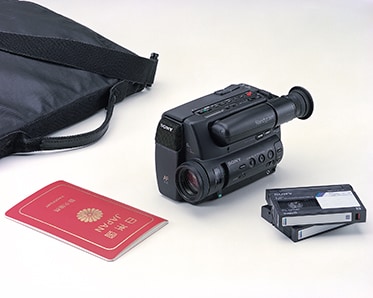
The CCD-TR55 8mm Handycam Camcorder (1989)
Soon after releasing the 8mm video camera, however, both employees within the company and retailers started to remark how VHS-C still managed to be smaller than the 8mm. Sony was soon faced with the need to shrink the 8mm video camera even further, which became the starting point for "Project 88," an idea from Morio's team proposed towards the end of 1986 to sell a consumer-grade lightweight video camera for eighty thousand yen, starting on the 8th of August, 1988. Seeing that over ten million people were traveling abroad every year from Japan, the team decided to focus on young vacationers as their target demographic, designing the new device to be small enough to fit easily inside a travel bag while minimizing parts which would protrude from the main body, such as the lens or control buttons. New ideas were brainstormed and implemented for every aspect of the camera, from its design to its layout, its control scheme, its materials, and its production process. Slowly but surely, by combining strengths from around the company, the new 8mm video camera was coming closer to reality.
At last, in May 1989, the world's smallest and lightest video camera capable of both recording and replaying video was announced: the CCD-TR55. Weighing only 790 grams (1.74 pounds), the supremely portable device sold far better than was expected. The first production lot of fifty thousand units sold out in only two days, with supplies unable to keep up with demand for an additional three months.
Starting with the CCD-M8 released in 1985, Sony's 8mm video cameras had already been labeled with the Handycam brand. The CCD-TR55 was then further marketed as being "passport-sized," emphasizing the device's size and capturing users' imaginations with the device's unprecedented convenience. Recognized for its functionality, quality, price, and of course its design, the CCD-TR55 was eventually selected by the then-Ministry of International Trade and Industry for its Good Design Grand Award (the "G-Mark") that year, beating out nearly four thousand other products in the competition and becoming Sony's first product to receive the Grand Award.
Through Betamax, VHS, and the 8mm video camera, the world of video had finally been brought fully into the home. Starting from the image sensors developed in-house at Sony, Sony's cameras would open up a new realm of possibilities and value to how people experienced images. Producing its devices in-house would also firmly establish Sony's vertical business structure, and the imaging segment would grow to become a reliable backbone for Sony's electronics business far into the future. As the shift would be made from analog to digital in the near future, Sony's imaging technology would continue to evolve and be implemented in countless different fields, from digital still cameras, to smartphones, to medical equipment.