
Chapter 7
Digitizing Music
Part 1 The Early Days of Digital Audio
Walking through Sony's doors in 1971, Heitarou Nakajima had already spent several years working on digitizing sound at the NHK before joining Sony. It was no surprise, then, that not long after he was appointed as head of the Audio Technology Center, Nakajima formed a development team and started work on digitizing audio. The first digital recording device they created, the X-12DTC, was completed in 1974 and was the size of a large refrigerator. This titanic machine marked the beginning of Sony's long and storied history with digital audio.
Wishing to create a lightweight and actually affordable product, Nakajima arrived at one possible conclusion: to adapt the technology to be used with the newly released Betamax home VTR device. Given the large amount of data required to record and play video, Betamax VTR bandwidths ranged between two to three hundred times that of analog audio. By installing a circuit for recording and playing digital audio onto the Betamax machine released just that year in 1975, even data-heavy digital audio could be handled without issue, while simultaneously keeping costs low.
The result of this experiment was the PCM-1, which combined VTR and pulse code modulation (PCM) technology into one PCM audio unit. Sold as the world's first device capable of recording and playing sound digitally, the PCM-1 was put on store shelves in September 1977.
While the PCM-1 was praised for its clear sound quality, it suffered from far more issues than could be made up for by that fact alone.
As dynamic range (the amplitude ratio between the loudest and quietest sounds) increased, background noise would inevitably taint the recording unless done in a well-soundproofed room. The device's developers had failed to foresee differences between the development environment and the environment where the device would actually be used. Nakajima readily and humbly accepted this feedback, treating it as a lesson for their next project.
The project met with some unexpected good luck as well, however. Developed simultaneously with the consumer-grade PCM-1, a prototype professional-grade PCM processor was highly praised by world-renowned conductor Herbert von Karajan. During a visit to Japan in September 1978, a PCM device was used to record one of Maestro Karajan's practice sessions and, upon replaying the digitally recorded music, he was struck by what he referred to "a new sound." Maestro Karajan's approval became a source of deep motivation for the engineers working on the project.
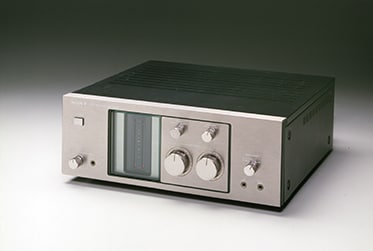
The PCM-1 Audio Unit (1977)
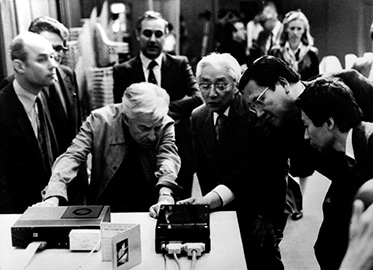
DAD (Digital Audio Disc) Demonstration in Salzburg (from left: Herbert von Karajan, Akio Morita, and Norio Ohga)
Part 2 Lessons from the PCM-1
Since the earliest stages of development on the PCM-1, Sony had already begun experimenting with optical discs for recording and playing digital audio. During the same period when the Betamax consumer VTR was brought to market in 1976, Sony was also testing products utilizing LaserDisc video disc technology, which had been pioneered by Philips. Seeing a promising future for Sony in laser-based technology, Kazuo Iwama also gave his support for the project, leading to the formation of a team working on optical video discs.
That spring, Toshitada Doi brought a prototype PCM-1 to the videodisc development team office and asked them to cut a fresh disc for him. He then tried to use the PCM-1 to convert the video disc directly into a digitized audio disc without any modifications or alterations to the disc, something which should have been possible with the technology at hand.
The result, however, was disappointing. Amidst a deafening wall of static noise, the recorded music failed to even play continuously, constantly skipping between fragments of the recording - far from the clean audio that the team expected. The cause, as was eventually discovered, was due to signal dropout from dust particles and other contaminants on the disc. After many attempts to fix the issue, the team would eventually solve the problem by using mathematical error correction techniques. This was quite a bold solution, as such techniques had not yet been incorporated into manufacturing processes at that point, but the decision to implement this technology at this early stage served as a key breakthrough for developing the future Compact Disc format.
COLUMN
Sony's DNA
Key to the Digital Audio Revolution: Error Correction Techniques
Digital audio is recorded onto discs by first converting an audio signal into binary (data represented by numerical values of one or zero) and then engraving microscopic pits onto the disc surface corresponding to the binary data. Upon playing the disc, lasers are fired at the disc surface, which are read by a detector. The engraved pits cause changes in the detected signal's strength, which are then reconverted back into electrical signals.
Error correction refers to a technique where a device reading a disc can mathematically detect misread signals during the process of converting detector signals into electrical signals - a crucial breakthrough for the technology, as discs are far more prone to signal errors than magnetic tape. After experimenting with the prototype PCM-1, Doi immediately ordered his team of computer scientists to begin creating systems to simulate the error correction process. This became a deciding factor behind Sony's dominance within the field of digital audio.
Part 3 Joint Development with Philips
Amidst the furious ongoing experimentation, Norio Ohga paid a visit to Philips in June 1978. There, he laid his eyes upon the prototype Audio Long Play (ALP) disc, a disc 11.5 centimeters in diameter, capable of storing one full hour of music data. Immediately recognizing the technology's potential to succeed vinyl as a music format, Ohga knew that if Sony and Philips were to work together on this project, they could create something truly amazing. After all, Philips was the leading developer of optical video disc technology, while Sony was the company behind developing ground-breaking digital audio processing technologies. If these two titans were to join forces, there would be no doubt that something new and revolutionary would be created. Each of the companies also had a record company under their umbrellas, which strengthened their music distribution capabilities and provided further incentive for the venture.
After several meetings between the Sony and Philips executives, a plan was formally hammered out for joint development to begin with Philips. Once the digital audio disc format was solidified between the two companies, the resulting concept would be presented at an industry meeting in June 1980.
Immediately upon starting joint development, however, debates emerged between the two companies on a variety of measures. Philips had proposed using a 14-bit system as it would be easier to implement, whereas Sony preferred a 16-bit system for its greater dynamic range, despite the technological difficulty it would bring - the companies ultimately decided on the 16-bit system. Recording time and disc size also sparked debate, with Philips pushing for an 11.5 centimeter disc (the same length as the diagonal of a compact cassette) containing 60 minutes of recording time, to which Ohga responded, "if it can't play an opera in full, it's no good." A seventy-five-minute runtime would fit over 95 percent of all classical pieces - which when calculated, meant that the disc would need to be twelve centimeters in diameter. Slowly but surely, through these types of debates, this new era-defining format would be brought to reality.
The end result was Sony's proposed sixteen-bit twelve-centimeter disc, capable of seventy-five minutes of recording at 44.1 kilohertz. Ultimately named the Compact Disc Digital Audio System, the technology which would go on to become a de facto standard for the entire music industry was finally born.
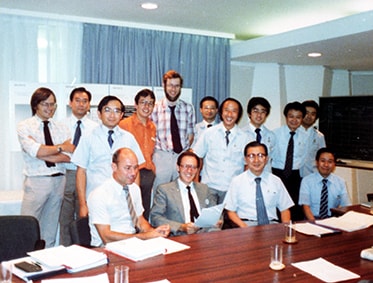
The Sony and Philips Engineering Teams (1979)
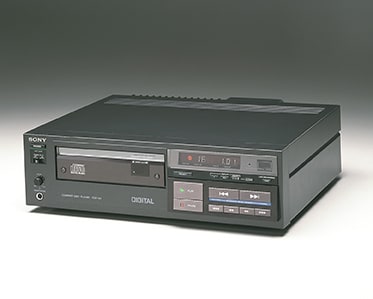
The CDP-101, the World's First CD Player (1982)
Part 4 The CDP-101 CD Player
Concurrently with preparations for the upcoming industry meeting, the development team was also hard at work developing the first commercial product to make use of the new CD format. Although Ohga had proposed a launch date of October 1982, the timeline was unrealistic. Key components in the hardware had various flaws that needed to be upgraded, requiring far more development time to get the product up to a marketable standard.
Between the optical pickup components, the lenses, and the circuit semiconductors, not a single component was up to standard. After consolidating the various issues, over two hundred distinct problems remained to be solved - far too many to accomplish in just two years. More members were brought onto Nakajima and Miyaoka's technology research team to tackle these issues, including Katsuaki Tsurushima's team from the acoustic business' technology department, and members from Nobuyuki Idei's audio department.
Despite the difficulties, a number of problems were eventually solved after combining forces from each of these separate departments. A prototype was completed in 1981, followed by a more compact prototype in the same year to be displayed at the Audio Fair convention that fall.
In the end, however, hardware can never succeed without software to accompany it. Ohga soon ordered CBS Sony Records to begin preparing a facility for the mass production of CD software, which after much debate, resulted in a factory on the bank of the Oi River in Shizuoka Prefecture to house the world's first CD software production facility, alongside a cleanroom. Although production activities were to officially begin in April 1982, the decision to make the discs out of new polycarbonate materials was only finalized in August, CD production only went online in mid-September, and further adjustments were made all the way up to the first sale dates in October.
This lightning pace was what allowed Sony to push out the very first CDP-101 on the 1st of October 1982. Starting at a price of 168,000 yen, the launch was accompanied by the release of the world's first fifty CD titles from CBS Sony. Though Billy Joel's 52nd Street perhaps stands out as most notable among the titles, this initial set of releases spanned many genres, including classical, pop, rock, and Showa pop music. This genre variety was meant to establish a wider market of listeners, and by the end of the year, over one hundred titles had been sold in the new media format. CBS Sony continued expanding their CD catalog into the future, releasing a best hits album of then-retired idol Momoe Yamaguchi which became a best seller in 1984. Following the jazz revival of the time, CBS Sony also produced CDs of and for The Miles Davis Series, Pablo Records, Prestige Records, Riverside Records, and later Blue Note Records, growing their customer base beyond classical music fans.
This marked the dawn of the CD age. The series of projects also became the first example of Sony's strategy of "joining hardware and software," exemplified by the future "PlayStation" which focused on developing markets through both technology and media content. The success of the Compact Disc would later be described by Ohga himself: "I'm not sure anything can symbolize the power that the entire Sony Group together holds better than the CD."
Part 5 Universalizing the Music Listening Experience: The Portable CD Player
Although CD demand continued to grow after establishing itself as a new format, the core customer base remained largely the same: audiophiles. Sony naturally wished to expand CDs to the general public, for which they would need a smaller and more affordable CD player.
It was here when Kozo Ohsone, now in charge of the General Audio Department specializing in compact audio devices, spurred his team into action. "Let's try making a CD player like this," he told his employees, giving them a square-shaped block of wood measuring 13.4 centimeters on each side and about four centimeters thick - as large as four CD cases stacked together. "I don't care if you need to put crickets or cicadas in there, just get it to make sound," he emphasized.
Although his demands were strict from the get-go, Ohsone made sure to maintain a sense of humor in his work. Setting device specifications by using a wood model that anyone could pick up and visualize was also one of Ohsone's trademarks, as he firmly believed that "instead of basing our ideas only on devices that already exist, we should aim for a small device anyone would be happy to use and not settle for anything less." Morita too, with his mind set on further growing the CD format, laid out his own demands on the price front. "We need to keep it below fifty thousand yen," he decided. "Even if we take some losses at first, the profits are sure to come in the future." Following these two philosophies, the D-50 was put to market in November 1984, two years after the first CD sales. Not only was it sold at the then-jaw-dropping price tag of only 49,800 yen, but the device managed to fit all of the capabilities of the CDP-101 into that CD-case-sized block Ohsone had proposed, promptly leading the D-50 to become a smash hit.
The success of the D-50 prompted even more titles to be released on CD, thus establishing the music CD industry proper. Although CD production was a mere tenth of analog records during the tail end of 1984 - when the D-50 was first put to market - the two formats had started to reverse positions just two years later in 1986. By 1988, CD production had already surpassed analog record's peak with one hundred million units, and in 1992 CDs achieved a staggering three hundred million units produced.
CD players were also becoming increasingly more compact at a faster pace. Sony would soon release a portable CD player that could be listened to while walking, akin to the Walkman, named the Discman (later unified under the CD Walkman name). Production was also speeding up, with Sony Group alone producing one hundred twenty million CDs annually in Japan, the United States, and Europe by 1987, rapidly constructing a worldwide distribution system for both CD hardware and software.
Sony's CD business would continue to expand by marketing its device components to professional clients as well, including their large-scale integration (LSI) and semiconductor-based optical pickup technology. Under Ohga's directive to try to occupy 50 percent of the CD player market when including these component sales, Sony would hold as much as a 70 percent share of the entire CD player market at its peak. The optical pickup devices, for instance, would begin sales in 1984 and reach one hundred million units sold in the following ten years. When counted together with the components used within Sony's own devices, the total number of these components numbered two hundred million - equivalent to half of all the CD players in the world.
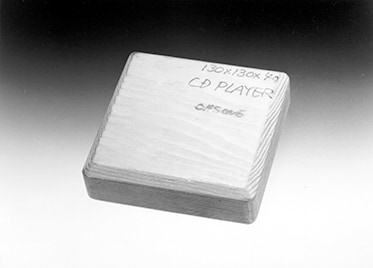
Wooden Maquette of the D-50 Signed by Ohsone (1983)
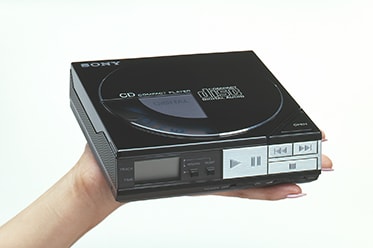
The D-50, the World's First Portable CD Player (1984)
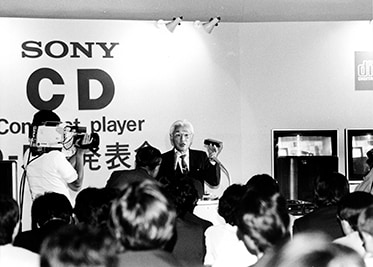
Morita at the D-50 Announcement Event (1984)
Part 6 The MiniDisc
Although the explosive success of CDs led to their quick dominance over vinyl records as the new form of playable media, sales of the compact cassette - the dominant form of recordable media at the time - were beginning to plateau as the world headed into the 1990s. Ohga soon set his heart on creating another disc-based device to succeed cassettes as the next generation of recordable audio media, and soon happened upon Tsurushima's team in the Audio Development Division working on an audio-recordable CD. Ohga's direction to them was swift: "instead of recording to CD, we need to make something smaller - a smaller disc to replace the compact cassette's recording and play functions." Work on this new form of audio media began in 1990.
As members who had experience developing the CD assembled under Tsurushima, work began on using magneto-optical recording technology to record audio data onto an even smaller-sized magneto-optical disc. Having decided on a 6.4-centimeter-wide disc, the task now was to fit the same seventy-five minutes of recording time on a CD onto a disc half as large and with one-fourth the surface area. This issue was solved with help from the Information System Research Center by developing a new signal processing method named ATRAC, allowing for significantly improved audio compression techniques. Walking while holding the device was also known to cause the disc to skip, so work was done simultaneously on a shock-proof memory system using semiconductor-based memory chips that would solve this issue.
Development finished just over a year later in May 1991, with the new audio format being revealed to the public as the MiniDisc. The device was capable of recording audio like a cassette but possessed the high audio quality and quick seek times of a CD. The discs were loaded into cartridges so as to be easy to carry, and thanks to the shock-proof memory, the whole device could be carried around without any playback issues.
The use cases for each format were now made clear: the CD was for listening to music while relaxing; the MiniDisc was for convenient listening on the go. Aggressive marketing campaigns were conducted across Japan, the United States, and Europe under Ohga's leadership, and licenses were quickly signed with prominent hardware and software makers across the industry to expand the MiniDisc ecosystem.
Shizuo Takashino's team from the General Audio Department, who specialized in technology miniaturization, was ultimately given the task of turning the MiniDisc fully into a marketable product. Their next job - to further shrink the device down to a disc size of a mere six centimeters - came to fourteen of their most seasoned members who had worked on both the Walkman and the D-50 towards the end of 1991. Their deadline: November 1992. Aiming to release the new device at the same time as Philips and their business partners were planning to release the Digital Compact Cassette, they had less than a year to complete this daunting task.
Work on the MiniDisc's software and recording media, on the other hand, was proceeding swimmingly as they faced this deadline. Plans were made across Japan, the United States, and Europe to streamline production by installing equipment into the already operational CD production facilities. In Japan, Sony Music Entertainment (Japan) (SMEJ) began their MiniDisc project, while President of Sony Corporation of America and Chairman of Sony Music Entertainment (SMEI) David Schulhof began business discussions with various record companies. Actual MiniDisc production began swiftly in August 1992 in Japan and later that fall overseas, while MiniDiscs meant for recording started production in Sendai.
Finally, in November 1992, sales of the recording-model MZ-1, the replay-model MZ-2P, and the recordable MDW-60 MiniDiscs hit store shelves in Japan, alongside 88 MiniDisc titles released by Sony Music Entertainment (Japan). Both hardware and software sales would grow as the devices were then released overseas the next month, and by 1995, over one million MiniDisc products had been sold in Japan alone.
With the CD's release in 1982 and now the MiniDisc's release in 1992, Sony had once again brought new tides to the music industry ten years after its revolutionary CD. The path for digital audio would continue to expand into the future, becoming ever more convenient as new eras came to pass.
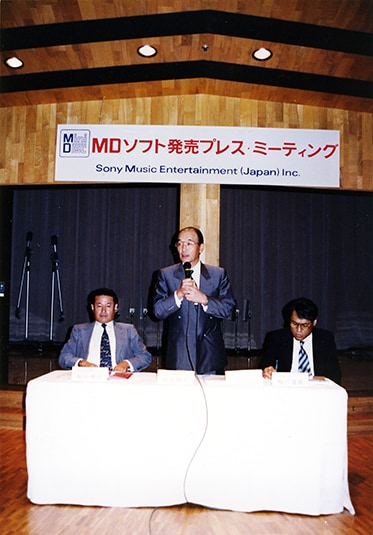
SMEJ President Shugo Matsuo announcing MiniDisc titles (1992)
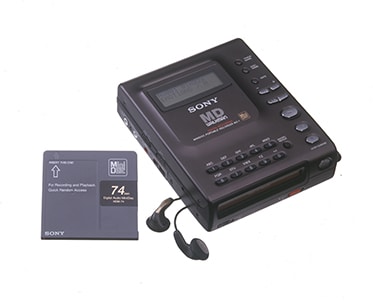
The MZ-1, the First MiniDisc Recorder (1992)