
Ethics and Compliance

Basic Approach
Under our Purpose & Values we strive to earn trust for the Sony brand through ethical and responsible conduct. Such commitment supports Sony’s value creation.
With this in mind, Sony’s ethics and compliance program is designed to comply with laws, manage key group-wide risks, and foster an ethical corporate culture. The program is continuously improved, taking into account changes in the business environment, based on both best practices and global regulatory expectations.
Sony has also adopted in-depth group-wide policies, procedures, and controls for key risk areas such as antitrust, anti-corruption, and privacy and personal information management. Senior management evidences its commitment to ethical business conduct by repeatedly communicating the importance of staying true to the Code and leading by example.
Looking to the Future
Sony continuously assesses its risks and engages in ongoing reviews and program improvements to maintain and elevate an ethical corporate culture. Senior management continues to allocate necessary resources to achieve Sony’s goal of ethical and responsible business conduct and compliance with all applicable laws and regulations by all Sony Group personnel.
The Sony Group Code of Conduct
The Code of Conduct is the cornerstone of Sony’s ethics and compliance program and applies to all Sony board members, officers, and employees (“Sony Group personnel”).
The Code explains what we should do in our day-to-day work to earn trust for the Sony brand, embracing Sony’s Purpose & Values. The Code provides a set of guiding principles to conduct our business activities on a principled path. Staying true to the Code is the basis for earning trust from stakeholders, and such continued efforts contribute to Sony’s sustainable growth.
Sony engages with colleagues, business partners, and the communities in which Sony does business based on the Code.
Please refer to the below page for the Code of Conduct.
Sony periodically updates the Code of Conduct as part of its continued effort to provide clear direction on Sony’s ethical principles and to maintain the Code’s effectiveness.
The Code confirms Sony’s commitment to its core ethical values in every aspect of its business operations and includes guidance on key areas such as:
-
Earn Trust
Earn Trust for the Sony Brand / Make Sound Business Decisions / Speak Up -
Contribute to the World
Contribute to a Sustainable Society / Live with Planet Earth -
Empower and Respect People
Respect Human Rights / Embrace Diversity of People and Foster Respect / Engage in Sound Labor and Employment Practices / Maintain a Healthy and Safe Work Environment -
Strive to Create and Deliver Kando
Be Diverse and Competitive / Deliver Kando Experiences / Market Honestly / Compete Fairly -
Collaborate Responsibly
Collaborate with Business Partners / Source Responsibly -
Embrace Creativity and Technology
Use Technology Responsibly / Create and Protect Intellectual Property / Safeguard Confidential Information / Respect Privacy / Maintain Information Security -
Safeguard Sony’s Integrity
No Corruption / Avoid Conflicts of Interest / Protect Sony’s Assets / Keep Accurate Records and Reports / Make Appropriate Public Disclosures / No Insider Trading / Follow Trade Control Laws / Follow Tax Laws / Communicate Responsibly
Sony also recognizes its responsibility as a member of a global society. The Code reflects principles set out in relevant ethical guidelines, which include (among others):
- Organization for Economic Co-operation and Development (OECD) Guidelines for Multinational Enterprises
- The United Nations Global Compact
- The United Nations Guiding Principles on Business and Human Rights
- The United Nations Universal Declaration of Human Rights
- Sustainable Development Goals (SDGs)
Sony also actively participates in Keidanren (Japan Business Federation), an alliance of Japan’s leading corporations and observes the standards in the Charter of Corporate Behavior of Keidanren. These standards are also embodied in the Code.
The Code was approved by the Sony Group Corporation Board of Directors and adopted by the decision-making bodies of every Sony Group company as their respective code of conduct. Sony Group managers, at all levels, are responsible for promoting the Code as part of their ongoing commitment to creating a culture of integrity and ensuring ethical and responsible business conduct. The Code, which is available on Sony’s website and on each Sony Group company’s intranet, is provided in 25 languages to help ensure that it is clearly understood by Sony Group personnel and relevant third parties working for Sony. Sony provides additional translations as necessitated by changing workforce demographics.

KPIs/Targets
• Foster an ethical culture based on Sony’s Purpose & Values and the Sony Group Code of Conduct.
• Continuously assess compliance risks in relation to business activities and review the compliance program based on the results of the assessment.
Organizational Structure
Sony instituted a global ethics & compliance network to ensure effective oversight and implementation of our program by all Sony Group companies.
Global Ethics & Compliance Network
Overview
Sony’s global ethics and compliance program is designed to support ethical and responsible business conduct. It is a shared endeavor among directors, management, and employees at all levels at Sony, with each person taking ownership and responsibility for ethical business conduct and compliance with the law and in every interaction. Sony established a group-wide ethics & compliance network (the “Global Network”) to strengthen effective implementation of the ethics and compliance program throughout Sony Group.
In the Global Network, Business Domain Heads and management have a responsibility as the first line for ensuring an ethical culture and managing legal risks associated with the business. Sony’s ethics and compliance personnel and departments, as the second line, provide support, advice, and oversight to the business to support an ethical culture and effective risk management.
Sony’s Monitoring Team and Audit departments provide objective and independent assurance.
The Global Network (i) establishes a centralized compliance risk related management framework in line with best practices; (ii) provides necessary support and guidance to ethics and compliance personnel embedded in the business; and (iii) monitors compliance with the risk management framework to provide effective oversight, addresses gaps between the ethics and compliance program’s requirements and actual operations, and drives consistency and continuous program improvement across all Sony Group companies.
Roles
Executives in charge of Compliance:
Provide top-level leadership for the Global Network and oversee Sony’s global ethics and compliance program.
Sony Group Corporation Ethics & Trust Department:
Under the Executives in charge of Compliance and with support of the Compliance Leadership Team, designs and implements Sony’s group-wide ethics and compliance program and network, and provides updates to the Board of Directors and the Audit Committee. It also works with the Compliance Leadership Team members and the Ethics & Compliance Officers to conduct comprehensive risk assessments and implement compliance policies, procedures, and internal controls to prevent and detect unethical behavior. It provides oversight of investigations related to potential legal or policy violations.
The Compliance Leadership Team:
Provides advice and recommendations regarding program activities and input regarding operational and regional issues. The team is comprised of the Senior Vice President in charge of Compliance, all Ethics & Compliance Strategy Leaders, the Head of the Monitoring Team, and experienced legal/compliance personnel from Sony Group companies.
Monitoring Team:
Helps to measure the effectiveness and maturity of Sony’s global ethics and compliance program by conducting periodic and global-based assessments on program implementation and by undertaking risk-based compliance audits and validations of internal controls.
Business Domain Heads and Ethics & Compliance Officers:
Implement and execute the ethics and compliance program and other activities to effectively manage the legal and regulatory risks and maintain the ethical culture in their Business Domain.
Global Ethics & Compliance Network

Oversight by the Board of Directors and Audit Committee
The Sony Group Corporation Board of Director’s Audit Committee provides oversight of Sony’s program. The Audit Committee receives monthly reports as well as periodic, in-person updates concerning the ethics and compliance program’s activities. Reports to the Audit Committee include information about global regulatory developments, top and emerging risks, and data used to inform program design, implementation, and effectiveness, such as data derived from program assessments, audit and investigation results, compliance hotline metrics, ethical culture survey results, and employee training data. It also includes information about program improvements. The Sony Group Corporation Board of Directors also receives annual updates on compliance-related risks and Sony’s global ethics and compliance program.
Key Initiatives in FY2025
- Operated the Sony Ethics & Compliance Hotline, an internal reporting mechanism (663 cases in fiscal 2025).
- Implemented third party risk-management based on the Sony Group Third Party Engagement Policy.
- Conducted the Compliance Program Review.
- Developed and implemented action plans based on results from Sony’s most recent Ethical Culture Survey.
- Implemented anti-corruption programs based on the Sony Group Anti-Bribery Policy.
Sony’s Ethics and Compliance Program
The Basics
Sony’s ethics and compliance program starts with “Tone from the Top.” Senior management continuously communicates the importance of being true to Sony’s core ethical values. Their commitment is supported by a robust ethics and compliance program aligned with business processes, including ongoing risk assessments, policies and procedures, training and messaging, third party management, resources for reporting, and monitoring and audits. Sony continuously improves its program in accordance with regulatory guidance and other leading practices that organizations with mature ethics and compliance programs have found to be effective.
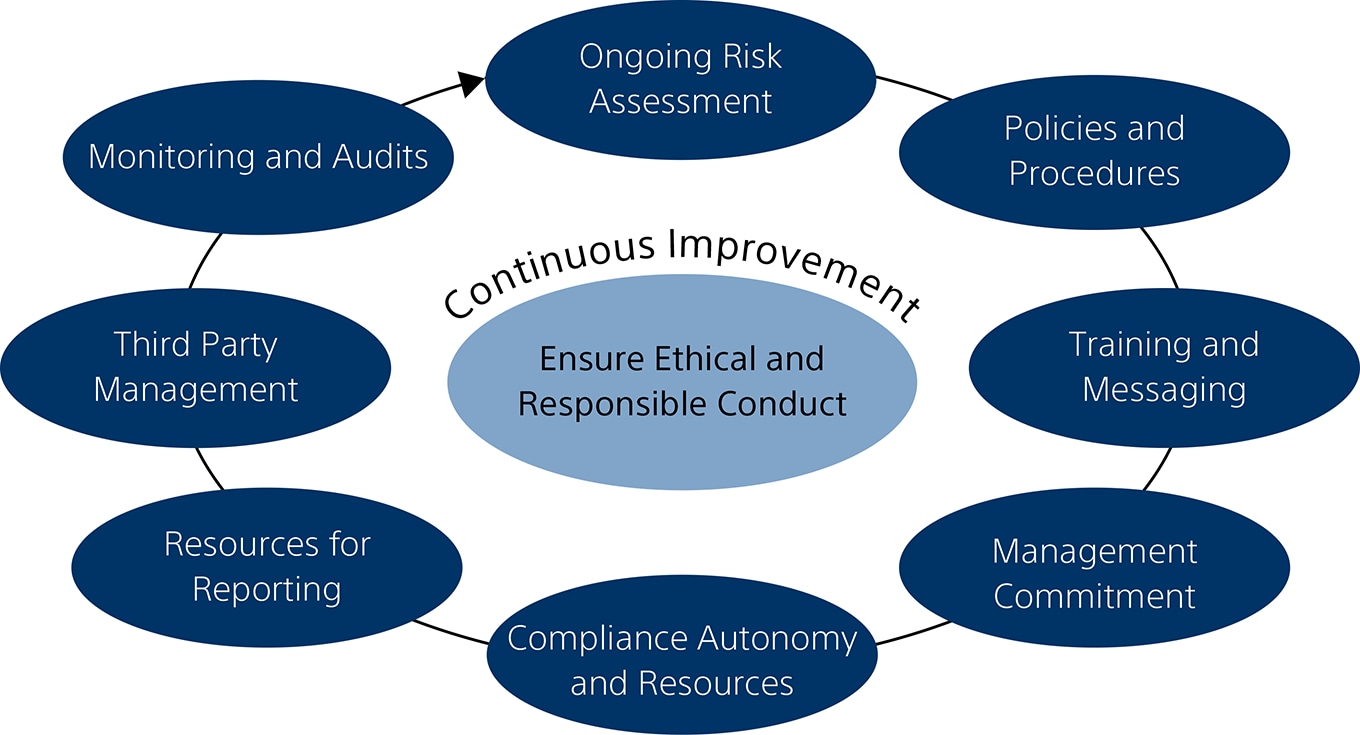
Risk Assessment Areas under Ethics and Compliance Program
Sony conducts ongoing risk assessments to help ensure that Sony’s ethics and compliance program activities effectively mitigate and manage our top risks. When conducting risk assessments, the Ethics & Compliance Officers perform the risk evaluation process for relevant ethics and compliance risks in their respective business domains together with business management. The SGC Ethics & Trust Department then evaluates the overall risk of Sony Group based on the business domains’ risk evaluation results.
Key legal and compliance risk areas assessed include:
- AI Related
- Antitrust / Competition
- Bribery
- Conflict of Interest
- Economic Sanctions
- Environmental Related
- Financial Regulations
- Fraud
- Information Security
- Infringement of Intellectual Property
- Insider Trading
- Labor and Employment Related
- Money Laundering
- Privacy / Personal Information Protection
- Product Safety / Product Compliance
- Public Disclosure
- Supply Chain Related
- Trade Compliance
Policies and Procedures
Sony’s global policies provide necessary rules and procedures to help ensure ethical and responsible business conduct and compliance with applicable laws and regulations. For example, Sony maintains global policies in each of the following risk areas:
- Sony Group Anti-Bribery Policy
- Sony Group Third Party Engagement Policy
- Sony Group Record Retention Policy
- Sony Group Global Policy on Antitrust / Competition Law Compliance
- Global Insider Trading Prevention Policy
These policies are regularly communicated to all Sony Group personnel and relevant third parties as appropriate. Policies are regularly reviewed to ensure that they clearly state Sony’s direction on important matters, reflect current legal and business requirements, and are effectively implemented by the relevant business units.
Antitrust and Competition Law Compliance
Sony seeks to outperform competition based on the merits of its products, services, and entertainment - not by unfair business practices. Sony complies with all antitrust and competition laws and does its part to promote a fair and competitive marketplace. Sony has implemented the Sony Group Policy on Antitrust / Competition Law Compliance, which explains the purpose of competition laws and guides employees on compliance with such laws. Sony personnel monitor changes and developments in competition laws and maintain up-to-date controls, policies, and procedures for compliance with these laws.* Sony has also developed robust, customized training courses to raise awareness regarding competition laws and to reinforce the policy requirements.
- *Sony’s material legal and regulatory proceedings in fiscal year 2025 are disclosed in our Form 20-F: “Item 8. Financial Information A. Consolidated Statements and Other Financial Information. Legal Proceedings,” p. 87.
Training and Messaging
Sony has adopted a “Compliance Education Protocol” to ensure that minimum ethics and compliance training and communications in critical risk areas are provided to all employees and relevant third parties working for Sony. For example, all Sony Group personnel and relevant third parties working for Sony are required to complete comprehensive Code of Conduct training and Proper Workplace Conduct training within 90 days of first providing services to Sony. Refresher comprehensive Code of Conduct training must also be completed at least every four years. In addition, in-depth training on key Code of Conduct topics must be completed at least once every two years and training on information security and privacy must be completed at least annually. Additional compliance training is mandated based upon risk assessments and employee and third-party roles and responsibilities. Key ethics and compliance training includes:
- Anti-Bribery
- Third Party Engagement
- Antitrust and Fair Competition
- Import / Export Trade Compliance
- Manager Training
Furthermore, frequent messaging concerning Code topics and key risk areas is provided to all Sony Group personnel and relevant third parties working for Sony.
Third Party Management
Sony established internal rules and procedures to help ensure compliance with applicable laws and regulations related to potential third party risks, which include: bribery, money laundering, economic sanctions, trade controls, tax matters, and supply chain laws related to the procurement of electronics products.
These rules are designed to help ensure that Sony only does business with reputable third parties.
Third Party Due Diligence
The Sony Group Third Party Engagement Policy was established to help ensure compliance with applicable laws and regulations related to potential third party risks, which include: bribery, money laundering, economic sanctions, trade controls, tax matters, and supply chain laws related to the procurement of electronics products. This policy describes the methodology for assessing the risk profile for higher risk transactions and includes risk-based due diligence and pre-approval requirements. Required due diligence is performed by the employees responsible for the transaction with support from legal, finance, and accounting as appropriate. The results of due diligence determine whether the transaction can proceed or whether it can only proceed subject to additional safeguards. Ongoing monitoring for red flags is required and due diligence must be refreshed periodically after the commencement of the transaction. All personnel involved in third party onboarding, including relevant personnel in Sony’s finance, accounting, trade controls, and legal functions are required to receive training on this policy.
Anti-Bribery and Corruption
Sony believes that corruption negatively impacts the communities and economies where we do business and that it must be eliminated to realize a sustainable, inclusive, and transparent society. One of the core principles set forth in the Code is the need to give due consideration to the impact of our business activities on the interest of our stakeholders. The Code prohibits all types of corrupt practices. Sony has also adopted global policies (“Sony Group Anti-Bribery Policy” and “Sony Group Third Party Engagement Policy”) that contain rules and procedures designed to prevent corruption involving government officials.
Sony closely monitors global anti-corruption laws and enforcement trends to ensure that Sony’s global ethics and compliance program and internal controls properly address these evolving risks.
Sony’s Anti-Bribery and Corruption Program
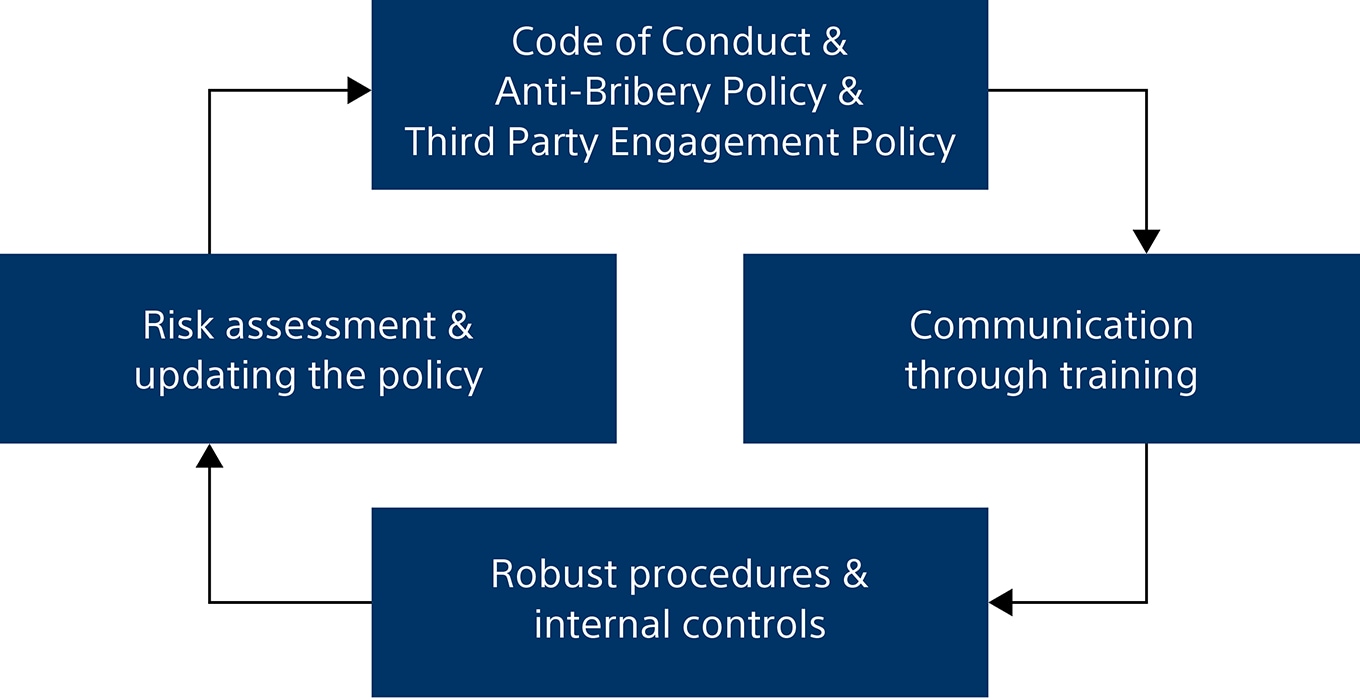
Policies
- The Code prohibits improper payments in every transaction, whether with a government official or with a private party.
- The Sony Group Anti-Bribery Policy provides rules and procedures designed to prevent government corruption, including pre-approval rules and limitations on the amount and type of permitted expenditures.
- The Sony Group Third Party Engagement Policy provides rules and risk-based procedures, including due diligence and pre-approvals for any third party that may interact with a government official on Sony’s behalf.
Communication through Training
- Sony provides extensive training and support to assist local management with policy compliance. For example, all Sony employees receive training on anti-bribery and corruption expectations as part of the Code of Conduct training upon hire. Refresher training is also provided at least every four years thereafter.
- In addition, employees who are at a higher risk for interactions with government officials (i.e., senior management, marketing, sales, procurement, and any other employees identified as dealing with government officials) receive more focused anti-corruption training at least every two years and more frequently if indicated by risk assessments. This enhanced training includes training on Sony’s specific policy pre-approval and due diligence requirements.
- For personnel in Sony’s control functions (legal, finance, accounting, and other control personnel) the above described training is supplemented by live, in-person training.
Robust Procedures & Internal Controls
- Sony has implemented robust internal controls and accounting processes designed to detect and prevent violations of company policies relating to improper payment risks and to ensure accurate books and records.
- Third parties (including intermediaries such as distributors and sub-agents) who interact with government officials on Sony’s behalf, joint venture partners, parties to acquisition targets, and certain investments are subject to risk based due diligence. In accordance with the due diligence procedures specified based on risk levels—including but not limited to the type of transaction, whether the transaction involves any red flags or high risk territories that Sony specifically identifies in its polices, and whether the transaction involves any intermediaries such as distributors and sub-agents—employees handling the transaction and professional functions such as the Finance, Accounting, or Legal departments in each company perform due diligence together as appropriate. Due diligence is performed periodically thereafter if the transaction is continuous in its nature. Any transacting parties (including intermediaries such as distributors and sub-agents) who pose high risks must also agree to abide by applicable anti-corruption laws and regulations and Sony’s Anti-Bribery Policy and Third Party Engagement Policy.
- Concerns are promptly investigated via the Global Network and legal department of each subsidiary. Appropriate action for the case such as disciplinary, remedial, and/or corrective action is considered and implemented. Such remediation activities are monitored until completed.
Risk Assessment & Updating Policy
- Sony conducts periodic anti-corruption assessments and audits of its business to raise overall awareness, detect potential misconduct, and monitor compliance with anti-corruption laws and policy.
Sony continues to leverage opportunities to share both knowledge and best practices across its system.*
- *Sony’s material legal and regulatory proceedings in fiscal year 2025 are disclosed in our Form 20-F: “Item 8. Financial Information A. Consolidated Statements and Other Financial Information. Legal Proceedings,” p. 87.
Elimination of Anti-Social Forces
Sony strongly opposes anti-social forces that threaten to disrupt the order and safety of the community. Sony will not entertain relationships with members of anti-social forces. Furthermore, Sony will not give economic benefits to, or accept illegal demands from, any anti-social force. Sony ensures that it does not do business with members of organized crime and other anti-social forces by performing due diligence procedures on its business partners and providing relevant communications to its employees.
Reporting Concerns
Sony believes that a “speak up / listen up” culture—where employees are encouraged to raise concerns and feel confident that they can do so without fear of retaliation—is a key to early detection and prevention of ethical and regulatory problems.
Multiple Reporting Channels
Sony provides many different types of resources to employees to enable them to raise concerns, including the Sony Group Ethics & Compliance Hotline (“Hotline”).

The Hotline is available online (in 33 different languages) or by phone, 24 hours a day, seven days a week. The phone lines are staffed by specially trained third-party representatives, with translators in up to 47 different languages. All information provided to the Hotline is handled confidentially. Calls to the Hotline are not recorded or traced, and reporters may remain anonymous to the extent permitted by law.
How Sony Operates the Hotline / How Sony Investigates Reported Matters

All concerns raised through the Hotline are investigated independently of ordinary internal reporting structures. Third party representatives, following the receipt of concerns, check possible conflicts of interest before providing necessary information to the appropriate ethics and compliance personnel. The ethics and compliance personnel review each report to determine the appropriate investigator with subject matter expertise to conduct the investigation. Under the oversight of Sony Group Corporation Ethics & Trust Department and respective Ethics & Compliance Officer, the ethics and compliance personnel and the investigator investigate the reported allegations, collect more information, and take other actions as appropriate. They may also work with internal or external legal and/or other subject matter experts to determine how to best investigate and resolve the allegations. When a violation of law or company policy is confirmed, management will take any necessary corrective action to improve business operating systems or take disciplinary action against employees involved in the violations. Each Ethics & Compliance Officer reviews all reports, responses, and investigation results for all companies in their business domain to help ensure matters are fully and fairly addressed. The concerns raised by the Hotline are reported to Sony Group Corporation Ethics & Trust Department either immediately or on a monthly basis, depending on the nature of the case. All cases are ultimately reported to the Sony Group Corporation Audit Committee.
In fiscal year 2025, the Hotline received 663 concerns. The pie chart below shows the total number of concerns received in fiscal year 2025 by category. 68% of raised concerns related to employees, diversity, and the workplace. 13% related to business integrity.
FY2025 Reported Concerns by category
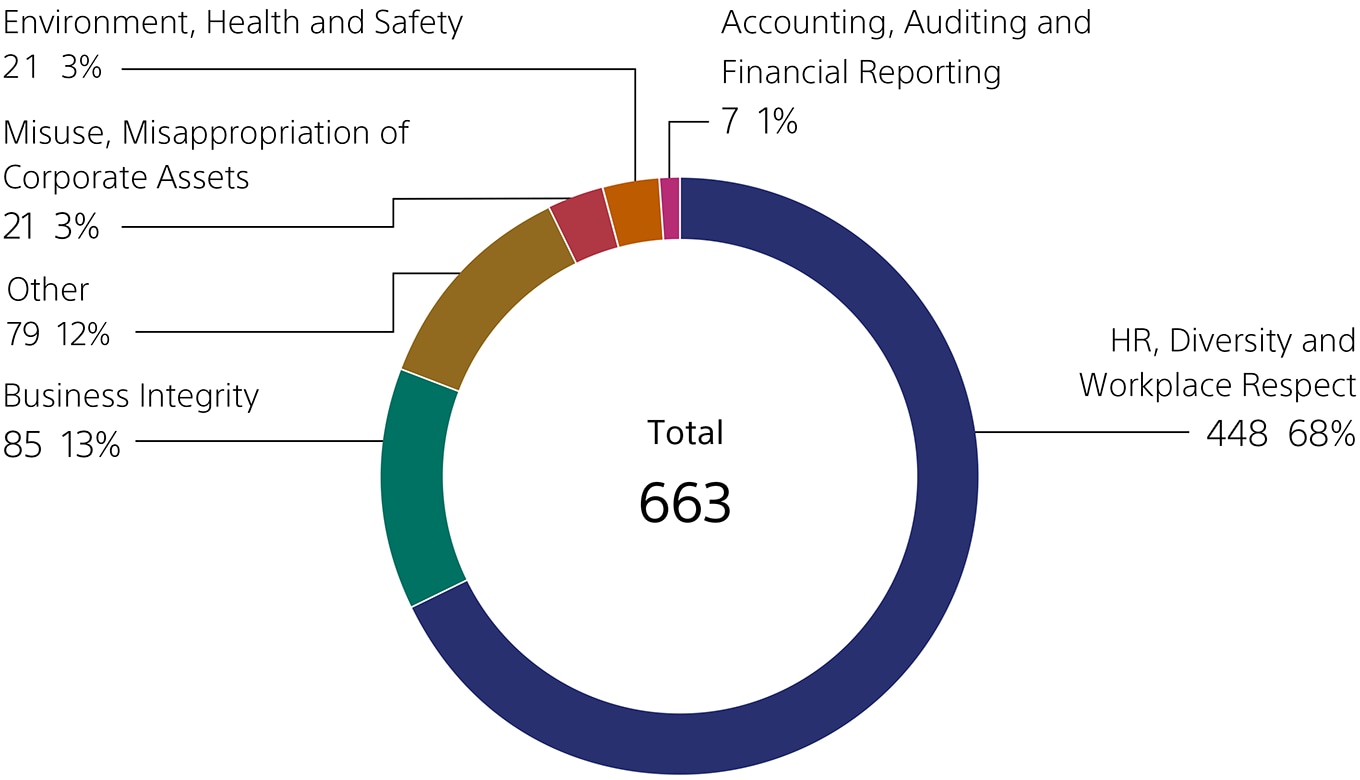
- Notes:The figures in percentages are rounded to the nearest whole number.
In fiscal year 2025, 138 concerns were substantiated and remediated as appropriate. The remainder includes cases that were unsubstantiated, and cases under investigation, among others.
The table below are examples of issues raised through our Hotline, including information about how these issues were addressed.
FY2025 Hotline Cases
| Issue(s) Raised | Guidance | Action(s) Taken |
|---|---|---|
|
A manager instructed employees to submit expense claims that did not accurately reflect the actual circumstances. |
The Sony Group Code of Conduct provides that Sony personnel must not cause records to be inaccurate or create records that are misleading or artificial. |
An investigation confirmed the allegation. The manager was given a stern warning and provided with guidance to prevent recurrence. |
|
An employee submitted commuting expense reimbursement requests that did not reflect the actual commuting route. |
The Sony Group Code of Conduct provides that Sony personnel must not cause records to be inaccurate or create records that are misleading or artificial. |
An investigation confirmed the allegation. The employee reimbursed the expenses and was subject to disciplinary action. |
|
A manager used disrespectful language towards an employee. |
The Sony Group Code of Conduct provides that Sony is committed to a workplace culture based on respect. |
An investigation confirmed the allegation. The manager was provided with a stern warning and guidance concerning proper conduct in the workplace. |
How Sony Promotes Speak-Up Resources
Sony continuously promotes both the need to raise concerns as well as the various resources available for employees to raise their concerns. The Code clearly states that every employee is responsible for speaking up to protect their colleagues and Sony. Code of Conduct training and ongoing messages also promote the importance of reporting concerns and advise employees that their concerns can be directed to either their manager, human resources/people experience personnel, legal and compliance personnel, or the Sony Ethics & Compliance Hotline. Since Sony understands that employees may prefer to raise concerns with their manager in the first instance, training is also provided to all managers on how to create an environment where employees feel comfortable speaking up when they observe unethical behavior. This training instructs managers on how to handle concerns and prevent any appearance of retaliation.
No Retaliation
Sony strictly prohibits retaliation in any form. The Code and other internal rules explicitly provide that Sony does not tolerate any form of retaliation against anyone for making a good faith report or for cooperating in an investigation of a report. Sony keeps information provided to the Hotline confidential to the extent possible. Sony promotes its policy against retaliation in training and communication to all Sony Group personnel and imposes strict consequences in the event anyone is found to have engaged in retaliatory behavior.
Monitoring / Audit
Sony has multiple mechanisms to measure the effectiveness and maturity of Sony’s global ethics and compliance program. These mechanisms include: conducting reviews of program implementation on a global basis and using advanced analytics on data from various sources, such as the Hotline and ethical culture survey results, third party benchmark information, and audit/review results. Sony also conducts risk-based compliance reviews, audits, and validations of controls.
Compliance Program Review
Sony’s Monitoring function is focused on monitoring Sony’s ethics and compliance program. One of its key monitoring activities is conducting periodic Compliance Program Reviews. The Compliance Program Review is conducted in collaboration with ethics and compliance personnel in each group company, utilizing an automated real-time process, and also serves as an educational initiative for ethics and compliance personnel. For each finding/gap identified through the review process, action plans are developed, and the remediation progress is monitored.
Sony intends to continue conducting periodic reviews to ensure continuous ethics and compliance program improvement.
Ethical Culture Survey
Sony periodically conducts an anonymous global survey containing detailed perceptions of Sony’s ethical culture. The survey is designed to measure ethical culture and the effectiveness of the ethics and compliance program. Each Ethics & Compliance Officer works with Sony group companies in their business domain that participated in the survey to analyze their results and to take appropriate actions to improve ethical culture and compliance program effectiveness.
In Fiscal Year 2025, Sony Group developed and implemented action plans based on the results of our most recent Ethical Culture Survey, which was conducted during the second half of Fiscal Year 2024.
Privacy and Personal Information Management
Sony believes it is important to protect the personal information of Sony’s customers, employees, and other stakeholders and thus ensure trust.
The global privacy landscape has undergone unprecedented transformation in recent years. There has been ongoing legislative change in relation to data privacy and adjacent areas such as artificial intelligence, cyber, and digital services. This has been accompanied by geopolitical instability and rapid technological advancement such as machine learning and AI.
To be able to respond to these changes and to ensure Sony continues to earn stakeholders’ trust, Sony continues to strengthen its global data protection and privacy program by ensuring even closer collaborations among relevant corporate functions. Sony’s approach to compliance, including data privacy, continues to be grounded in a group-wide governance structure that enables the effective management of potential risks and incorporates appropriate controls into business processes, systems, and products to safeguard the personal information of Sony customers, employees, and other stakeholders.
Privacy Governance
Led by Sony Group Corporation’s Senior Vice President responsible for Privacy, Sony has a governance structure of privacy and personal information management that covers the entire Sony Group. Sony’s privacy management is governed by a set of global policies and standards, which are based on applicable laws, principles, and best practices. These policies set forth Sony’s group-wide commitment to privacy and define practices and procedures to be followed by Sony executives and employees to ensure appropriate handling and protection of the personal information that Sony collects, stores, and/or processes.
Sony routinely reviews and revises these policies and standards to address changes in the risk landscape, and the regulatory environment. For example, Sony introduced a set of Ethical Privacy Principles via its global privacy management framework, which are designed to ensure trust with our customers, employees, and other stakeholders through the proper and ethical handling of personal information.
Sony monitors the global implementation of these policies. In addition, Sony has a monitoring program in place to periodically assess the Group’s compliance with Sony’s overarching privacy management framework and to proactively identify and manage potential privacy risks. Under the direction of Sony Group Corporation’s Senior Vice President responsible for Privacy, the Sony Group Corporation Privacy Section, Privacy Officers, and Legal departments responsible for privacy and personal information management at Sony Group companies work together to ensure effective implementation of policies and standards. In addition, Sony has a Privacy Leadership Team consisting of privacy leaders from across the Group. This team is responsible for advising on and supporting Sony Group Corporation’s Senior Vice President responsible for Privacy, with setting privacy strategy and direction. Strong executive support for, and governance of privacy are essential. Accordingly, executives at Sony Group Corporation and each Sony Group company take responsibility for playing an active role in managing privacy risks within their organizations and instilling a culture that respects privacy and builds trust.
Safeguarding Privacy and Personal Information
Sony continues to enhance protection of personal information by evaluating and addressing privacy risks through the use of a global privacy management framework that promotes the integration of privacy principles and requirements into Sony’s data processing activities at each stage of the data life cycle.
To maintain the stakeholders’ trust, Sony looks for ways to improve practices, implement stronger controls, and provide more robust security to protect personal information and other information entrusted to its care.
Employee Training
Sony believes every employee has a role to play in safeguarding privacy. To increase the education and awareness of our workforce, Sony requires all employees to receive information security and privacy training. In addition, Sony provides privacy specialist personnel with regular training and awareness on new privacy requirements and hot topics, as well as running privacy-related working groups and group-wide privacy compliance projects.