
Climate Change Initiatives

Approach to Climate Change
Sony aims to achieve zero GHG emissions in its business activities, as well as throughout the entire life cycle of its products and services. In order to reduce emissions, we conduct scenario analysis*1 in accordance with TCFD Recommendations, analyze and ascertain climate-related risks and opportunities, and review the countermeasures. To achieve zero GHG emissions, Sony works mainly to maximize energy-saving measures and introduce as much renewable energy*2 as possible.
In addition to such measures as reducing the amount of electricity used at business sites, promoting the installation of solar power generation equipment, and maximizing energy efficiency in Sony products and services, Sony also encourages similar measures in the supply chain, including at contract manufacturers and suppliers of raw materials and components, to reduce direct and indirect GHG emissions. Sony also investigates ways to offset any emissions that might remain through efforts such as carbon removal.
- *1See the following Climate Change Disclosures (TCFD) for more information on scenario analysis in accordance with TCFD Recommendations.
- *2Renewable energy includes solar, wind, water, geothermal, and biomass. This is energy that comes from sustainable sources.
Assessing GHG Emissions over the Entire Value Chain
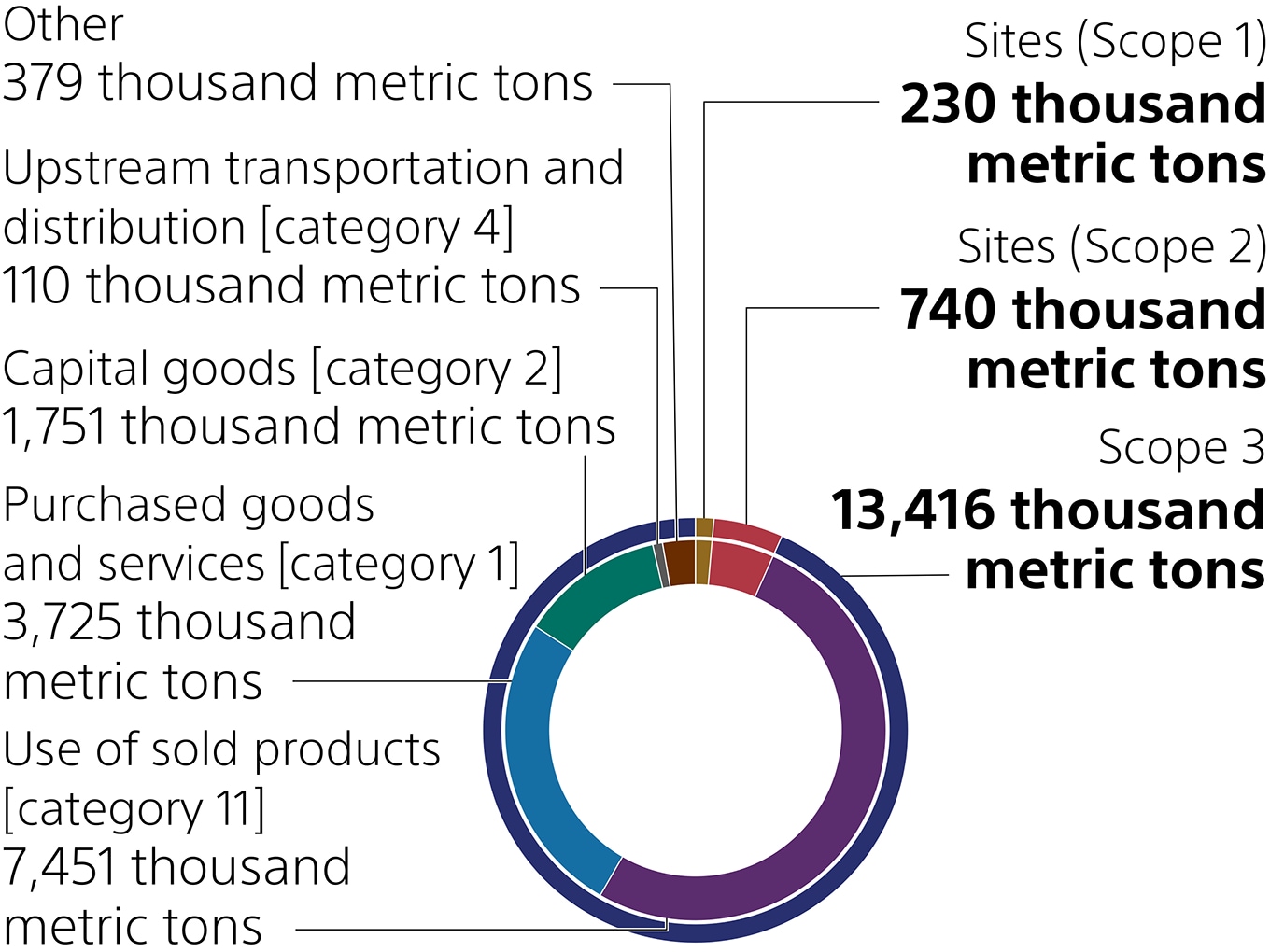
The recent escalation of climate change issues has prompted corporations to broaden the scope of efforts to ascertain the GHG emissions not just of their own operations but also those throughout their entire value chain.*3 Sony has determined emissions from its major component suppliers and manufacturing contractors. Furthermore, based on the level of emissions identified, Sony has calculated emissions for its entire value chain.*4
The amount of emissions from Sony’s overall value chain in fiscal year 2025 is estimated to be approximately 14,386 thousand metric tons. The largest volume of emissions, approximately 7,451 thousand metric tons, was from “energy consumed during product use.” The next largest category was “goods and services procured,” which includes raw materials and components, at approximately 3,725 thousand metric tons. Sony will continue to strive to identify and manage emissions over the entire value chain.
- *3Value chain refers to the entire product life cycle process, from procurement of materials through to manufacturing, use and disposal. It includes upstream and downstream manufacturing processes.
- *4GHG emissions are calculated in accordance with the GHG Protocol’s scope 3 accounting and reporting standard and guidelines published by Japan’s Ministry of the Environment. For details on the scope of data collection for GHG emissions across the value chain, please refer to "Scope, Collection Period, and Accuracy of Compiled Data" > "Scope of data collection" > "Site data" in the Data Book “Environmental Data Collection Methods and Rationale.” For details on the data calculation methods and rationale, please refer to “Greenhouse Gas-Related Data Collection Methods and Rationale” in the Data Book “Environmental Data Collection Methods and Rationale.” Following Sony’s completion of the partial spin-off of its Financial Services business on October 1, 2025, the scope of data collection for this report generally excludes the Financial Services business; however, in accordance with the “Environmental Data Collection Methods and Rationale,” these results include data from the Financial Services business for the period up to the execution of the Spin-off.
GHG Emissions from the Value Chain
Supply Chain
Working with Materials/Parts Suppliers and Subcontractors to Reduce Environmental Impact
As a part of efforts to reduce environmental impact across the supply chain, we request that our materials and parts suppliers and subcontractors handle both GHG and water depletion issues. For GHG emissions, Sony requests them to monitor emission levels, set medium- and long-term targets for emissions reduction and perform progress management. Sony conducts annual surveys on reduction of environmental impact,*5 including GHG emissions and water use in manufacturing of materials, components and products supplied to Sony and status of reduction targets. These surveys further include biodiversity considerations as well as implementation status of conservation initiatives.
In fiscal year 2025, Sony obtained answers about a variety of data from materials and parts suppliers which account for approximately 90% of the total transaction value and from subcontractors which account for approximately 90% of the total transaction value. We provided both tools and guidance to support GHG emissions calculation for suppliers who were unable to do so. This enabled all suppliers surveyed to be able to calculate and monitor their emissions.
Our 1.5°C Science Based Target (SBT) stipulates suppliers of raw materials and components and contract manufacturers will set SBT-consistent reduction targets equivalent to 10% of supply chain GHG emissions by fiscal year 2025. To achieve this, suppliers representing 11% of GHG emissions across the supply chain for fiscal year 2025 have set SBT-consistent targets. Furthermore, Sony has encouraged its major materials and components suppliers to take action to achieve net-zero GHG emissions by fiscal year 2030*6 from the use of purchased electricity when manufacturing products for the Sony Group, and has obtained agreements from more than 50 suppliers.
- *5Applies to raw materials and components suppliers in the ET&S, G&NS, I&SS and All Other segments, and to certain contract manufacturers in the ET&S and G&NS segments.
- *6The target achievement timing for the Road to Zero environmental plan and certain medium- and long-term environmental targets had previously been presented as "20XX". Beginning with this report, these references have been represented as "FY20XX" to align with the fact that environmental data aggregation and target management are conducted on a fiscal-year basis. No changes have been made to previously disclosed target details.
Sharing Expertise on Reduction of Energy Consumption and Promoting Renewable Energy Utilization
In fiscal year 2022, Sony began promoting the Partner Eco Challenge Program as a part of supplier engagement efforts to provide suppliers with expertise on the reduction of energy consumption as implemented at Sony sites.*7 In this program, personnel who are familiar with environmental initiatives and energy management visit suppliers, identify areas for improvement at manufacturing sites and provide Sony expertise. Using this as a starting point, employees at supplier manufacturing sites proactively develop initiatives for improvement and verify the results of these initiatives during the half-year period set for the program. During this period, Sony regularly checks progress and provides support for initiatives by visiting the site, while also holding seminars on basic energy conservation, supplying checklists for suppliers to carry out their own energy-saving initiatives and other endeavors that raise awareness throughout the site. Through this program, Sony accelerates the use of renewable energy as its power usage on the supplier site, setting goals equivalent to SBT and providing ongoing support for the acquisition of target certification.
The program targeted production sites in Japan in fiscal year 2022, but was expanded to China in fiscal year 2023, then Thailand in fiscal year 2024, and was continued through fiscal year 2025. Individual sites have established systems for carrying out their own energy conservation initiatives, with a number of improvement efforts underway, which has led to voluntary and ongoing action by employees on site.
- *7In fiscal year 2025, support was provided to certain raw materials and components suppliers that primarily had business relationships with the ET&S segment.
Sony Sites
Total Site GHG Emissions
With the target of reducing absolute greenhouse gas (GHG) emissions from Sony sites by 5% relative to fiscal year 2020 levels by fiscal year 2025,*8 Sony worked to reduce greenhouse gases such as CO2 and perfluorocarbons (PFC) related to energy consumption. In fiscal year 2025, the total volume of GHG at sites was approximately 0.97 million metric tons, which was approximately 12.0% lower than in fiscal year 2020. While there was an increase in the amount of energy used in semiconductor manufacturing sites, overall emissions decreased due to increased efforts to promote energy-saving, expansion of renewable energy use and other GHG emission reduction measures.
- *8For details on the scope of data collection, please refer to "Scope, Collection Period, and Accuracy of Compiled Data" > "Scope of data collection" > "Site data" in the Data Book “Environmental Data Collection Methods and Rationale.” For details on the data calculation methods and rationale, please refer to “Greenhouse Gas-Related Data Collection Methods and Rationale” > “Greenhouse gas emissions from sites” in the Data Book “Environmental Data Collection Methods and Rationale.” Following Sony’s completion of the partial spin-off of its Financial Services business on October 1, 2025, the scope of data collection for this report generally excludes the Financial Services business; however, in accordance with the “Environmental Data Collection Methods and Rationale,” performance against this target includes data from the Financial Services business for the period up to the execution of the Spin-off.
Total Site GHG Emissions

GHG Emissions from Energy Use at Sony Sites
Sony makes efforts to restrict GHG emissions through infrastructure-related measures including installation of high-efficiency equipment and the promotion of energy recycling, and also enhance nonstructural measures, notably through training programs designed to foster energy conservation leaders.
In fiscal year 2025, emissions of GHG from energy use at Sony sites*9 accounted for approximately 0.842 million metric tons, out of the approximately 0.970 million metric tons, of total GHG emissions at Sony, down by approximately 163,000 metric tons from fiscal year 2020. The above GHG emissions resulting from energy use at Sony sites include emissions from fuel used by Sony-owned business vehicles. In fiscal year 2025, GHG emissions resulting from fuel used in vehicles amounted to approximately 7,000 metric tons.
- *9For details on the scope of data collection, please refer to "Scope, Collection Period, and Accuracy of Compiled Data" > "Scope of data collection" > "Site data" in the Data Book “Environmental Data Collection Methods and Rationale.” For details on the data calculation methods and rationale, please refer to “Greenhouse Gas-Related Data Collection Methods and Rationale” > “Greenhouse gas emissions from sites” > "GHG emissions from energy consumption (energy-related)" in the Data Book “Environmental Data Collection Methods and Rationale.” Following Sony’s completion of the partial spin-off of its Financial Services business on October 1, 2025, the scope of data collection for this report generally excludes the Financial Services business; however, in accordance with the “Environmental Data Collection Methods and Rationale,” these results include data from the Financial Services business for the period up to the execution of the Spin-off.
Emissions of PFCs and Other GHG
PFCs and other greenhouse gases with high global warming potential are used in cleaning and etching processes during the manufacturing of semiconductors. Emissions of PFCs and other GHG in fiscal year 2025 (calculated in terms of CO2)*10 totaled approximately 129,000 metric tons, up about 31,000 metric tons from fiscal year 2020. Despite the introduction of PFC abatement equipment and other reduction initiatives, total emissions increased due to the growth in semiconductor device production.
- *10For details on the scope of data collection, please refer to "Scope, Collection Period, and Accuracy of Compiled Data" > "Scope of data collection" > "Site data" in the Data Book “Environmental Data Collection Methods and Rationale.” For details on the data calculation methods and rationale, please refer to “Greenhouse Gas-Related Data Collection Methods and Rationale” > “Greenhouse gas emissions from sites” > "Emissions of PFCs and other greenhouse gases (non-energy-related)" in the Data Book “Environmental Data Collection Methods and Rationale.” Following Sony’s completion of the partial spin-off of its Financial Services business on October 1, 2025, the scope of data collection for this report generally excludes the Financial Services business; however, in accordance with the “Environmental Data Collection Methods and Rationale,” these results include data from the Financial Services business for the period up to the execution of the Spin-off.
Promoting Efficient Energy Use
To achieve its fiscal year 2030 reduction targets, Sony is working on various energy conservation activities at its sites around the world.
High Efficiency Energy Systems for Plants
Sony Semiconductor Manufacturing Corporation (SCK)’s Nagasaki Technology Center (Nagasaki TEC) aimed to be one of the most energy efficient plants in the semiconductor industry upon construction of the Fab 5 extension building. For example, in chillers and boilers used for temperature and humidity control in semiconductor manufacturing clean rooms, AI-based advanced control technology was adopted to optimize chiller operation and minimize energy consumption, while a system that reuses waste heat from other production equipment was introduced to reduce boiler operation. These initiatives improved clean room energy efficiency by approximately 30% compared to fiscal year 2015.

Sony Technology (Thailand) Co., Ltd. (STT) is working to reduce GHG emissions from air conditioning systems by installing and operating highly efficient chiller systems*11 at its sites. Emissions have been reduced by approximately 1,248 metric tons across two plants in fiscal year 2025 through collaboration with Kansai Energy Solutions (Thailand) Co., Ltd. at its Chonburi Plant, as well as internal initiatives at its Bangkadi Plant.
Sony DADC Europe GmbH increased the efficiency of heat recovery by installing heat pumps in fiscal year 2021. This reduced the consumption of natural gas by 78% in fiscal year 2025 compared to fiscal year 2021, when it was installed.
- *11A chiller system that supplies chilled water to a plant.

Energy Conservation: Initiatives Driven by Plant Employees
Sony promotes a broad range of energy-saving efforts at its sites around the world. In addition to increasing the energy efficiency of buildings and equipment, in recent years Sony has actively implemented activities for reducing energy consumption driven by manufacturing site employees.
These activities focus on manufacturing sites, which consume more electricity than any other part of Sony’s manufacturing operations. Employees who are most familiar with the site set ambitious project targets, working closely with facility management to visualize energy used in the manufacturing process, identifying energy inefficiencies within the process then formulating and testing improvement measures before making ongoing improvements based on confirmed results. Particularly outstanding solutions are subsequently expanded to other sites.
These activities were prompted by the effectiveness of the Eco Challenge Project implemented in 2009 at Sony Group Corporation’s Sendai Technology Center (as it was then known) and Sony Storage Media Corporation’s Tagajo site. Similar energy conservation activities are now being implemented at Sony manufacturing sites around the world.
In 2025, Sony Technology (Thailand) Co., Ltd. employees actively engaged in energy-saving activities for both the production environment, such as air conditioners and lighting, and for production equipment and other manufacturing facilities. Despite the fact that the air-conditioned area has expanded year by year, power consumption in fiscal year 2025 was reduced by 1.2% compared to the previous fiscal year by improving warehouse temperature control and the working environment. Sony EMCS (Malaysia) is also promoting employee-led energy-saving initiatives in terms of both the production environment and equipment. Power usage is optimized by understanding the usage status and operating hours of each piece of equipment, thereby achieving lean operations according to production plans, and reducing power consumption.
Use of Renewable Energy and Renewable Electricity Rate
Sony’s original goal to use renewable energy (renewable electricity rate) for 15% or more of the electricity used in operations at business sites by fiscal year 2025*12 was updated to 35% or more by fiscal year 2025 in May 2022. Sony is working to adopt renewable energy in ways suited to the regional circumstances of its business sites worldwide, employing strategies such as installing solar power systems in site buildings, procuring renewable energy from power utilities, and utilizing renewable energy certificates. The above target was achieved two years ahead of schedule in fiscal year 2023, and in fiscal year 2025, renewable energy use amounted to approximately 1,290 GWh, with the renewable electricity rate reaching 44.5%.
- *12For details on the scope of data collection, please refer to "Scope, Collection Period, and Accuracy of Compiled Data" > "Scope of data collection" > "Site data" in the Data Book “Environmental Data Collection Methods and Rationale.” For details on the data calculation methods and rationale, please refer to “Greenhouse Gas-Related Data Collection Methods and Rationale” > “Renewable electricity rate” in the Data Book “Environmental Data Collection Methods and Rationale.” Following Sony’s completion of the partial spin-off of its Financial Services business on October 1, 2025, the scope of data collection for this report generally excludes the Financial Services business; however, in accordance with the “Environmental Data Collection Methods and Rationale,” performance against this target includes data from the Financial Services business for the period up to the execution of the Spin-off.
Renewable Energy Procurement Policy
Sony formulated its Renewable Energy Procurement Policy, and considers environmental impact from a variety of perspectives when introducing renewable energy power generation facilities
Key Procurement Policy
Evaluate environmental impacts associated with the installation and operation of power generation facilities and take measures to avoid adverse environmental impacts.
Examples of Environmentally Conscious Items:
- Land stability (outflow of earth or equipment due to slope collapse, etc.)
- Noise generated from power conditioners, etc.
- Impact of reflected solar panel light on living environment
- Impact on landscape
- Impact on animals, plants and ecosystems
- Check laws and regulations, and communicate with the local community during off-premises installation.
- Hydroelectric power generation must be 25 MW or less (exemption possible due to the procurement environment of the country/region).
- Ensure additionality by contributing to the expansion of new renewable energy generation capacity wherever possible.
- Select renewable energy sources that are located in the same country or region as the site.
Major Sony Sites that have Installed Solar Power Equipment
| Location | Sites | Capacity(as of March 31, 2026) |
|---|---|---|
|
Japan |
Sony Music Solutions, JARED Oigawa Center |
1.7MW |
|
Japan |
Sony Music Solutions, Oigawa Production Center |
0.2MW |
|
Japan |
Sony Global Manufacturing & Operations Kohda Site |
4.4MW |
|
Japan |
Sony Global Manufacturing & Operations Inazawa Site |
0.7MW |
|
Japan |
Sony Customer Service (Japan) Togane Technology Site |
0.2MW |
|
Japan |
Sony Semiconductor Manufacturing Kumamoto Technology Center |
2.9MW |
|
Japan |
Sony Semiconductor Manufacturing Nagasaki Technology Center |
1.4MW |
|
Japan |
Green Cycle |
0.3MW |
|
United States |
Sony Pictures Entertainment Studio |
1.8MW |
|
United States |
Sony Interactive Entertainment San Mateo |
0.4MW |
|
UK |
Sony UK Technology Centre |
1.0MW |
|
Austria |
Sony DADC Europe Thalgau Plant |
1.0MW |
|
Thailand |
Sony Technology (Thailand) Chonburi Plant |
6.1MW |
|
Thailand |
Sony Device Technology (Thailand) |
6.9MW |
|
Malaysia |
Sony EMCS (Malaysia) |
0.8MW |
|
South Korea |
Sony Electronics of Korea |
0.8MW |
Regional Initiatives
Even before joining RE100,*13 Sony had been taking action on renewable energy at sites around the world. It has already achieved 100% use of renewable energy in many regions. In fiscal year 2008, it was one of the first enterprises in Europe to make the switch to 100% renewable energy for the electricity consumed at its sites. Having achieved 100% renewable energy in the China region in fiscal year 2020, Sony is systematically increasing the amount of renewable energy it sources in North America, with the aim of achieving 100% in fiscal year 2030.
Through installation of solar power generation equipment and active use of renewable energy certificates, Sony has also achieved 100% renewable energy at all sites in the Pan Asia region in fiscal year 2022. In fiscal year 2025, Sony Technology (Thailand) Co., Ltd. Chonburi Plant added on-site solar power panels to its parking lot roof.
Similar introduction through a variety of initiatives is underway in Japan and East Asia, as well. In fiscal year 2025, we installed a new on-site solar power generation facility with a capacity of approximately 1.4 MW in the Fab 5 expansion building of Sony Semiconductor Manufacturing Co., Ltd. (SCK) Nagasaki Technology Center (Nagasaki TEC). Sony Electronics of Korea Corporation (SEK) has also expanded its on-site solar power generation facilities, bringing its total generating capacity to approximately 0.8 MW.

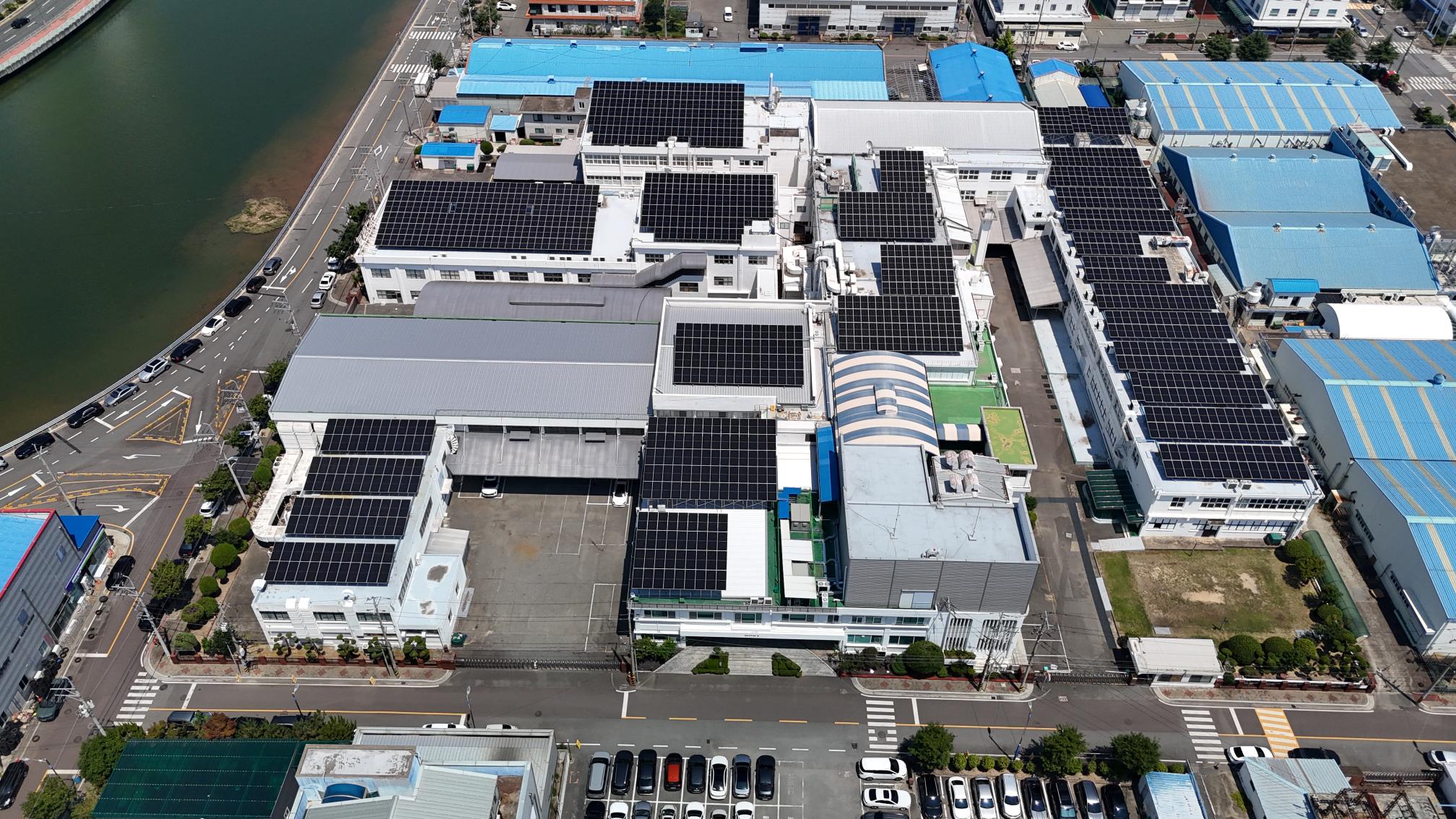
As the first such initiative in Japan, we have been operating a virtual PPA*14 using the feed-in premium (FIP) system since fiscal year 2022. With virtual PPA, power generated is then sold on the market, which means that market price fluctuations may cause a financial loss to Sony as the consumer, which we are then responsible for compensation for. Through the FIP system, government subsidies reduce risk associated with price fluctuations, making it possible to procure renewable energy that’s sustainable from a management perspective. Through these endeavors, the Sony Global Manufacturing & Operations Kohda Site has introduced environmental value of approximately 2.2 million kWh of electricity derived from renewable energy annually. Furthermore, Sony Semiconductor Manufacturing Corporation (SCK) also introduced the virtual PPAs using the FIP system in fiscal year 2023.
- *13RE100 is a global initiative led by the non-profit, The Climate Group in partnership with CDP in which participating companies set a goal of procuring 100% renewable electricity for power used in their global business operations.
- *14A virtual PPA (Power Purchase Agreement) is a system in which consumers (companies that wish to use electricity) conclude a long-term contract with a power generation company directly, trading the “environmental value” contained in renewable power rather than actual power.
Logistics
International and Inland GHG Emissions
With the target of reducing absolute GHG emissions related to international and inland logistics by 10% (compared with fiscal year 2018) by fiscal year 2025,*15 Sony has worked to reduce transport weight by making products and packaging smaller and lighter, while optimizing transportation efficiency and switching to transportation methods that have a low impact on the environment.
In fiscal year 2025, the total GHG emissions from product transport (international and inland) was approximately 103 thousand metric tons, a decrease of 42.7% over fiscal year 2018. This was due to changes in transportation volumes, switching to transportation mode with lower GHG emissions, consolidation of transportation through shared logistics with other companies and the use of milk runs, and improving loading efficiency through review of product packaging specifications, including carton size optimization.
- *15Applies to international transport of major electronics products (video game consoles, televisions, audio equipment, cameras, smartphones, image sensors, etc.) handled by the Sony Group’s G&NS, ET&S, I&SS and All Other segments, as well as regional transport of ET&S products in Japan, the US, Europe, China and Brazil. For Japan, transportation of some G&NS and Music segment products is also included.
GHG Emissions from Product Transportation (International and Inland)

Reducing Environmental Impact Through Collaborative Logistics
In 2024, Sony implemented a collaborative logistics initiative with other manufacturers, aiming to address social issues and reduce environmental impact of logistics in Japan. In 2024, for Hokkaido area, which has a large distribution range, Sony Marketing Corporation’s distribution warehouse was integrated with another manufacturer’s warehouse to begin shared deliveries to the mass retailers’ distribution centers. As a result, the number of transportation vehicles was reduced through shared deliveries for approximately 80% of the goods volume transported to retailers in the Hokkaido area, thereby reducing the burden on truck drivers and environmental impact. Based on this initiative in Hokkaido, we introduced shared logistics in the western Japan in 2025.
Promoting Modal Shift
As a part of its efforts to reduce environmental impact from the transport of finished goods, Sony promotes modal shift, switching the modes of transport it uses from air to sea and from truck to railroad.
Sony Electronics Inc. (SEL) in the United States continues to optimize the use of rail transport for product shipments from the West Coast to reduce GHG emissions generated during transport. SEL also focuses on increasing loading efficiency, reducing number of shipments; minimizing outbound air shipments; reducing small load shipments and working with carriers for shipment consolidation. Annually, SEL in conjunction with its logistics partner run a carrier nomination bid, strategically focused on reduction in environmental impact as a member of the SmartWay program operated by the United States Environmental Protection Agency (EPA). These efforts led to a 4.13% reduction in GHG emissions per ton mile shipped in fiscal year 2025 compared to fiscal year 2024.
In Japan, in addition to conventional truck transportation, Sony Marketing Inc. utilizes transportation by railway and ship to lower GHG emissions. In fiscal year 2025, GHG emissions attributable to the transport of products in Japan were approximately 88 metric tons lower than would have been the case if products had been transported by truck only.
Improved Loading Efficiency in Container Transport
We are working to improve loading efficiency in the transportation of containers for BRAVIA™ large screen televisions by taking every route possible. Typically, containers are loaded on to a cardboard pallet that is over 10 cm thick, which takes up space and leads to unusable space at the top of the container since they cannot be stacked. To better utilize the entire space, we now use 0.5 mm slip sheets to enable more items to be stacked in a single container.

Products and Services
Sony products consume electrical power while used by their owners, resulting in indirect emissions of GHG. Sony has adopted the target of reducing annual energy consumption per product from product use by 5% by fiscal year 2025 compared to the fiscal year 2018 level.*16 Sony sets specific fiscal year targets in every product category and is implementing diverse measures to reduce energy consumption.
Fiscal year 2025 annual power consumption per product Sony-wide decreased approximately 6.7% over fiscal year 2018. Total GHG emissions in product use over the lifetime of all products sold in fiscal year 2025 were estimated to be approximately 7.45 million metric tons.*17 Mainly due to reduced power consumption and sales of televisions and games, emissions decreased approximately 27% over fiscal year 2024.
- *16Applies to energy-using products which operate the intended main function with energy input from a commercial power supply in the ET&S and G&NS segments.
- *17In theory, emissions during product use in fiscal year 2025 should be calculated from the total quantity of electrical power consumed by previously sold Sony products that are still in use by consumers in fiscal year 2025. However, given the difficulty of determining how many previously sold Sony products are still in use by consumers of the total number of Sony products sold to date, Sony calculates the GHG emissions during product use by estimating the total quantity of electrical power consumed while in use over the lifetime of Sony products sold in fiscal year 2025. For details on the data calculation methods and rationale, please refer to “Greenhouse Gas-Related Data Collection Methods and Rationale” > “GHG emissions from use of sold products” in the Data Book “Environmental Data Collection Methods and Rationale.”
GHG Emissions from Product Use

- Notes:GHG emission factors for fiscal year 2018 use the 2013 country-specific factors.
- Note:For GHG emission factors for fiscal year 2021 and beyond, we use the most recent factors available for each fiscal year (at the beginning or end of the fiscal year). Furthermore, from fiscal year 2025, the emission factors applied have been changed from those available at the beginning of the reporting period to the latest factors available as of the end of the reporting period.
Energy Conservation in Products and Services & Leveraging Environmental Value
We deploy power-saving technology to a wide range of BRAVIA™ television models, aiming to both improve picture quality and reduce power consumption. Using Sony’s unique backlight control technology independently drives thousands of LEDs with exceptional precision. By concentrating light where it is needed most, it delivers higher brightness, deeper blacks and improved power efficiency. We have also worked to improve power efficiency by adopting a structural design that improves the heat dissipation of the backlight. By combining these technologies, the BRAVIA 5 introduced in 2025 has reduced annual power consumption by approximately 23% compared to the 2024 LED model.*18
In September 2025, PlayStation®5 (PS5®) and PS5 Pro consoles introduced a new feature for games called Power Saver. When enabled by users, PS5 games supporting this feature will scale back performance and will allow the console to reduce its power consumption by approximately 50%.*19 Games that support this feature display the new Power Saver icon on PS Store and the game title on the Home Screen.
Subscribers to the NURO Hikari fiber-optic broadband service can lease a BRAVIA television and make use of the NURO Denki CO2 Free Plan, which harnesses renewable energy. This energy plan combines electricity generated from natural gas, coal, oil and other fossil fuels with electricity generated from solar, wind and other renewable sources for increased environmental value (non-fossil fuel certified). This allows users to emit almost no CO2 through home-use electricity, including that consumed by their BRAVIA television.
Sony develops and provides technologies that contribute to reducing GHG emissions in the video production process. Virtual production technology combines large LED displays, cameras, camera tracking systems, and a real-time 3DCG rendering engine to enable real-time compositing of CG-created backgrounds and actual subjects within the studio, thereby reducing the travel of personnel and equipment associated with location shooting. For the Crystal LED VERONA, which boasts a high quality LED display used for virtual production and other professional applications, we combined high luminosity-efficient LEDs and proprietary power supply design to improve energy efficiency by approximately 32%*20 over conventional models.

- *18Based on comparisons under specific conditions. Internal study
- *19Based on measured power consumption for three games:
PS5 Power Saver mode off/on: Demon’s Souls - 222 W/89 W; Death Stranding 2: On the Beach - 214 W/112 W; Call of Duty: Black Ops 7 - 210 W/103 W.
If Power Saver is not enabled, or if games do not support the feature, the performance will not be scaled back and power consumption will not be reduced. - *20Power efficiency improvement per unit of brightness calculated at max brightness. Power efficiency per unit of brightness indicates the amount of power required to produce the required level of brightness. VERONA ZRD-VP15EB (with calibration function on) was compared to the ZRDB15A B series as the conventional LED model.
Awareness Campaigns
Raising Awareness Using Gaming Technology
Sony Interactive Entertainment (SIE) joined the Playing for the Planet Alliance at the 2019 UN Climate Summit to help address climate change. In June 2025, SIE launched Climate Station free on PS5 and PS VR2 as part of its commitment to the alliance. Climate Station uses the latest gaming technology, including virtual reality, to allow players to view, interact with, and understand complex climate data to raise awareness about climate change.
The application tells the story of climate change through three acts: Weather Year, Observations, and Projections, along with an Explainer Library to explore.
Weather Year explores Earth's meteorological events in 2019 and 2020, highlighting major climate events like wildfires, storms, floods, and droughts, as well as broader patterns such as cloud movement, storm tracks, greenhouse gases, and sea ice changes.

Observations compiles over 120 years of climate data, including temperature records for thousands of locations, enabling users to track long-term temperature changes. It also provides indicators like atmospheric carbon dioxide, ocean heat, and sea level rise to demonstrate evidence of climate change.
Projections let users explore future climate outcomes through Intergovernmental Panel on Climate Change (IPCC) models and emissions scenarios, exploring how choices affect key climate indicators such as temperature, extreme weather, biodiversity, drought, flooding, and other risks.

Climate Station's Explainer Library offers 90 minutes of multimedia content on climate change, covering topics from extreme weather to scientific models. These Explainers break complex ideas into clear, compelling insights.
Climate Station can be used at home, in research, and educational settings to turn complex climate data into an engaging experience. It draws information from expert sources like National Aeronautics and Space Administration (NASA), National Oceanic and Atmospheric Administration (NOAA), Berkeley Earth, the Climate Research Unit, and the World Climate Research Programme (WCRP). While climate change is a challenging subject, Climate Station aims to encourage hope and highlight potential solutions for our planet. This application continues SIE’s commitment to inspiring action and driving progress.
Participating in Initiatives of the Music Industry
Sony Music Group (SMG) actively participates in the Music Climate Pact (MCP) to promote decarbonization and share climate change insights within the music industry. SMG has initiated the Physical Audio Eco-Tier Program, an initiative to reduce the environmental impact of vinyl production by identifying areas for improvement supported by science-backed data from MCP’s industry studies.
To further advance climate action across the music industry, the Music Industry Climate Collective (MICC) was jointly established by major recorded music companies, including SMG, Universal Music Group, and Warner Music Group. Through MICC, guidance for Scope 3 GHG measurement for the recorded music industry has been developed. The guidance development process included a comprehensive stakeholder review and feedback period, with participation from independent record labels, climate experts, and stakeholders across the value chain. The guidance was made publicly available through online distribution in 2025.
In addition to deepening engagement with stakeholders across the music industry, SMG is pursuing environmental strategies to measure and manage its carbon footprint, source sustainable materials, and uphold supply chain standards.