
Resource Initiatives

Approach to Resources
Sony seeks to minimize the consumption of resources and maximize resource recycling in order to use resources effectively in its business activities and throughout the life cycle of its products and services, based on the globally prescribed promotion of a circular economy.
Sony minimizes resource consumption by reducing the weight of products, minimizing the use of packaging materials, and utilizing resources more efficiently in its internal operations. Concurrently, Sony also works to extend the life of products through quality and durability enhancements, while undertaking environmentally conscious design, such as making products easier to repair, in order to indirectly reduce resource consumption. Sony aims to reduce the number of parts derived from virgin resources to zero by identifying certain key resources in terms of environmental impact due to the depletion, uneven distribution and mining of resources, loss of biodiversity due to mining, and the effects of these impacts on local communities. Additionally, as part of its efforts to respond to the growing global problem of plastic pollution, Sony continues to work toward reducing the amount of single-use plastic product packaging.
In terms of waste, Sony recycles waste generated from internal operations, with the goal of eliminating landfilled waste. Additionally, Sony designs products to facilitate recycling and implements ongoing programs to collect and recycle end-of-life products according to the needs of local communities, while also promoting advanced recycling with recycling companies.
Water Use
Although water circulates around the earth continuously through the water cycle, the amount of water available for use by the planet’s inhabitants is limited. With population growth and other issues putting further pressure on water supplies, the importance of conserving this resource will increase in the years ahead. At the same time, risks such as flooding caused by extreme weather events can have a significant impact on business operations. Taking into account the locations of its sites, as well as regional differences, Sony will continue taking steps to minimize its withdrawal of water and to ensure the water discharges that return to water sources is of a quality that does not negatively impact the environment.
Paper Resources
Recognizing that paper resources are limited, under the Sony Group Paper / Printed Material Purchasing Policy, Sony constantly works to reduce paper consumption while prioritizing the procurement of environmentally preferable paper, such as paper made from resources sourced from FSC-certified and recycled paper.
Site Waste
Amount of Waste Generated at Sites
With the target of reducing the waste amount intensity value from Sony sites by 5% relative to fiscal year 2020 levels by fiscal year 2025,*1 Sony implemented a variety of measures to reduce waste and use resources more effectively. In fiscal year 2025, the amount of waste generated at sites worsened approximately 29.8% in waste intensity compared to fiscal year 2020. This was driven by significant changes to production categories or processes as well as the launch of new operations at certain facilities. In fiscal year 2025, sites generated approximately 66,000 metric tons of waste, which is up approximately 28.9% from fiscal year 2020. Although Sony has been promoting waste reduction by continuously improving production site processes and reducing sludge waste, the volume of waste increased, mainly driven by the expansion of semiconductor plants and increased production. Furthermore, approximately 5,000 metric tons of the total waste generated at sites in fiscal year 2025 consisted of plastic waste.
- *1For details on the scope of data collection, please refer to "Scope, Collection Period, and Accuracy of Compiled Data" > "Scope of data collection" > "Site data" in the Data Book “Environmental Data Collection Methods and Rationale.” For details on the data calculation methods and rationale, please refer to “Resource-Related Data Collection Methods and Rationale” > “Amount of waste generated at sites” in the Data Book “Environmental Data Collection Methods and Rationale.” Following Sony’s completion of the partial spin-off of its Financial Services business on October 1, 2025, the scope of data collection for this report generally excludes the Financial Services business; however, in accordance with the “Environmental Data Collection Methods and Rationale,” performance against this target includes data from the Financial Services business for the period up to the execution of the Spin-off.
Amount of Waste Generated at Sites

- Japan/East Asia: Japan, South Korea and Taiwan Region
Landfilled Waste Rate for Sony Sites
Sony’s goal is to reduce landfilled waste to 1% or less by fiscal year 2025 (excluding items beyond Sony’s control),*2 working to recycle waste generated through its operations. In fiscal year 2025, the landfilled waste rate for all Sony Group sites was approximately 0.6%. The rate for sites in Japan was approximately 0.3%. However, the group-wide landfilled waste rate for Sony sites in fiscal year 2025 became approximately 16.7% when the calculation includes waste that Sony is required by law or ordinance to dispose of by landfills. Sony strives to reduce the rate of waste disposed in landfills by recycling waste generated by sites.
- *2For details on the scope of data collection, please refer to "Scope, Collection Period, and Accuracy of Compiled Data" > "Scope of data collection" > "Site data" in the Data Book “Environmental Data Collection Methods and Rationale.” For details on the data calculation methods and rationale, please refer to “Resource-Related Data Collection Methods and Rationale” > “Amount of waste landfilled” in the Data Book “Environmental Data Collection Methods and Rationale.” Following Sony’s completion of the partial spin-off of its Financial Services business on October 1, 2025, the scope of data collection for this report generally excludes the Financial Services business; however, in accordance with the “Environmental Data Collection Methods and Rationale,” performance against this target includes data from the Financial Services business for the period up to the execution of the Spin-off.
Management of Industrial Waste
Sony takes precautions to ensure waste from its sites is not inappropriately disposed of. For example, in Japan, Sony has set consistent internal standards for selecting waste disposal contractors and inspecting disposal sites on an ongoing basis. It has also established an internal system of accreditation for disposal site inspectors, and is stepping up efforts to minimize risks associated with contracting out waste disposal. To reinforce this system, Sony implements periodic on-site inspections in the waste disposal contractors, thereby ensuring rigorous management procedures.
Examples of Waste Reduction
Sony is reducing waste at all its business sites. To reduce sludge waste, Sony Semiconductor Manufacturing Corporation has adopted a plant-based polymer flocculant with enhanced coagulation and flocculation performance for wastewater treatment from production equipment, optimizing and implementing its use at each technology center. This reduced the use of conventional primary (inorganic) flocculants and the amount of sludge generated from them. Further reductions were achieved by dewatering excess sludge.
Sony Storage Media Corporation (SSMC) installed equipment to reduce and solidify acidic wastewater discharged in large quantities in the magnetic powder manufacturing process for magnetic tape production. Since beginning operations in May 2024, the equipment has reduced the volume of acidic wastewater by approximately 98% of the volume processed.

Site Water Resources
Water Use and Risk at Sony Sites
Water is a constantly circulating and unevenly distributed resource, which makes water issues very regional in nature. To tackle this issue, Sony set the goals of improving the water use intensity value on sites that use high volumes of water by 5% relative to fiscal year 2020 by fiscal year 2025*3 and implementing risk reduction measures at sites located in water risk areas.*4 In fiscal year 2025, water use at Sony sites worsened approximately 4.5% in water intensity relative to fiscal year 2020. This was due to significant changes to production categories and processes at some facilities. Water use at sites in fiscal year 2025 was approximately 21.90 million m3, an increase of 17.1% relative to fiscal year 2020. Sony is making efforts to recycle water and save water on production sites, but the amount of water used has increased, mainly due to the expansion of semiconductor plants and increased production.
Sony also takes steps to ensure the quality of water discharges at its sites. In addition to observing related laws and regulations in each of the countries and territories in which it operates, Sony manages water discharges quality criteria further than is required. For example, the introduction of sophisticated water treatment facilities has enabled it to reduce BOD and COD levels*5 in discharged water.
- *3Applies to sites with high water consumption (annual water consumption of 500,000 m³ or more in fiscal year 2024) within the scope described in “Scope, Collection Period, and Accuracy of Compiled Data” > “Scope of data collection” > “Site data” in the Data Book “Environmental Data Collection Methods and Rationale.” For details on the data calculation methods and rationale, please refer to “Resource Related Data Collection Methods and Rationale” > “Volume of water use/withdrawal/discharged” > “Volume of water use” in the Data Book “Environmental Data Collection Methods and Rationale.”
- *4Applies to sites located in water risk areas within the scope described in “Scope, Collection Period, and Accuracy of Compiled Data” > “Scope of data collection” > “Site data” in the Data Book “Environmental Data Collection Methods and Rationale.” Sites located in water risk areas are defined as sites in areas where the overall water risk score was 3 or higher based on a combined assessment using water risk assessment tools provided by the World Resources Institute (WRI) and the World Wide Fund for Nature (WWF).
- *5Biochemical oxygen demand (BOD) and chemical oxygen demand (COD) are indicators of water pollution.
Water Use at Sony Sites

- Japan/East Asia: Japan, South Korea and Taiwan Region
Available water resources vary greatly in terms of quantity and quality, depending upon the region. In business, it is necessary to consider water resources from the perspective of securing enough water for production while maintaining good stakeholder relations. Sony uses water risk assessment tools provided by the World Resources Institute (WRI) and the World Wide Fund for Nature (WWF) to perform water risk assessments for the regions where Sony sites are located (see diagram below). Through these assessments, we found that sites with high water use are located in areas with low water risk, and sites located in high water risk areas have low water use (for domestic use only). In addition to conducting water risk assessments, Sony works with local stakeholders to promote activities tailored to local water risks, helping to ensure appropriate use of water.
Results of water risk assessment for Sony Group sites using the WRI tool

Efforts in Water Use and Local Water Risk
- Sony's semiconductor manufacturing sites account for the largest share of water withdrawals, but most are located in areas with relatively low water risk. Nevertheless, Sony promotes wastewater recycling and other water conservation initiatives to reduce overall water use.
- To address water pollution risks, voluntary standards for pollutants in wastewater discharges have been established at sites facing higher discharge-related risks.
- Although sites located in areas with higher risks of water depletion and scarcity are primarily non-manufacturing sites with relatively low water use, Sony continues to implement water conservation measures at these sites as well.
One example of initiatives underway at areas of high water risk can be found at our non-manufacturing sites (offices, etc.) in India, where initiatives include conducting awareness training, the use of spray jet faucets, as well as the filtration and treatment of collected and stored rainwater for use in flush toilets and other facilities. At Chonburi Plant and Bangkadi Plant of Sony Technology (Thailand) Co., Ltd., annual water use has been reduced by approximately 27,000 m3 through on-site treatment of wastewater for use in cooling towers.
Initiatives to Reduce Water Use
For semiconductors and electronic devices, vast amounts of water are needed in manufacturing processes. At its plants all over the world, Sony is taking a variety of measures to preserve local water resources, including wastewater recycling and initiatives for reducing water use.
Increasing Semiconductor Production while Reducing Water Use
Sony Semiconductor Manufacturing Corporation (SCK) is working toward reducing the amount of water used in semiconductor production while increasing the production capacity.
SCK Nagasaki Technology Center (Nagasaki TEC) is working to reuse water discharges from gas detoxifying equipment used in semiconductor manufacturing, achieving a reuse rate of approximately 80% of the water discharge from this system. In addition, Nagasaki TEC has been working on the reuse of treated sewage water to contribute to the recycling and effective use of resources (water). In collaboration with local authorities such as Nagasaki Prefecture and Isahaya City, Nagasaki TEC has established a system to further purify the local treated sewage water and was the first in the prefecture to reuse the treated sewage water for industrial use. This has reduced the extraction of local groundwater.
SCK Kumamoto Technology Center (Kumamoto TEC) is aiming to reduce water used for combustion treatment to remove exhaust gas emitted from the semiconductor production lines. To do this, Kumamoto TEC has enhanced the equipment to increase the proportion of recycled water, thereby lowering the amount of fresh water needed for combustion treatment by about 50%. In addition, in order to help preserve the abundant aquifer in the Kumamoto region, Kumamoto TEC has for many years been conducting “groundwater recharge” efforts. This involves flooding fields with local river water that slowly permeates into the water table during times when no crops are being grown. In fiscal year 2025, approximately 3.05 million m3 of groundwater was recharged, a volume that exceeds that used by Kumamoto TEC.

Reducing Water Use in Various Ways
Sony’s sites promote a variety of initiatives tailored to local conditions to reduce water use, including the use of rainwater.
Green Cycle Corporation, an affiliate of Sony that engages in the recycling of home appliances, has been collecting and using rainwater since fiscal year 2014 in recycling processes, such as for crushing machines and in toilet flushing. In fiscal year 2025, rainwater accounted for approximately 43% (1,551 m3) of the total water use at the plant.
Sony Device Technology (Thailand) Co., Ltd. (SDT) also implemented rainwater harvesting to utilize the rainwater as a water supply for cafeterias and restrooms and also filtered the harvested rainwater through a deionized (DI) water system to employ it in production areas. As a result, SDT reduced municipal water use by approximately 46,300 m3 in fiscal year 2025.
The Sony headquarters building uses treated wastewater to cool its heat source equipment. By using water treated at the nearby Shibaura Water Reclamation Center to cool heating equipment, the amount of clean water normally used to replenish the water in the cooling towers has been reduced by approximately 30,000 m3 per year.
Products and Services
Total Volume of Resources Used in Products
Sony is working to reduce the average mass of products in order to minimize resource inputs. In fiscal year 2025, the total volume of resources*6 used in products*7 was approximately 271 thousand metric tons, which was 47% lower than in fiscal year 2018. This is due to continuous efforts to reduce the size and weight of both products and packaging in a wide range of product categories, as well as a decrease in the number of units sold.
In fiscal year 2025, the Sony Group used approximately 7.7 thousand metric tons of circular plastic*8 in its products.*7 This amount consisted of approximately 44% circular plastic content from scraps and other waste materials generated from manufacturing by the Sony Group and other companies, and approximately 56%*9 post-consumer circular plastic content from used products, containers, and other sources. We have used approximately 83 thousand metric tons of circular plastic from fiscal year 2014 through fiscal year 2025.
- *6Total volume of resources used is the total weight of resources used in products, accessories, instruction manuals and packaging materials. The weight of total products shipped is used to represent this value.
- *7Applies to products in the ET&S segment (excluding certain medical devices and FeliCa chips), the G&NS segment (excluding certain accessories), certain products in the I&SS segment, certain products in the Music segment (Japan), and certain products in the All Other segment.
- *8Recycled and renewable plastic
- *9The fiscal year 2025 report contains incorrect values; in fiscal year 2024, approximately 52% of circular plastics were made from scrap generated in the manufacturing processes of the Sony Group and other companies, and approximately 48% were circular plastics made from used products and containers.
In the Sustainability Report (prior-year report) published in fiscal year 2025, we stated that the ratios of circular plastics made from scrap generated during the manufacturing processes of the Sony Group and other companies, and circular plastics made from used products and containers, were approximately 69% and approximately 31%, respectively, for fiscal year 2024; however, the correct figures are approximately 52% and approximately 48%, respectively.
Amount of Circular Plastic Used in Products
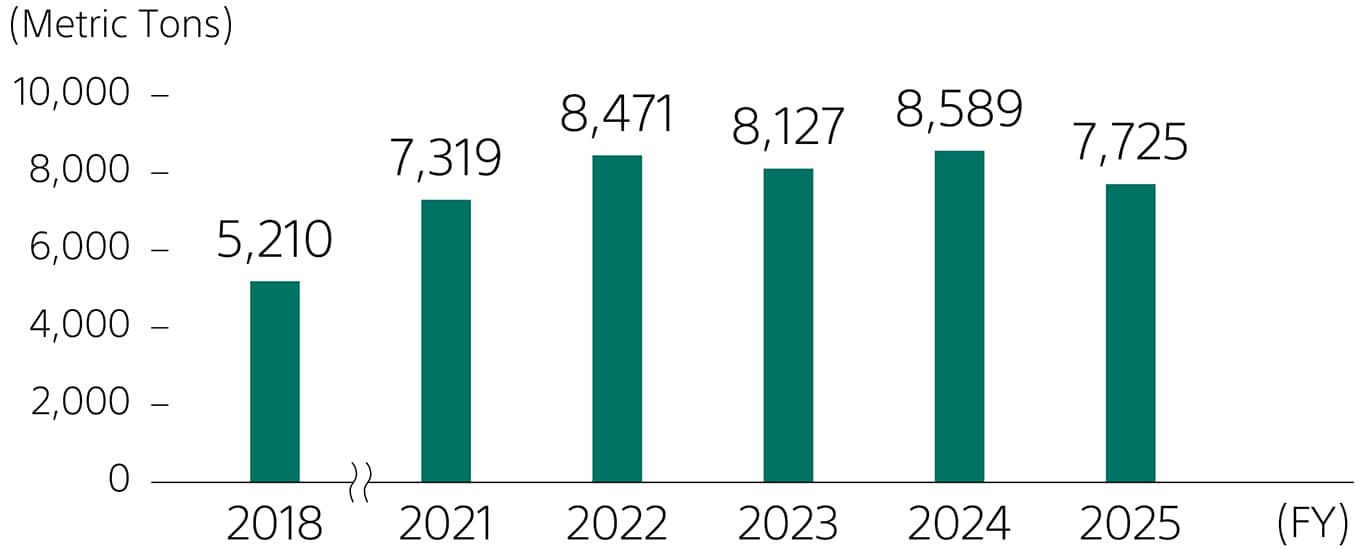
Reducing Use of Virgin Plastics in Product Bodies
With the target of reducing virgin oil-based plastic used per product by 10% from the fiscal year 2018 level, by fiscal year 2025 (excluding packaging),*10 Sony expanded use of recycled plastics and made product chassis more lightweight and compact. We also began adopting renewable plastics for our products in fiscal year 2026. In fiscal year 2025, virgin oil-based plastic used per product was down approximately 22.1% from the fiscal year 2018 level. This is mainly due to the advancement of recycled plastics across a wide range of product categories in ET&S segment, including televisions, as well as the reduction in the size and weight of PlayStation®5.
In the music segment, we employed an environmentally conscious disc tray for our music and video packaging that is made from our Original Blended Material and other paper to reduce virgin oil-based plastic by 97%,*11 and have further accelerated measures to reduce plastic group-wide.
- *10Applies to PlayStation®5 consoles in the G&NS segment; products in the ET&S segment (excluding memory media, certain medical devices and FeliCa chips); and tape media and optical disc media in the All Other segment.
- *11Compared to conventional plastic disc trays
- Sony Corporation - Creating NEW from reNEWable materials | A new approach driven by collaboration across the supply chain
- Packaging | Sony Original Blended Material | Sony United Kingdom
- Environmentally Conscious Disc Tray (in Japanese)
Incorporating Recycled Plastic
To reduce the consumption of virgin oil-based plastic, Sony has expanded the use of recycled plastics in a broad range of product categories by developing recycled plastics while elevating quality and reducing manufacturing costs.
Our truly wireless LinkBuds Fit headphones employ recycled plastic for the main body and part of the case, and are the first fully wireless Sony headphones to feature recycled plastic bottle material, which was used for the pink marble pattern material.
For the lenses of α™ interchangeable lens cameras, we incorporated recycled plastics into exterior and functional parts that require high versatility in manufacturing and durability, adopting these for select models released from 2024 onwards.
Optical network terminals with integrated Wi-Fi routers for the NURO Hikari fiber-optic broadband service, supporting Wi-Fi 7 and Wi-Fi 6, achieved a recycled plastic usage rate of 76% in fiscal 2025.
PlayStation game disc cases incorporate recycled polypropylene plastics from post-industrial waste in Europe, the United States, and Australia and New Zealand, with a global average recycled content of 22% in fiscal year 2025.*12
- *12Our Sustainability Report published in fiscal year 2025 incorrectly described the fiscal year 2024 recycled material use rate of 26% as global. In fact, this percentage only reflected Europe, the United States, and Australia and New Zealand, and did not include Japan or other Asian countries.

SORPLAS™, Sony’s Original Flame-Retardant Recycled Plastic
Sony put SORPLAS™ (Sustainable Oriented Recycled Plastic), a flame-retardant recycled plastic, into practical use in 2011. This plastic achieved high quality and reduced environmental impact through an optimal blend of proprietary non-halogen and non-phosphorus flame retardant, and waste plastics (polycarbonate resin). Unique compounding technology ensures flame retardancy while keeping the amount of flame retardant added to less than 1%, enabling the plastic to be made of up to 99% recycled materials. CO2 emissions during manufacturing can be reduced up to approximately 72% compared to when flame-retardant virgin plastics are used for the same purpose.*13
SORPLAS is used in a variety of our products, including BRAVIA™ televisions, Xperia™ smartphones, and digital cameras. In recent years, Sony has begun practical use of a closed loop recycling system where plastics recovered from the back covers of televisions are reused as part of the raw materials for SORPLAS, which are used for the back covers of new TVs. In closed loop recycling, materials recovered from a used product are harnessed as materials to create new products of the same type. Sony Semiconductor Solutions Corporation and Sony Corporation collaborated to establish a technology for identifying plastics suitable for TV applications and an optimal material mixing method for plastics derived from used TVs collected at Green Cycle, one of Japan’s home appliance recyclers. First adopted in the BRAVIA 8 (65-inch) 4K OLED TV in 2024, this technology allows us to utilize recycled plastics recovered from used televisions, regardless of the manufacturer while maintaining the same high quality as our conventional SORPLAS products.
Sony has been selling SORPLAS itself since 2014, and this provision to third parties further promotes resource recycling and reduces environmental impact.
- *13Comparison of the CO2 emitted from the production of SORPLAS to that of flame-retardant virgin plastic for the same application. Based on Sony research.
Volume of Additive Required for Material to Meet Flame-retardancy Standard (V-0 rating at 1.5 mm)

- Sony Corporation - Recycled TV Components Utilized in SORPLAS™*1 for BRAVIA™ TV Parts
- SORPLAS | Post-Consumer Recycled Plastic Sony Products | Sony United Kingdom
- Sustainability in BRAVIA TVs | Sony Asia Pacific
Building a Global Renewable Plastics Supply Chain
Sony audio-visual products use many components that must meet exacting performance requirements. For these components, it has been difficult to replace petroleum-derived virgin plastics with plastics derived from material recycling while maintaining equivalent performance.
One solution to this issue is to use biomass-derived renewable plastics made from materials such as waste cooking oil. However, we must ensure transparency and reliability in the supply chain, including the origin and distribution of raw materials for these renewable plastics, and the entire process from raw material to finished product is complex, making such verification difficult to manage.
To manage this problem, we partnered with Mitsubishi Corporation on the “Creating NEW from reNEWable materials” project, bringing together companies and partners, including raw material suppliers and chemical manufacturers from around the world, to visualize the entire supply chain starting from biomass-derived raw materials and construct a new global supply chain. For this supply chain, we adopted a mass balance approach*14, where a mixture of biomass-derived and conventional petroleum-derived raw materials are used, with the renewable, biomass-derived share allocated to products according to the amount of input. This enabled Sony to introduce plastics with allocated renewable attributes that are equivalent in performance to conventional petroleum-derived plastics.

The renewable plastic made possible by this supply chain is used in audio-visual products such as the WF-1000XM6 wireless noise-canceling stereo headset released in 2026. Approximately 25% of the total plastic in this headset is allocated to recycled materials’ characteristics, helping reduce the use of petroleum-derived virgin plastics.

- *14A chain of custody model following a product from raw materials to finished product, where raw materials are assigned to the portion of a product for which they are input, when raw materials, such as biobased materials, are mixed with raw materials that do not have those characteristics.
Reducing Plastic Packaging
Sony adopted the targets of reducing plastic packaging used per product by 10% from the fiscal year 2018 level by fiscal year 2025*15 and eliminating plastic packaging from newly-designed small products*16 by fiscal year 2025*17, and worked to reduce the amount of single-use plastic packaging used in a range of product categories.
In fiscal year 2025, plastic packaging used per product was 29.9% lower than in fiscal year 2018. This was mainly due to the reduction in the amount of polystyrene foam used in TV packaging and the shift from plastic to paper packaging materials in audio and other product categories.
We eliminated plastic packaging materials*18 in the packaging for all newly-designed products in fiscal year 2025. We also eliminated plastic packaging materials in the WH-1000XM6 and WF-1000XM6 headphones, Xperia 1 VII and Xperia 10 VII smartphones and α7 Ⅴ and RX1R III digital cameras, etc., which were released in 2025. Additionally, the individual packaging cartons for these products were made of Sony’s proprietary paper material, Original Blended Material.
- *15Applies to PlayStation®5 consoles in the G&NS segment; products in the ET&S segment (excluding certain medical devices and FeliCa chips); and tape media and optical disc media in the All Other segment.
- *16Applies to products weighing less than a certain amount.
- *17Applies to products in the G&NS segment (excluding game software) and the ET&S segment (excluding certain medical devices and FeliCa chips).
- *18Excludes plastic materials when use is unavoidable, such as coatings and adhesives.

- The continuing evolution of packaging with the environment in mind
- Recycled Plastics & Packaging | Sustainable Headphones | Sony Asia Pacific
- Initiatives | Sony and the Environment - Sony Group Portal
- Packaging | Sony Original Blended Material | Sony United Kingdom
Packaging Material Initiatives by Product Category
Simulation techniques are used for BRAVIA™ packaging to continue to refine the placement and shape of cushioning to protect products during transportation while minimizing the use of plastic cushioning materials. For the TV model sold in fiscal year 2025 (K-85XR90), the amount of plastic cushioning material used was reduced by approximately 46% compared to the 2018 model (KD-85X9000F).
In medical related products, we used pulp molded cushioning material made from recycled paper instead of conventional polystyrene foam for the LMD-27M1MD 27-inch 4K LCD monitor. We also adopted a nonwoven bag made primarily from plant-derived cellulose to protect the monitor and developed individual packaging that does not require polypropylene tape, so we were able to reduce the amount of plastic used by approximately 84%*19 compared to the previous model (LMD-X2710MD).
Packaging for home audio products released in fiscal year 2025 was made of approximately 75% recycled materials in 2025, helping to reduce environmental impact without compromising packaging design or product protection.
- *19Comparison of the 2025 model (LMD-27M1MD) to 2020 model (LMD-X2710MD)
Utilization of Surplus Biomass
Triporous is a plant-based porous carbon material that Sony obtained end-to-end patents for, then began licensing in 2019. Triporous is made from rice husks, of which Japan alone generates around two million metric tons per year, and this excess biomass is part of approximately 100 million metric tons generated annually worldwide, meaning that Triporous production helps reduce air pollutants and GHG emissions by presenting an alternative to incineration or landfill disposal. This rice husk-derived microstructure gives it adsorption properties that differ from conventional activated carbon, and has been confirmed to have high adsorption capacity for surfactants and some per- and polyfluoroalkyl substances (PFAS) in industrial and domestic wastewater.
This is expected to help improve the water and soil environment and extend water purifier and water treatment equipment filter life while reducing costs and waste. Currently, its implementation in society is expanding—we are moving toward practical application in apparel, interior textiles and healthcare with PFAS removal demos being conducted in a project commissioned by the Ministry of Environment.

- Triporous™ - Sony Group Portal
- Triporous™ | Innovating New Material | Sony | Sony United Kingdom
- Sony Begins Licensing of New Material Triporous™ - Sony Group Portal
- News Release: Triporous™ Selected for Functional Material Development and Demonstration Project Commissioned by Ministry of the Environment in Japan (in Japanese)
Going Paperless
Sony is working to reduce paper use across a wide range of its product categories by digitizing instruction manuals while maintaining product usability. For products that previously included paper manuals in multiple languages, we have transitioned to illustrated guides and electronic instruction manuals, streamlining information to that which customers need immediately after purchase. Reviewing and optimizing the materials included with our products has significantly reduced paper use, and we continue to expand these initiatives.
Resource Conservation in Transport, Storage and Sales
Sony is working to reduce resource consumption in products and packaging as well as during product transport, storage and sales. To keep stacked cartons from collapsing during transport of products and parts in manufacturing sites and warehouses, Sony adopts reusable bands as one of its materials. This has contributed to the reduction of use and disposal of packaging materials such as stretch films.
In Japan, we conserve resources by standardizing the size of BRAVIA™ television promotional items, and by reducing the packaging size by folding materials. Previously, boxes containing promotional materials were discarded after delivery, but in fiscal year 2023, we began using these boxes as storefront signage as a part of efforts toward zero packaging waste.

Product and Part Refurbishment and Reuse
Sony is committed to resource circulation through refurbishment*20 and the reuse of products and components. PlayStation®5 (PS5®) is sold as a certified refurbished product in the United States and the United Kingdom. These products include PS5 consoles and controllers that have been returned by consumers. Every PlayStation certified refurbished product completes a rigorous recertification process that includes full testing that meets the same functional standards as new PlayStation products.
In BRAVIA™ televisions, used LCD panels and main boards are repaired and reused as components in regions such as Japan, Europe, and China. For α™ interchangeable lens cameras, main circuit boards and other parts are collected, repaired and reused as replacement parts. Through this reuse of individual components, we are reducing the use of new parts and promoting the circular use of resources.
- *20To inspect, repair, and maintain returned products and other items to restore them to a condition suitable for reuse.
Product as a Service (PaaS)
Sony is advancing selected initiatives to maximize the resource value embedded in its products by increasing the utilization of each product unit through Product-as-a-Service (PaaS) models, in which products are provided as services, rather than through a one-time sales model.
For example, Sony (China) Ltd. is promoting circular economy projects that contribute to a long-term sustainable society, such as service-oriented operations centered on PaaS, including camera leasing programs with rental partners. Through repeated leasing and return cycles, a single product can be used by different customers over its lifetime.
In addition, refurbished units and idle devices are incorporated into these programs, helping to extend product lifecycles and improve resource efficiency while reducing reliance on new product manufacturing.
Extending Product Life to Save Resources
Sony indirectly reduces resource consumption by extending product life. Xperia™ 10 VII smartphones released in 2025 feature a Battery Care function that reduces load on the battery during charging to help increase battery lifespan, reducing deterioration even after four years of use.*21 This ensures stable battery performance that holds up in everyday use, making the need to replace the battery or purchase a new product less frequent. Further, up to four OS upgrades*22 and six years of security updates are supported, ensuring a software environment that can be used with peace of mind over the long term. Such initiatives extend product lifespan, reduce waste and help resources be used more efficiently.
- *21Based on a simulation that repeatedly charges and discharges with the same type of battery. Battery life varies by use.
- *22Number of OS version upgrades and years of security updates vary by device purchase date.
Take Back and Recycling
Sony’s Product Recycling Policy
Sony subscribes to the principle of individual producer responsibility (IPR), that is, the idea that a producer bears responsibility for its products over their entire life cycle. Accordingly, Sony is focused on recycling-oriented product design, collection and recycling used products, and building global recycling systems that suit the needs of individual countries and regions. Sony recognizes its social responsibility as a manufacturer to deal with its used products and actively promotes product collection and recycling, and complies with recycling laws and regulations in countries and regions around the world.
Product Recycling Initiatives
In the treatment of used products, Sony complies with national laws and regulations governing the transfer of hazardous waste to non-OECD countries, as stipulated in the Basel Convention on the Control of Transboundary Movements of Hazardous Wastes and their Disposal, recycling laws and regulations in countries and regions around the world, including Japan’s Home Appliance Recycling Law, the EU’s Waste Electrical and Electronic Equipment Directive (WEEE Directive), state recycling laws on waste electrical and electronic equipment in the US, and India’s E-Waste Management Rules, 2022 and amendments.
Sony’s Recycling Targets and Record
Sony promotes the collection of end-of-life products worldwide with our goal to establish and maintain recycling schemes suitable for the needs of local communities.*23 In fiscal year 2025, Sony’s Take-Back of End-of-Life Products Record*24 was approximately 58 thousand metric tons of end-of-life products. The figures for fiscal year 2025 are aggregate figures current as of July 2026, and do not include some countries.
Sony has also been working on advanced recycling since fiscal year 2021 with the goal to improve collection efficiency 1.5 times over fiscal year 2020 in regard to the recycling of key mineral resources (tantalum),*25 further improving efficiency from fiscal year 2021 to 2022. We worked with specific recycling plants in Japan to adjust sorting equipment and improve the operation process used to collect parts containing tantalum from end-of-life products. These efforts led to 55% of the total weight of parts in end-of-life products containing tantalum being recoverable by the end of fiscal year 2022, approximately 44 times the efficiency of fiscal year 2020. From then through fiscal year 2025, we conducted annual capacity verification of the recovery process to ensure that recovery efficiency is maintained.
- *23The ET&S and G&NS segments comply with recycling laws and regulations in countries and regions worldwide.
- *24This includes the weight of batteries and packaging. End-of-life products collected and counted may vary by region.
- *25Applies to a Sony affiliate that conducts recycling operations pursuant to Japan’s Home Appliance Recycling Law.
Take-back of End-of-Life Products Record
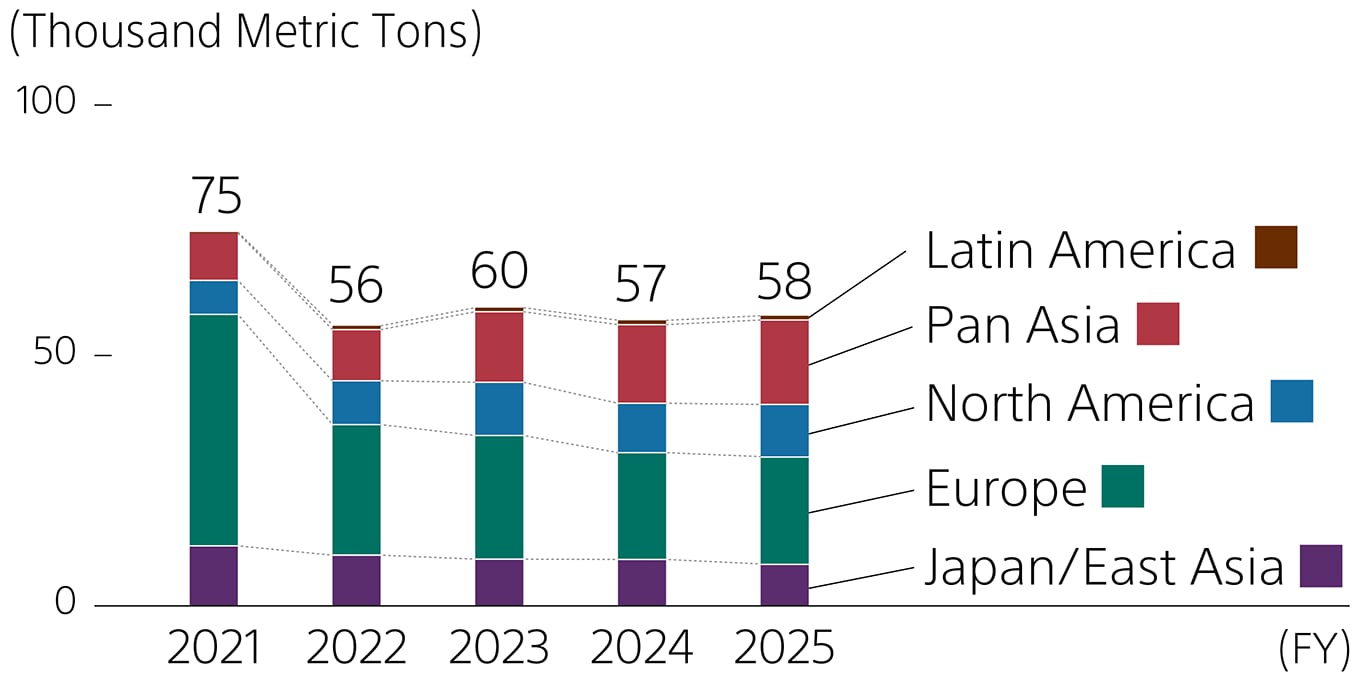
- Note:The figure for fiscal year 2025 is as of July 2026. The figure for fiscal year 2024 was corrected from that of previous year’s report.
- Note:Japan/East Asia refers to the Japan, South Korea and Taiwan region.
Improving Product Recyclability
Working with the Sony Group’s Specialized Recycling Company
As one of its strategies for resource efficiency, Sony works to increase the recyclability of its products. When examining various related measures, Sony receives feedback from Green Cycle Corporation, an affiliate of Sony specializing in the recycling business. Highly effective, practical measures incorporating these ideas and suggestions for easier disassembly and separation of materials obtained during the recycling process are then drawn up and submitted to Design departments for each product category. Meanwhile, Sony supports the efforts of Green Cycle Corporation to improve its recycling technologies by sharing the latest information on product dismantling.
Workshops on Television Recycling
Sony has been holding workshops on television recycling since 2006 at Green Cycle Corporation.*26 Attended by product designers, mechanical designers and a wide array of employees in other fields, we use these events to reaffirm the importance of recyclability considerations and recycling-oriented design for future product manufacture. Training begins with observation of television disassembly lines, followed by hands-on experience taking apart LCD televisions themselves. After, Green Cycle line managers hold discussions, explaining current challenges and needs. Participants then apply what they’ve learned to design products sold worldwide, better incorporating difficulties and improvement points for disassembly work, as well as their understanding of the importance of reusing materials gained in this way.
- *26These events weren’t held from 2020 to 2022 due to COVID-19.

Recycling Activities in Japan
Sony recycles televisions and personal computers in line with applicable recycling-related laws in Japan. Sony also bears the cost of recycling lithium-ion batteries and other small rechargeable batteries, as well as packaging materials, as required by law. Sony works to improve recycling methodology for home appliances at its affiliated companies.
Recycling of Television Sets
Japan’s Home Appliance Recycling Law, which came into effect in April 2001, initially covered four major home appliances: televisions, refrigerators, washing machines and air conditioners. In April 2009, the law was revised to also cover LCD and plasma televisions and clothes dryers, and in April 2024, extended to OLED televisions. Among applicable products, Sony manufactures televisions.*27 The Home Appliance Recycling Law requires consumers to pay collection, transport and recycling fees when disposing of applicable home appliances, retailers to take back such appliances and return them to manufacturers, and manufacturers to recycle these appliances.
Sony has established a nationwide cooperative recycling network with four other manufacturers. As a consequence, Sony-manufactured televisions are now recycled at 19 recycling plants across Japan. One of these plants is operated by Green Cycle Corporation, which manages a recycling business as a Sony Group company.

At these recycling plants, TVs are manually disassembled, and the parts are crushed and sorted using various equipment. Materials such as iron, copper, aluminum, and plastic are then separated out and sold to businesses that produce raw materials, making them available for reuse. In addition, certain harmful substances such as lead and mercury found in some older products and parts are removed and disposed of properly in accordance with the law.
In fiscal year 2025, Sony recycled approximately 57 thousand CRT televisions and 392 thousand LCD, OLED and plasma televisions. The Home Appliance Recycling Law obliges manufacturers to maintain recycling rates of at least 55% for CRT televisions and at least 74% for LCD, OLED and plasma televisions. Sony has consistently exceeded these rates since fiscal year 2001. In fiscal year 2025 the recycling rate for Sony-manufactured CRT televisions was 74%, while for Sony-manufactured LCD, OLED and plasma televisions it was 86%.
- *27Sony-manufactured televisions include products bearing the Aiwa brand manufactured in and before 2005.
Green Cycle collects and sorts polypropylene (PP), a commonly used plastic, from used home appliances, putting them through a high-purity sorting process that results in a PP ratio of 98% or more before selling this material to domestic resin compounders in a process which contributes to domestic circulation of plastic resources.
The water used in this sorting process is rainwater and water generated during the sorting process, making almost 100% of the water used recycled.

Recycling of Personal Computers
Although Sony sold off its personal computer business in July 2014, it is collecting and recycling its PC products in Japan that are no longer used by households and businesses, including long-time corporate users, in accordance with Japan’s Act on the Promotion of Effective Utilization of Resources. Items being recycled are desktop PC units, notebook PCs, CRT displays, and LCDs.*28
Sony is a member of the PC3R Promotion Association and collects and recycles used PC products under the industrywide collection and recycling scheme operated by the association. The results of the association’s collection and recycling efforts are published on the association’s website (link below).
In fiscal year 2025, Sony collected and recycled a total of approximately 12 thousand units, for a total weight of approximately 58.4 metric tons. From these items, about 40.0 metric tons of materials were reused, including metal, plastic, and glass parts.
- *28LCD displays include gaming monitors
- Result of Collection and Recycling of Used PCs by the PC3R Promotion Association (in Japanese)
- Information on Recycling Used Computers Made by Sony (in Japanese)
Recycling Activities in Europe
Take back legislation in Europe—in particular, the European Union (EU) legislations on Waste Electrical and Electronic Equipment (WEEE),*29 Batteries,*30 and Packaging*31—requires manufacturers to organize and finance the collection and recycling of end-of-life products and packaging.
Sony takes full responsibility for its take back obligations in all applicable European countries. With the aim of building a recycling market where the principle of competition works in Europe, Sony formed the European Recycling Platform (ERP) in cooperation with other companies in 2002, building efficient and cost-effective systems for the collection and recycling of end-of-life products that enable member companies to fulfill their obligations as manufacturers. Sony continuously strives to find the best recycling partners.
- *29Directive 2012/19/EU on waste electrical and electronic equipment (WEEE)
- *30Regulation (EU) 2023/1542 on batteries and waste batteries
- *31Directive 94/62/EC on packaging and packaging waste (to be replaced by Regulation (EU) 2025/40 on packaging and packaging waste published in January 2025)
Sony’s Recycling Compliance Systems
Sony utilizes authorized collection schemes for the collection and recycling of WEEE, batteries, and packaging across Europe. These conduct regular on-site audits of all contracted recyclers to ensure compliance and prevent illegal shipments outside the EU. Sony engages authorized partners that undertake recycling on behalf of manufacturers to ensure our products are recycled in a compliant manner, in accordance with European Directives and country specific regulations.
In 2025, Sony financed the costs of recycling approximately 21,429 metric tons of end-of-life products and packaging in Europe. In collaboration with other manufacturers, Sony discloses relevant information on components that require special treatment for product categories placed on the market in Europe for recyclers to facilitate safe recycling.
Recycling Activities in North America
Sony Electronics Inc. in the United States and Sony of Canada ULC continue to enhance recycling of electronics in North America. All recycling and support activities are committed to a responsible recycling process that complies with state and provincial legislation and voluntary initiatives.
United States: Promoting of the Sony Take Back Recycling Program
Sony Electronics Inc. (SEL) continues to promote the Sony Take Back Recycling Program, designed to increase recycling rates for used electronics in compliance with individual state laws and regulations. Through this program, SEL partners with recycling companies across the United States, offering consumers the opportunity to drop off Sony products at designated collection centers free of charge. In fiscal year 2025, these collection centers, mail back and through compliance channels collected approximately 5,479 metric tons (12.08 million pounds) of used consumer electronics. This equates to recycling approximately 0.27 kg for every 1 kg of electronics sold.
In addition to its ongoing efforts, SEL hosted two e-waste recycling events in 2025 in Mineral Point (WI), and Waikiki (HI). These events supported local communities in safely recycling electronic waste, partnering with certified recyclers to ensure proper handling and collection of materials. Responsible recycling of old electronics allows materials to be repurposed or reused in new products.
SEL also manages a website that provides consumers with useful recycling information that helps make used electronics recycling easy through a variety of features, including a search function to find nearby recycling centers. As a member of The Battery Network Program,*32 SEL facilitates the free recycling of rechargeable batteries in line with the program’s guidelines.
- *32The Battery Network is a nonprofit public service organization that conducts and manages rechargeable battery recycling programs and provides related consulting services in the United States and Canada.

Recycling Responsibly
In addition to conducting its own independent audits of recyclers and the downstream processing firms to which they subcontract, SEL has set forth a recycling policy whereby all recycling partners must obtain Responsible Recycling (R2) or e-Stewards certification. These recycling certification systems evaluate environmental management performance and workplace standards. To further our commitment to responsible recycling, SEL has continued to be engaged as an e-Stewards enterprise.
Canada: Working with Provincial Governments to Support Electronics Recycling Programs
Since the launch of the first provincial program in 2004, Sony of Canada ULC (Sony Canada) has collaborated with provincial governments to establish recycling programs for end-of-life products. From 2008 through 2015, Sony Canada operated an expanded recycling program for small electronics equipment across Canada by enabling consumers to drop off products at retail partner locations across the country. More recently, compliance obligations with provincial programs matured to deliver appropriate collection opportunities for consumers through the Electronic Products Recycling Association (EPRA). Consumers and businesses can drop off their end-of-life electronics free of charge for responsible recycling at an EPRA-authorized drop-off location in 10 provinces and two territories. In addition, Sony Canada is a founding and current board member of Electronics Product Stewardship Canada (EPSC). EPSC, a coalition of leading electronics manufacturers working to design, promote and implement sustainable solutions for end-of-life electronics.
Recycling Activities in Pan Asia
The operations of Sony in the Pan Asia region stretch from the Middle East to New Zealand. Throughout the region, Sony offices and manufacturing locations continually work to ensure that the recycling needs of the local community are met. In terms of national electronic waste recycling legislation, Sony actively works with local partners to ensure that local requirements are met.
India: Working with a Local Partner to Collect and Recycle E-Waste
In order to ensure compliance with E-Waste Management Rules, 2022 and amendments, Sony India Private Ltd. (Sony India) has partnered with a leading third-party company for channelization of e-waste, which includes collection and recycling of e-waste. In fiscal year 2025, Sony India collected and recycled approximately 13,683 metric tons of e-waste internally and through the third-party partner. Additionally, Sony India focused on raising awareness regarding environmentally safe disposal of E-waste and encouraged end-consumers to submit their end-of-life Sony Products to the broad network of e-waste collection points established by Sony India for their safe disposal.
In fiscal year 2025, Sony India launched awareness campaigns through newspapers and social media, and organized seminars through its third-party recyclers. Pan India circulation of newspapers reached more than 6.6 million readers, and 30 seminars were conducted in schools and institutions. Sony India continues to review results and formulate future plans on collection and recycling of used products accordingly.
Australia: Participating in the “National Television and Computer Recycling Scheme” (NTCRS)
Since 2012, Sony Australia Limited (Sony Australia) has been taking part in a recycling scheme with partners accredited by the Australian federal government under new home appliance recycling legislation, specifically the “National Television and Computer Recycling Scheme.” Under the recycling system, Sony Australia has been making a concerted recycling effort over this period of time. From July 2025 through June 2026, approximately 1,789 metric tons of applicable e-waste had been recycled as Sony’s share of the total amount recycled.
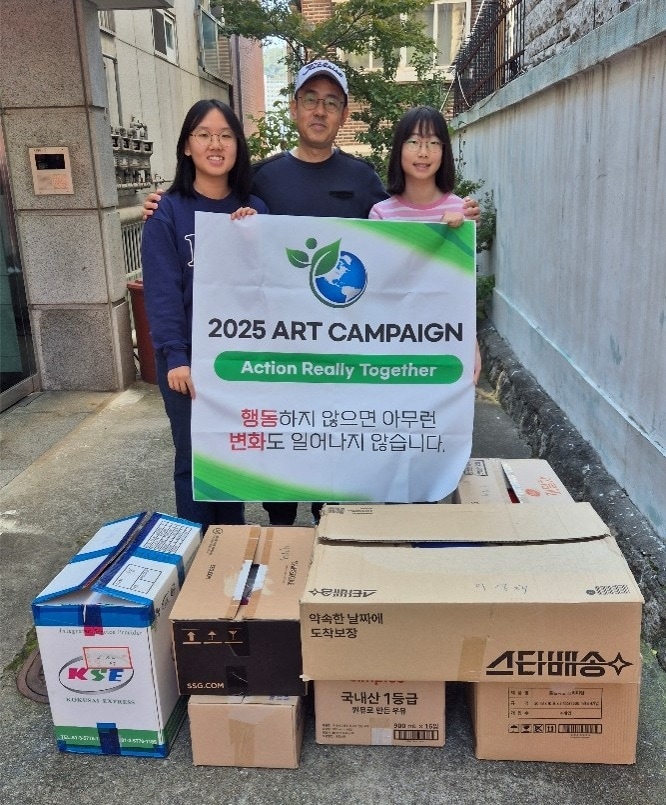
Korea: “ART” (Action Really Together) Campaign
In Korea, the recycling law has been in place since 2003 and covers electronics, batteries as well as packaging. Sony Korea Corporation has been working with related associations to collect the specific volume assigned by the government annually. In addition, to educate and encourage employees and local communities to play their parts in e-waste recycling, Sony Korea has initiated the “Zero Waste Campaign” in Korea since 2012. This initiative has since been extended to Sony Group companies, neighbors and friends of Sony employees as well as other organizations. Hence, the campaign was renamed “Action Really Together (ART)” in 2016 to emphasize the importance of taking action together for a good cause, regardless of brands. Besides collecting end-of-life products for recycling, Sony Korea also collects unwanted used products in good working condition and donates them to a local NGO.
Singapore: Building Awareness and Participation in E-Waste Recycling
Sony Electronics (Singapore) Pte Ltd. supports national e-waste recycling efforts by participating in regulated collection schemes, where e-waste is managed by authorized recyclers to ensure proper treatment. Since 2023, the company has also joined the annual International E-Waste Day campaign with government agencies and collection schemes to raise public awareness on responsible recycling. As part of the campaign, exhibitions are held to showcase Sony’s “Designed with Resource Recycling in Mind” initiatives, highlighting its commitment to circularity. Internal collection drives and employee awareness activities are also conducted during the campaign period.

Recycling Activities in Latin America
Sony has offices in a number of Central and South American countries, including Argentina, Bolivia, Chile, Colombia, Ecuador, Mexico, Panama and Peru. These offices operate recycling programs designed to meet the needs of their particular areas. Here we introduce a joint project operated throughout Latin America as well as representative examples of Sony commitment to recycling initiatives.
Sony Joint Project: Green Service Program
Since 2010, Sony sales companies in Latin America, including Sony Inter-American, Sony Chile, Sony Argentina and Sony Bolivia, gradually launched the Green Service Program. Under this initiative, using participating companies’ service networks, products and components that are under warranty but discarded during repair are appropriately treated. Also the e-waste generated by Sony sales companies’ facilities in Latin America are appropriately treated under this program as well. This program marks a shift in focus from simple disposal to the proper management and repair of products, helping Sony fulfill its responsibility to reduce the environmental impact of its products after they are sold and respond to the expectations of customers. In fiscal year 2025, approximately 21 metric tons of e-waste was collected and processed appropriately. Going forward, the companies will continue to implement the Green Service Program.
Recycling Programs in Latin America
Sony encourages customers to recycle their products under each recycling program in countries with existing take back and recycling regulations.
In Mexico, Sony handles the individual WEEE take back and recycling scheme through 6 collection points, and complies with the recycling regulation based on producer responsibility. In Colombia, Ecuador and Peru, Sony belongs to a collective scheme promoting WEEE take back and recycling, and complies with the recycling regulation.
Also, in Colombia and Chile, Sony is participating in the collective take back program for containers and packaging. These collective programs seek to continue the path to the recycling of containers and packaging within the framework of the existing regulation.
Awareness Campaigns
Initiatives Through Characters
Sony Music Entertainment (Japan) Inc. (SMEJ), in collaboration with the Japan Sustainable Flower Association, is promoting the Rebloom Flower Project, which focuses on the issue of flower loss—when flowers are discarded despite still being usable for viewing. In this project, we collect and utilize the congratulatory flowers offered at live performances. Through this project, we aim to effectively utilize resources in order to reduce waste and affect change in consumer behavior. As a part of this campaign, a photo spot decorated using these flowers was set up inside of Peter Rabbit™ Garden Cafe Jiyugaoka. Afterward, a well-attended workshop on resource circulation was held, where participants learned how to make sachets from the flowers used at the photo spot. Through this initiative, we showed how flowers used at an event could be repurposed in multiple ways instead of being simply discarded after their first use, helping attendees deepen their understanding on the issue of flower loss.
