
Environmental Management Approach and Organizational Structure

Sony Group Environmental Vision
The Sony Group Environmental Vision presents a philosophy and principles for environmental management activities throughout the global Sony Group with the aim of contributing to the realization of a sustainable society. Since enacting the Sony Global Environmental Policy, which is a predecessor of the Sony Group Environmental Vision and the Environmental Action Program, in 1993, Sony has pursued a broad range of environmental initiatives. In 2010, we updated our Environmental Vision along with the formulation of the Road to Zero environmental plan.
Philosophy
Sony recognizes the importance of preserving the natural environment that sustains all life on the earth for future generations and thereby ensuring that all humanity can attain a healthy and enriched life. In order to realize such a sustainable society, Sony strives to achieve a zero environmental footprint throughout the lifecycle of our products and business activities.
Basic Policy
Sony reduces our environmental footprint and prevents environmental pollution throughout the lifecycle of our products and business activities by complying with all applicable environmental regulations and also by continually improving our global environmental management systems. Sony formulates the following goals in four key environmental perspectives and takes proactive actions to achieve those goals.
Climate Change
Sony reduces energy consumption and is striving to achieve zero greenhouse gas (GHG)*1 emissions throughout the life cycle of its products, service and business activities.
- *1Gases that raise the temperature of the earth’s surface by absorbing infrared radiation from reflected sunlight. Carbon dioxide (CO2), methane, nitrous oxide, hydrofluorocarbon (HFC), perfluorocarbon (PFC), sulfur hexafluoride (SF6) and nitrogen trifluoride (NF3) are seven typical examples. Note that GHG in this report may refer to specific greenhouse gases depending on the scope of calculation and disclosure, and does not necessarily include all gases listed above.
Resources
In order to minimize resource inputs for our business activities, Sony identifies “Key Resources” and strives to achieve zero usage of those virgin materials. Sony also uses water efficiently, minimizes waste from sites and maximizes our effort for take back and recycling products from markets.
Chemical Substances
Sony minimizes the risk of chemical substances that we use causing serious harm to human health and the environment. Sony maintains strict control over the chemical substances we use, while, in line with the precautionary approach, taking steps whenever possible to reduce, substitute and eliminate the use of substances that have potentially significant impacts on the environment even in the cases where scientific evidence is not fully proven.
Biodiversity
Sony protects and utilizes ecosystem services in a sustainable manner, while actively promoting maintenance and recovery of biodiversity through our business and local contribution activities.
In order to realize the Environmental Vision, Sony sets targets, formulates concrete plans and initiates actions, while contributing to a better society through partnerships and communication with internal and external stakeholders.
Sony focuses on four environmental perspectives

“Road to Zero,” Sony’s Global Environmental Plan
As stated in the Sony Group Environmental Vision, Sony strives to realize a sustainable society by achieving a zero environmental footprint throughout the life cycle of its products and business activities. It is this long-term goal that prompted Sony to name its new global environmental plan, Road to Zero. Under this plan, Sony aims to bring its environmental footprint to zero by fiscal year 2050*2 and works to achieve medium-term environmental targets toward this end. In May 2022, Sony made the decision to bring forward the target year of achieving a zero environmental footprint in the climate change area by ten years from fiscal year 2050*2 to fiscal year 2040*2.
- *2The target achievement timing for the Road to Zero environmental plan and certain medium- and long-term environmental targets had previously been presented as "20XX". Beginning with this report, these references have been represented as "FY20XX" to align with the fact that environmental data aggregation and target management are conducted on a fiscal-year basis. No changes have been made to previously disclosed target details.

Green Management 2025 Overview
Sony is working toward its goal of having a “zero environmental footprint”, setting medium-term (5-year) environmental targets progressively backcasted from target years in consideration of the appropriate level of environmental impact at that point, which is then reflected in targets for individual fiscal years. This approach will enable Sony to work steadily toward achieving the zero environmental footprint goal, while making ongoing adjustments based on current progress.
Sony Moves Even Closer to Zero with Fiscal Year 2025 Targets
From April 2021, Sony worked to achieve the goals set under the Green Management 2025 medium-term environmental targets (fiscal years 2021 to 2025).
Green Management 2025 in Context
In light of the urgent environmental issue of climate change, GHG emissions must be reduced to virtually zero by 2050 in order to keep the global average temperature increase below 1.5°C (compared to preindustrial levels) as recommended in the Special Report on Global Warming of 1.5°C approved by the Intergovernmental Panel on Climate Change (IPCC)*3 in 2018. In order to realize a decarbonized world with virtually zero GHG emissions, companies will need to develop energy saving products, introduce renewable energy*4, and reduce emissions throughout their supply chains. At the same time, in order to achieve sustainable use of resources, economic growth must be balanced with environmental impact; societies must shift to circular economies; and the recent problem of ocean plastic pollution must be addressed.
- *3IPCC: Intergovernmental Panel on Climate Change
- *4Renewable energy includes solar, wind, water, geothermal, and biomass. This is energy that comes from sustainable sources
Formulating Green Management 2025
Sony believes that encouraging business partners, consumers, and other stakeholders to take action and work together to build a sustainable world is equally as important as its own environmental activities. When formulating Green Management 2025, Sony examined its past environmental activities and conducted a group-wide materiality analysis focused on what is important to Sony, its stakeholders and society at large. Based on these results and the wider social context, Sony reaffirmed the importance of the four environmental perspectives that it has been working to address: climate change, resources, chemical substances, and biodiversity. Under GM2025, the following three areas were particular key priorities.
Focus Point 1. Improve Energy- and Resource-Efficiency of Products
Sony continues to pursue energy efficiency during product use, which accounts for the majority of GHG emissions throughout the life cycle of its products. In addition to minimizing the consumption of resources, Sony takes action to reduce the amount of plastic used in products and packaging in order to address the growing problem of ocean plastic pollution.
Focus Point 2. Expand Renewable Energy Use
Sony is a member of RE100 and aims to achieve 100% renewable electricity utilization at all Sony Group sites by fiscal year 2030.*5 Sony will further accelerate efforts to achieve this goal by expanding the use of renewable electricity to at least 35%*6 of the total amount of electricity used at all Sony sites around the world by fiscal year 2025.
- *5The target achievement timing for the Road to Zero environmental plan and certain medium- and long-term environmental targets had previously been presented as "20XX". Beginning with this report, these references have been represented as "FY20XX" to align with the fact that environmental data aggregation and target management are conducted on a fiscal-year basis. No changes have been made to previously disclosed target details.
- *6Revised May 2022
Focus Point 3. Enhance Supply Chain Engagement to Reduce Environmental Impact
Sony has been working to reduce the environmental impact of the entire supply chain by working even more closely with raw material and component suppliers and contractors to which it outsources manufacturing. Sony endeavors to further enhance its engagement with these partners, encouraging them to set targets for reducing GHG emissions and water consumption and managing their progress and continuing to request them to eliminate the use of substances specified by Sony from their manufacturing processes and perform appropriate management.
In addition, Sony has helped raise awareness of the Sustainable Development Goals (SDGs), including those in relation to the environment, through its entertainment content reaching more than 2 billion people around the world. Alongside the three key focus points outlined above, Green Management 2025 also focuses on promoting these activities and encouraging engagement in environmental activities with the aim of getting over 2.5 million people to take action.
Green Management 2025 Targets and Results
Under the Green Management 2025 (GM2025) medium-term environmental targets, which spanned from fiscal year 2021 through fiscal year 2025, Sony set targets for each stage of the product lifecycle and took action accordingly. The targets and results of activities for each stage are outlined below.
Climate Change
| Items | Targets | Results |
|---|---|---|
| Product/Service Planning and Design | Reduce annual energy consumption by 5% per product (base fiscal year 2018)*7 | Approx. 6.7% decrease |
| Operations | Reduce absolute GHG emissions from Sony’s sites by 5% (base fiscal year 2020)*8 | Approx. 12.0% decrease |
| Utilize renewable electricity by 35%*9 or more*10 | Approx. 44.5% | |
| Supply Chain | Request suppliers of raw materials and components and contract manufacturers to monitor their GHG emissions, set medium- and long-term targets for emissions reduction, and perform progress management*11 | Requested major suppliers of raw materials and components and contract manufacturers to track GHG emissions, set medium- and long-term reduction targets and implement reduction measures. Conducted annual survey to monitor performance and progress |
| Logistics | Reduce absolute GHG emissions related to logistics between nations and within regions by 10% (base fiscal year 2018)*12 | Approx. 42.7% decrease |
- *7Applies to energy-using products which operate the intended main function with energy input from a commercial power supply in the ET&S and G&NS segments.
- *8For details on the scope of data collection, please refer to "Scope, Collection Period, and Accuracy of Compiled Data" > "Scope of data collection" > "Site data" in the Data Book “Environmental Data Collection Methods and Rationale.” For details on the data calculation methods and rationale, please refer to “Greenhouse Gas-Related Data Collection Methods and Rationale” > “Greenhouse gas emissions from sites” in the Data Book “Environmental Data Collection Methods and Rationale.” Following Sony’s completion of the partial spin-off of its Financial Services business on October 1, 2025, the scope of data collection for this report generally excludes the Financial Services business; however, in accordance with the “Environmental Data Collection Methods and Rationale,” performance against this target includes data from the Financial Services business for the period up to the execution of the Spin-off.
- *9Increased from 15% to 35% in May 2022.
- *10For details on the scope of data collection, please refer to "Scope, Collection Period, and Accuracy of Compiled Data" > "Scope of data collection" > "Site data" in the Data Book “Environmental Data Collection Methods and Rationale.” For details on the data calculation methods and rationale, please refer to “Greenhouse Gas-Related Data Collection Methods and Rationale” > “Renewable electricity rate” in the Data Book “Environmental Data Collection Methods and Rationale.” Following Sony’s completion of the partial spin-off of its Financial Services business on October 1, 2025, the scope of data collection for this report generally excludes the Financial Services business; however, in accordance with the “Environmental Data Collection Methods and Rationale,” performance against this target includes data from the Financial Services business for the period up to the execution of the Spin-off.
- *11Applies to raw materials and components suppliers in the ET&S, G&NS, I&SS and All Other segments, and to certain contract manufacturers in the ET&S and G&NS segments.
- *12Applies to international transport of major electronics products (video game consoles, televisions, audio equipment, cameras, smartphones, image sensors, etc.) handled by the Sony Group’s G&NS, ET&S, I&SS and All Other segments, as well as regional transport of ET&S products in Japan, the US, Europe, China and Brazil. For Japan, transportation of some G&NS and Music segment products is also included.
Resources
| Items | Targets | Results |
|---|---|---|
| Product/Service Planning and Design | Reduce the amount of virgin oil-based plastics per product unit (excluding packaging materials) by 10% (base fiscal year 2018)*13 | Approx. 22.1% decrease |
| Reduce the amount of plastic packaging per product unit by 10% (base fiscal year 2018)*14 | Approx. 29.9% decrease | |
| Eliminate plastic packaging for newly-designed small products*15*16 | Eliminated plastic packaging materials for newly-designed products in fiscal year 2025*17 | |
| Operations | Improve waste generation intensity value by 5% (base fiscal year 2020)*18 | Worsened by approx. 29.8% |
| Reduce landfilled waste rate to 1% or less (excluding waste outside of Sony control)*19 | Approx. 0.6% | |
|
- Sites that withdraw a large volume of water: improve water usage intensity value by 5% (base fiscal year 2020)*20 - Sites located in high water-risk areas: implement water risk reduction activities corresponding to the water risk of the area*21 |
Worsened by approx. 4.5% Implemented risk mitigation measures tailored to each area, such as water saving and recycling in areas that has water scarcity risk |
|
| Promote the use of certified and recycled paper*22 | Promoted the use of recycled paper and certified paper based on our purchasing policy for paper and printed media | |
| Supply Chain | Request suppliers of raw materials and components and contract manufacturers to set water consumption reduction targets and perform progress management, while taking into consideration the water depletion risk in the areas where each site is located*23 | Requested major suppliers of raw materials and components and contract manufacturers to track water usage, set reduction targets and implement reduction measures. Conducted annual survey to monitor performance and progress |
| Take Back and Recycling | Establish and maintain recycling schemes suitable for the needs of local communities*24 | Took measures based on legal requirements in areas where laws and regulations on take back and recycling are in place. Implemented voluntary collection and recycling activities in certain areas where laws and regulations are not yet in place |
| When recycling a key mineral resource (tantalum), improve sorting efficiency 1.5 times (vs fiscal year 2020)*25 | Improved recovery efficiency by about 44 times |
- *13Applies to PlayStation®5 consoles in the G&NS segment; products in the ET&S segment (excluding memory media, certain medical devices and FeliCa chips); and tape media and optical disc media in the All Other segment.
- *14Applies to PlayStation®5 consoles in the G&NS segment; products in the ET&S segment (excluding certain medical devices and FeliCa chips); and tape media and optical disc media in the All Other segment.
- *15Applies to products weighing less than a certain amount.
- *16Applies to products in the G&NS segment (excluding game software) and the ET&S segment (excluding certain medical devices and FeliCa chips).
- *17Excludes plastic materials for which use is technically unavoidable, such as coating and adhesive materials.
- *18For details on the scope of data collection, please refer to "Scope, Collection Period, and Accuracy of Compiled Data" > "Scope of data collection" > "Site data" in the Data Book “Environmental Data Collection Methods and Rationale.” For details on the data calculation methods and rationale, please refer to “Resource-Related Data Collection Methods and Rationale” > “Amount of waste generated at sites” in the Data Book “Environmental Data Collection Methods and Rationale.” Following Sony’s completion of the partial spin-off of its Financial Services business on October 1, 2025, the scope of data collection for this report generally excludes the Financial Services business; however, in accordance with the “Environmental Data Collection Methods and Rationale,” performance against this target includes data from the Financial Services business for the period up to the execution of the Spin-off.
- *19For details on the scope of data collection, please refer to "Scope, Collection Period, and Accuracy of Compiled Data" > "Scope of data collection" > "Site data" in the Data Book “Environmental Data Collection Methods and Rationale.” For details on the data calculation methods and rationale, please refer to “Resource-Related Data Collection Methods and Rationale” > “Amount of waste landfilled” in the Data Book “Environmental Data Collection Methods and Rationale.” Following Sony’s completion of the partial spin-off of its Financial Services business on October 1, 2025, the scope of data collection for this report generally excludes the Financial Services business; however, in accordance with the “Environmental Data Collection Methods and Rationale,” performance against this target includes data from the Financial Services business for the period up to the execution of the Spin-off.
- *20Applies to sites with high water consumption (annual water consumption of 500,000 m³ or more in fiscal year 2024) within the scope described in “Scope, Collection Period, and Accuracy of Compiled Data” > “Scope of data collection” > “Site data” in the Data Book “Environmental Data Collection Methods and Rationale.” For details on the data calculation methods and rationale, please refer to “Resource Related Data Collection Methods and Rationale” > “Volume of water use/withdrawal/discharged” > “Volume of water use” in the Data Book “Environmental Data Collection Methods and Rationale.”
- *21Applies to sites located in water risk areas within the scope described in “Scope, Collection Period, and Accuracy of Compiled Data” > “Scope of data collection” > “Site data” in the Data Book “Environmental Data Collection Methods and Rationale.” Sites located in water risk areas are defined as sites in areas where the overall water risk score was 3 or higher based on a combined assessment using water risk assessment tools provided by the World Resources Institute (WRI) and the World Wide Fund for Nature (WWF).
- *22For details on the scope of data collection, please refer to "Scope, Collection Period, and Accuracy of Compiled Data" > "Scope of data collection" > "Site data" in the Data Book “Environmental Data Collection Methods and Rationale.”
- *23Applies to raw materials and components suppliers in the ET&S, G&NS, I&SS and All Other segments, and to certain contract manufacturers in the ET&S and G&NS segments.
- *24The ET&S and G&NS segments comply with recycling laws and regulations in countries and regions worldwide.
- *25Applies to a Sony affiliate that conducts recycling operations pursuant to Japan’s Home Appliance Recycling Law.
Chemical Substances
| Items | Targets | Results |
|---|---|---|
| Product/Service Planning and Design | Eliminate high-risk applications of “Controlled Substances”*26 that are of high concern and use alternative substances*27 |
Promoted use of alternative substances based on Sony standards for management of chemical substances. For more information on alternatives for polyvinyl chloride (PVC) and brominated flame retardants (BFR), please see below. |
| Operations |
Take actions for the specified chemical substances (Class 1–4)*28, as outlined below Class 1 substances: Prohibit use Class 2 substances: Prohibit use (Exemptions granted for certain applications) Class 3 substances: Reduce the total amount of VOCs*29 released into the air to below FY2010 level or less |
Class 1 substances: No use of prohibited substances Class 2 substances: No use of prohibited substances Class 3 substances: Emissions of VOC into the air: Approx. 24.5% reduction |
| Supply Chain | Request and manage the response of suppliers of raw materials and components and contract manufacturers to Sony Group’s unified standard, for raw materials, components and products supplied to Sony Group, as well as products/semi-products to be delivered from an outsourcing contractor*30 | Requested suppliers of raw materials and components and contract manufacturers comply with Sony standards for the management of chemical substances |
| Request suppliers of raw materials and components and contract manufacturers to eliminate the use of substances specified by Sony Group in their manufacturing processes and perform appropriate management*30 | Requested suppliers of raw materials and components and contract manufacturers to properly manage to ban the use of substances specified by Sony from manufacturing processes and surveyed status of the use of these substances |
- *26“Controlled Substances” is an abbreviation for “Environment-related Substances to be Controlled,” and it refers to substances contained in parts and devices that the Sony Group considers to have significant environmental impact on both humans and the global environment.
- *27Applies to the G&NS, ET&S and I&SS segments, and certain companies in the All Other segment.
- *28For details on the scope of data collection, please refer to "Scope, Collection Period, and Accuracy of Compiled Data" > "Scope of data collection" > "Site data" in the Data Book “Environmental Data Collection Methods and Rationale.” For details on the data calculation methods and rationale, please refer to “Other Data Collection Methods and Rationale” > “Volume of chemical substances handled/emitted” in the Data Book “Environmental Data Collection Methods and Rationale.” Following Sony’s completion of the partial spin-off of its Financial Services business on October 1, 2025, the scope of data collection for this report generally excludes the Financial Services business; however, in accordance with the “Environmental Data Collection Methods and Rationale,” performance against this target includes data from the Financial Services business for the period up to the execution of the Spin-off.
- *29VOC: Volatile organic compounds
- *30Applies to the G&NS, ET&S and I&SS segments, and certain companies in the Music and All Other segments.
Biodiversity*31
| Items | Targets | Results |
|---|---|---|
| Operations | Continually promote biodiversity conservation activities respecting the needs of local communities | Implemented activities to preserve biodiversity at 44 sites according to local needs |
| In employee cafeterias, promote the serving of environmentally conscious food | Provided meals using environmentally conscious ingredients at 41 sites and raised employee awareness through employee workshops at 47 sites | |
| Implement initiatives to reduce ocean plastic pollution | Stopped using plastic bottles in conference rooms at 39 sites, stopped providing free plastic bags at 21 sites and conducted cleanup activities at 50 sites | |
| Supply Chain | Request suppliers of raw materials and components and contract manufacturers to take initiatives giving consideration to biodiversity*32 | Requested suppliers of raw materials and components and contract manufacturers take biodiversity into consideration. Surveyed supplier biodiversity activities |
- *31In principle, the scope of site data comprises ISO 14001-certified sites among Sony Group consolidated sites, covering all manufacturing sites, distribution sites with 100 or more employees, and non-manufacturing sites with 1,000 or more employees. However, biodiversity data also includes sites that are not ISO 14001-certified. Performance against biodiversity-related targets excludes data from the Financial Services business.
- *32Applies to raw materials and components suppliers in the ET&S, G&NS, I&SS and All Other segments, and to certain contract manufacturers in the ET&S and G&NS segments.
Overall
| Items | Targets | Results |
|---|---|---|
| Product/Service Planning and Design |
Centering around the entertainment business, raise the awareness of more than 2 billion people on sustainability issues and engage more than 2.5 million people by the entire Sony Group (Cumulative total since fiscal year 2021) |
Utilized entertainment content to raise the awareness of 0.60 billion people across the entire group, and promoted participation of 57 million people. Although the number of global campaigns fell short of initial expectations, resulting in the awareness target not being met, the engagement target was eventually reached through active efforts on social media and events. |
For a list of Green Management 2025 targets, see the following website.
Green Management 2030 Overview
Formulation of Green Management 2030
Sony has formulated its next medium-term environmental targets, Green Management 2030 (GM2030). We began working toward achieving these fiscal year 2030 targets in April 2026.
Social Trends and Challenges
Recent years have seen a growing social awareness of the threat to humanity posed by environmental issues, and the impacts have already begun to be felt. The situation in regarding to important issues such as climate change, resources and biodiversity is as follows, and all require an urgent response.
Climate Change Challenges
Many global companies are working to achieve net zero GHG emissions in their business endeavors by around 2050 in accordance with the universal Paris Agreement target “to limit the temperature increase to 1.5°C above pre-industrial levels.” However, according to the global progress assessment conducted at COP28 (the 28th United Nations Climate Change Conference) in 2023, it was shown that current efforts by countries and companies alone are insufficient to achieve the 1.5°C target, and that further strengthening of emission reduction measures is necessary. Urgent action is needed to achieve the 1.5°C goal.
Resource Challenges
Although the earth’s resources are finite, resource usage and waste are both on the rise due to projected increases in population and consumption over the medium to long term. In light of this, countries and regions have come together to strengthen resource circulation initiatives as well as laws and regulations, with international standardization of circulation indicators well underway. We must minimize resource input and waste generation while maximizing resource circulation in order to use these finite resources sustainably.
Biodiversity Challenges
Modern growth in population and economy have led to significant increases in demand for food and energy, leading to deforestation, overfishing and waste disposal issues, all of which significantly impact biodiversity, which includes the degradation and loss of habitats, increases in invasive species and pollution. At COP15 (the 15th Conference of the Parties to the United Nations Convention on Biological Diversity) in 2022, the Kunming-Montreal Biodiversity Framework was adopted as an international goal, with 2030 targets to achieve nature positivity in place. Efforts have further required to reduce and eliminate plastic pollution due to its impact on both marine and terrestrial life.
Setting GM2030 Targets
We reviewed previous medium-term environmental targets set forth in GM2025 while looking at social trends described above to formulate GM2030 and its target indicators, in consideration of achieving zero environmental impact by fiscal year 2050. Stakeholder requests were also considered in drafting target content.
GM2030 is about reducing environmental impact throughout the lifecycle of our products and business activities for each of the four important environmental aspects—climate change, resources, chemical substances and biodiversity—with each categorized based on environmental characteristics to set targets.
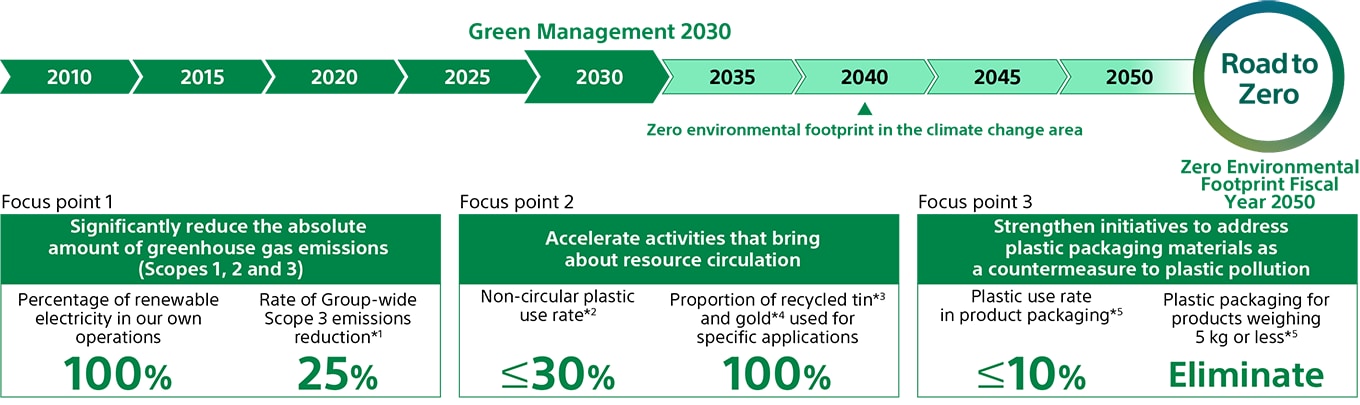
GM2030 Focus Points and Main Targets
The following three focus points are set for GM2030.
Significantly reduce the absolute amount of GHG emissions (Scopes 1, 2 and 3)
- Reduce group-wide scope 1 and 2 emissions by 60% compared to fiscal year 2025 and remove carbon that is equivalent to the residual emissions
- Achieve 100% renewable electricity used in our own operations
- Reduce group-wide scope 3 emissions by 25% compared to fiscal year 2025
- Encourage raw materials and parts suppliers and contract manufacturers to monitor and reduce GHG emissions*33
- Encourage major raw materials and parts suppliers to achieve 100% renewable electricity used in the manufacturing of products for Sony Group*33*34
- *33Applies to the G&NS, ET&S and I&SS segments, and certain companies in the All Other segment.
- *34Initiative details are discussed with suppliers in countries/regions where procuring renewable energy is more difficult.
Accelerate activities that bring about resource circulation
- Achieve a non-circular plastic use rate per product weight of 30% or less*35
- Use 100% recycled materials for tin in solder for mounting of major printed circuit boards in specific models*36
- Use 100% recycled materials for gold in major printed circuit boards and other components in specific models*36
- Promote better recyclability in product development*37
- Promote implementation of measures to ensure the appropriate use of resources, including enabling products to be used for a longer time and fostering reuse of products/components*37
- *35Applies to products newly launched in fiscal year 2026 or later by Sony Interactive Entertainment (excluding game software), Sony Corporation, and Sony Semiconductor Solutions Corporation (including SORPLAS™). Products sold under third-party brands are excluded.
- *36Applies to products manufactured at Sony Group manufacturing sites by Sony Interactive Entertainment (SIE), Sony Corporation (SEC), and Sony Semiconductor Solutions Corporation (SSS). Specific models using recycled tin and recycled gold will be selected from among models manufactured at Sony Group sites by SIE, SEC, and SSS, with implementation to proceed through fiscal year 2030.
- *37Applies to products of Sony Interactive Entertainment and Sony Corporation.
Strengthen initiatives to address plastic packaging materials as a countermeasure to plastic pollution
- Achieve a plastic use rate in product packaging of 10% or less*38
- Eliminate plastic packaging for products weighing 5 kg or less*38*39
- Eliminate plastic packaging used at Sony Group retail operations*39*40
- Eliminate single-use plastics used in conference rooms*41
- Eliminate single-use plastics distributed free of charge at on-site shops, etc.*41
- Continuously conduct cleanup activities at each site*42
- *38Applies to products newly launched in fiscal year 2026 or later by Sony Interactive Entertainment, Sony Corporation, and Sony Semiconductor Solutions Corporation. Game software and products incorporated into third-party products before reaching end customers are excluded.
- *39Excluding packaging where use is technically unavoidable
- *40Applies to the G&NS and ET&S segments.
- *41Applies to ISO 14001-certified sites among Sony Group consolidated sites, covering all manufacturing sites, distribution sites with 100 or more employees, and non-manufacturing sites with 1,000 or more employees.
- *42Applies to ISO 14001-certified sites with 200 or more employees among Sony Group consolidated sites, covering all manufacturing sites, distribution sites with 100 or more employees, and non-manufacturing sites with 1,000 or more employees.
- *1Compared with FY2025
- *2Rate of plastics other than recycled or renewable plastics used per product weight
- *3Tin used in solder for mounting of major printed circuit boards in specific models. The Specific models in question using recycled tin will be selected from among models manufactured at Sony Group sites by Sony Interactive Entertainment, Sony Corporation, and Sony Semiconductor Solutions Corporation, with implementation to proceed through fiscal year 2030
- *4Gold used in major printed circuit boards and other components in specific models. The Specific models in question using recycled gold will be selected from among models manufactured at Sony Group sites by Sony Interactive Entertainment, Sony Corporation, and Sony Semiconductor Solutions Corporation, with implementation to proceed through fiscal year 2030
- *5Excluding packaging where use is technically unavoidable
- Note: Focus point 1 applies to the Group (all Sony Group businesses), while focus points 2 and 3 apply to select business segments
- Note: Targets indicated are main examples and not an exhaustive list
Climate Change Targets
Since 2010, when Sony established its environmental plan “Road to Zero,” Sony has been working toward the goal of achieving net zero GHG emissions*43 across the value chain for scopes 1 to 3 by fiscal year 2050, while setting medium-term environmental targets for five-year increments, titled Green Management 20XX (GM20XX). However, in response to the worsening impact of climate change worldwide necessitating greater urgency in the transition to a decarbonized society, in May 2022, we moved the target year for net zero GHG emissions up to 2040, and are currently focusing on climate change measures with mid- to long-term goals as follows.
- *43Implement carbon removal that is equivalent to the residual emissions
Approval for 1.5°C Science Based Targets
Our climate change targets for fiscal years 2025 and 2035*44 have been approved by the Science Based Targets (SBT)*45 initiative as consistent with a 1.5°C goal. Our fiscal year 2040 net-zero GHG reduction target is also certified as a net-zero SBT.
- *44These are the SBT-approved targets for supplier engagement by fiscal year 2025 and for reducing Scope 1 and 2 emissions and Scope 3 emissions from the use of sold products by fiscal year 2035. They are distinct from the GM20XX targets described above.
- *45SBT is an international initiative to encourage companies to set science-based GHG reduction targets in order to limit the increase in the average global temperature due to climate change to 1.5 degrees Celsius above preindustrial levels.

RE100 Membership to Accelerate the Shift to 100% Renewable Energy
In 2018, Sony joined RE100*46 and itself is working toward sourcing 100% renewable electricity for the worldwide operations of the Sony Group by fiscal year 2040. This target was moved up to fiscal year 2030 in 2022, and we are currently working to accelerate the introduction of renewable energy at our sites around the world.
- *46RE100 is a global initiative led by the non-profit, The Climate Group in partnership with CDP in which participating companies set a goal of procuring 100% renewable electricity for power used in their global business operations.

Climate Change Targets

- * Initiative details are discussed with suppliers in countries/regions where procuring renewable energy is more difficult
Environmental Management Structure
Sony is implementing and continually improving its globally integrated environmental management system with the aim of realizing the Sony Group Environmental Vision, achieving its medium-term environmental targets and complying fully with legal requirements, regulatory demands and internal policies established for the group.
Integrated ISO 14001 Certification for the Entire Sony Group
Since the 1990s, Sony sites*47 throughout the world have sought certification under ISO 14001, the international standard for environmental management systems. Acquisition of ISO 14001 certification at all sites was completed in the early 2000s. Since then, Sony has expanded this effort, establishing a group-wide environmental management system integrating its headquarters with Environmental departments, business units and sites globally, while taking advantage of the management systems already operational at each business site, and acquiring integrated ISO 14001 certification for the entire Sony Group in fiscal year 2005. As of March 31, 2026, integrated ISO 14001 certification had been obtained by 76 of the Sony Group’s business units and sites around the world.*48
- *47“Sites” refers to manufacturing and non-manufacturing sites.
- *48The scope of integrated ISO 14001 certification is all manufacturing sites, distribution sites with 100 or more employees and non-manufacturing sites with 1,000 or more employees.
Specialized Functions for Environmental Management
In order to promote a wide range of measures, such as provision, manufacturing and sales of environmentally conscious products and services, recycling of its products, environmental management at its sites and awareness campaigns utilizing content, Sony has a dedicated headquarters that oversees environmental management for the entire Group based on the Sony Group Environmental Vision. It sets goals and rules and monitors performance. There are also specialized functions at this environmental headquarters, specifically in the areas related to energy consumed at sites and by products; resource conservation, including recycling; chemical substance management; biodiversity conservation; procurement and communications. Each specialized function is integrated and linked with related fields and internal organizations such as quality assurance, customer service, occupational health and safety, and disaster prevention, to create an even more effective management system.
The environmental headquarters is overseen by Sony’s management, which is the top management, and a Sony Group Corporation Senior Executive assumes ultimate responsibility. Management including the CEO of Sony Group Corporation share information to make decisions on environmental issues of importance to the Sony Group in regularly-held executive meetings. In an effort to deploy global environmental management, Sony established environmental organizations in each business unit to implement internal regulations for business divisions and sites under their jurisdiction and manage progress on environmental targets. Additionally, Sony has established six regional environmental offices to conduct audits of business divisions and sites and support cross-regional activities. These are the North America environmental office, Latin America environmental office, Europe environmental office,*49 Japan/East Asia environmental office,*50 China environmental office,*51 and Pan Asia environmental office.*52
- *49The Europe environmental office supervises divisions/sites in Europe, Israel, Turkey, and former Soviet Union (except for Azerbaijan, Tajikistan, Turkmenistan, and Uzbekistan).
- *50The Japan/East Asia environmental office supervises divisions/sites in Japan, South Korea and the Taiwan Region.
- *51The China environmental office supervises divisions/sites in mainland China and the Hong Kong Region.
- *52The Pan Asia environmental office supervises divisions/sites in Mongolia and other parts of Asia (except for divisions/sites supervised by the Europe environmental office, the Japan/East Asia environmental office, and the China environmental office), Africa, Middle East, Oceania, Azerbaijan, Tajikistan, Turkmenistan, and Uzbekistan.
The Sony Group Global Environmental Management System (as of March 31, 2026)

Continual Improvement by Using the PDCA Cycle
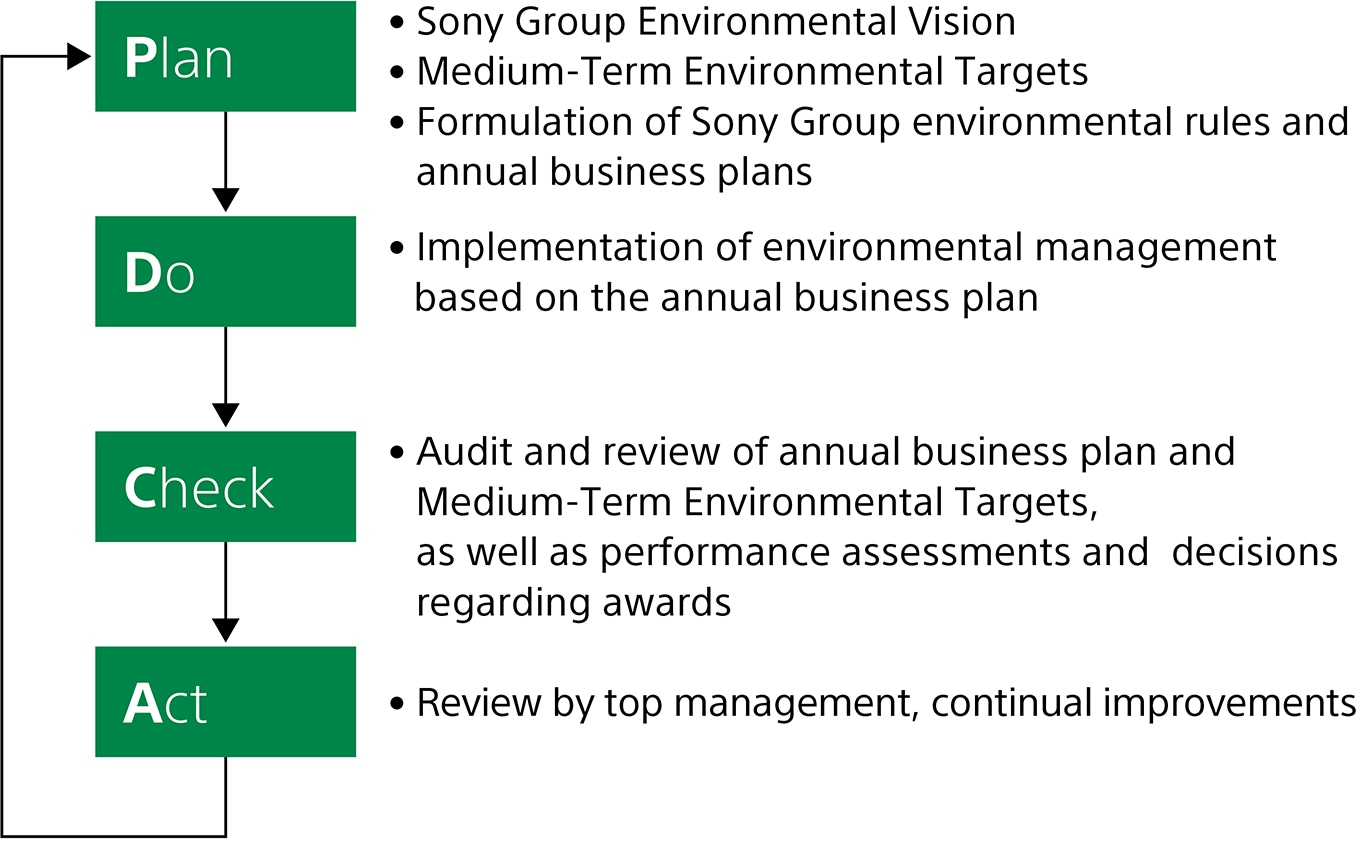
In compliance with ISO 14001, the global standard for environmental management systems that is based on the rationale of the Plan-Do-Check-Act (PDCA) cycle, Sony’s corporate headquarters conducts annual assessments of the environmental impact of the entire Sony Group and, after identifying risks and opportunities, incorporates its findings into medium-term environmental targets and annual plans. In line with these plans, individual business units formulate their own business plans based on the headquarters plan, which they then distribute to business divisions and sites under their jurisdiction. Then, individual business divisions and sites establish and implement their own annual plans, incorporating essential elements of guiding principles established by the headquarters and the business plan created by the business unit along with their own environmental impact assessments. Progress on the implementation of these business plans is reviewed regularly by a committee that is headed by the officer in charge of environmental affairs at headquarters, contributing to ongoing improvement efforts.
To gauge the progress of these environmental activities, Sony has developed an online data system for periodically collecting performance for, among others, energy consumption by products, energy used by sites, and volume of waste generated. To ensure the effective functioning of the PDCA cycle, Sony has created an environmental document structure in line with the requirements of ISO 14001. The structure covers overall elements of environmental management such as management procedures on site and in the business groups, internal environmental communications, efforts to make products more environmentally conscious, and internal audits. Another means by which the Sony Group facilitates environmental action is to provide broad environmental education for employees that is tailored to specific objectives or the type of work they perform.
The Sony Group Environmental Management System PDCA Cycle
Connecting Environmental Initiatives with Remuneration
In certain Sony Group businesses (ET&S, I&SS and G&NS segments), KPIs are established for initiatives addressing sustainability issues, including environmental matters, that each business considers important, and are incorporated into the performance evaluation of each business. The results of these evaluations are also reflected in the remuneration linked to business results of the Senior Executives in charge of the respective businesses. Awards are given annually on a global scale to recognize outstanding achievements in raising awareness and expanding initiatives.
Environmental Audits
Sony has established an integrated environmental audit system that combines three kinds of audits—internal, corporate and external—and aims to facilitate continual improvements to the Sony Group’s environmental management system, prevent environmental accidents at sites, and ensure the reliability of environmental data. In internal audits, business units and sites independently confirm the effectiveness of their own organization’s environmental management system. In corporate audits, headquarters or regional environmental offices conduct audits of business units and sites in order to verify compliance with internal regulations. In external audits, an external certification body conducts audits to determine the effectiveness of environmental management systems throughout the Sony Group.
Sony Group Environmental Audit System

Promoting Environmentally Conscious Design
Sony has set medium-term environmental targets for products, including reducing annual power consumption, promoting resource conservation and managing chemical substances.*53 Business units set areas of focus based on Sony medium-term environmental targets and targets based on the specific characteristics of the environmental impact throughout the lifecycle of targeted product categories.
In the course of product design, environmental targets are set for each product according to business unit targets and feedback about previous models to execute an environmentally conscious design. Environmental assessments are conducted and progress toward these targets is reviewed before mass-production of a product begins. Business units receive feedback on the results of this review, conduct their own review of progress with their medium-term environmental targets for each product, and report results to the department in charge of environmental functions at headquarters.
- *53For the businesses covered by GM2025, please refer to the respective targets in “Green Management 2025 Targets and Results.” For the businesses covered by GM2030, please refer to the respective targets in “Green Management 2030 Focus Points and Main Targets.”
Designing Environmentally Conscious Products: Key Considerations
| Observe Relevant Laws in Individual Countries |
|
|---|---|
| Reduction of Energy Consumption |
|
| Resource Conservation |
|
| Management of Chemical Substances |
|
| Others |
|
In turn, this department evaluates the targets and progress of each business unit and conducts an overall review of the Sony Group’s progress on achieving its medium-term environmental targets. Based on the results of this review, Sony determines areas of focus for the subsequent fiscal year. This method enables Sony to execute ongoing environmentally conscious processes for the department in charge of environmental functions at headquarters, as well as each business unit and product, which in turn ensure the development of environmentally conscious products.
Management Structure for Environmentally Conscious Product Development

Examples of Environmental Features in Sony Products
Sony is working on environmentally conscious and recycling-conscious designs and is improving environmental performance in terms of energy and resource conservation in a wide range of product categories. Signature products for these efforts are introduced on the following website.
Designing Recyclability and Reparability into Products
One initiative Sony is taking to ensure that its products are environmentally conscious involves designing them with recyclability and reparability in mind. This means, for example, labeling the material type of plastic used in parts to make it easier to extract resources from used products during recycling, and reducing the number of screws to make it easier to dismantle and repair the product. These specific environmental considerations are compiled and incorporated into the design of each product.
For example, Sony has issued Environmental Design Standards and Guidelines for TVs and Serviceability Standards, which are used when planning and designing new products, and monitors progress on meeting these standards. These design standards and guidelines reflect the trends in regulations inside and outside of Japan as well as Sony’s medium-term environmental targets. Sony conducts regular reviews and revisions of these guidelines based on industry trends and the latest recycling information, which is gathered via regular sharing of information and opinions with the Green Cycle Corporation, an affiliate of Sony engaged in the recycling business. Additionally, in order to ensure compliance with the laws and regulations regarding circular economy in Europe, Sony provides information on repair and disassembly of the display products such as TVs and commercial monitors on the support page of the website for repair shops and recyclers.
Utilizing Life Cycle Assessment (LCA)
Product life cycle assessment (LCA) is a means of identifying and quantifying the environmental impact of products at all stages of their life cycles, which include the manufacture and transport of materials and parts used in products, the assembly and transport of products, product use and standby mode, and end of life (i.e., disposal and recycling). LCA of major products helps us to clarify priorities for product improvement in each major product category and reduce the environmental impact of Sony products. Sony Corporation and Sony Global Manufacturing & Operations Corporation have developed internal tools to calculate the carbon footprint and material usage of their products. Visualizing the environmental impact of products enables this information to be used to respond to customer requests for disclosure of product environmental information and as an indicator to track the progress of environmental impact reduction activities. LCA results are reflected in medium-term environmental targets, reducing product environmental impact.